Category: Insights

  • Brand vs Non-Brand Reporting: What to Tell Leadership From Search Console

    Brand vs Non-Brand Reporting: What to Tell Leadership From Search Console

    Advisory Note — SEO in the AI Era

    Brand vs non-brand reporting, without the overclaim

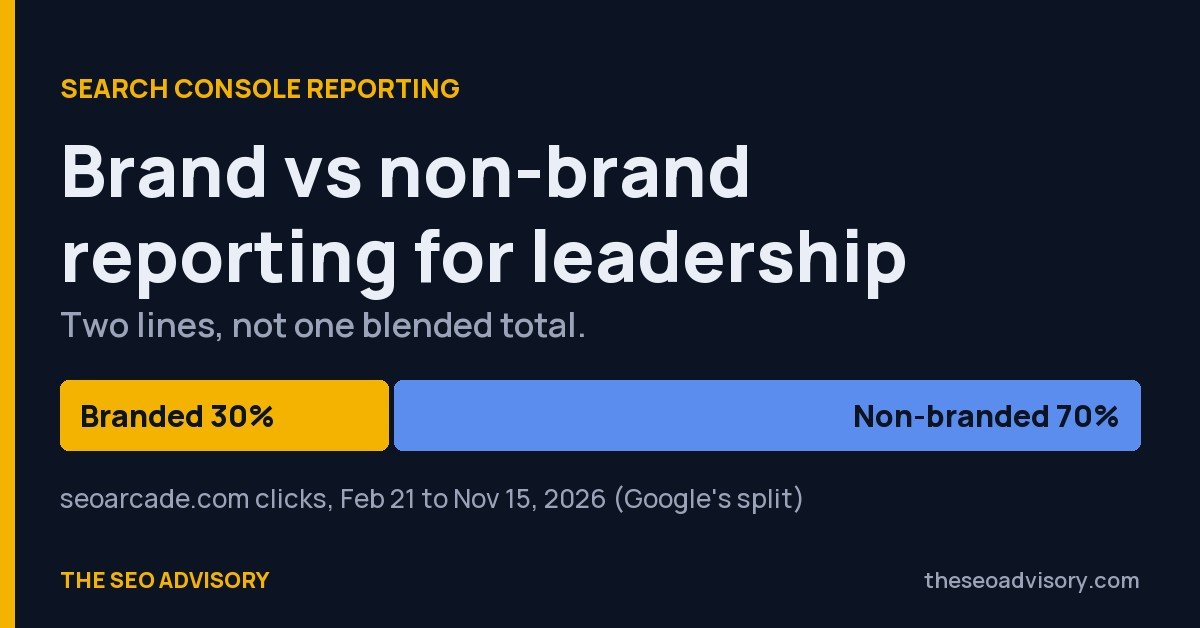
    Search Console now labels every click as branded or non-branded. Report the two lines separately, keep the hidden queries out of your claims, and treat brand demand as something the whole company moves.

    For years the brand line in an SEO report has been a guess. Someone wrote a regex for the company name, ran it over the queries Search Console was willing to show, and called the result “branded traffic”. Everything else became non-brand by default. Leadership saw one number for each, and nobody in the room knew how much of it was inference.

    That changed this month. On 16 November 2026 Google added a branded classification to the Search Console Search Analytics API, a year after the same split appeared as a filter in the Performance report. Every click on an eligible property now carries Google’s own label: branded or non-branded.

    For anyone who reports SEO upward — an in-house lead, an agency team, a fractional SEO manager — this is the most useful reporting change in a long time. It is also easy to oversell. Here is how Rob Bonham would set up the brand vs non-brand section of a monthly report, and the claims we would keep out of it.

    What the brand vs non-brand label covers, and what it doesn’t

    Google describes the classifier as an internal, AI-assisted system. It counts your brand name in any language, its misspellings, and products or services unique to your site. You do not write the rules, and you cannot edit them.

    The practical limits matter more than the model:

    • History starts on 21 February 2026. Any year-on-year brand comparison has to wait until next spring, or rely on your old regex for the earlier period, labelled as a different method.
    • Not every property is eligible. Ineligible properties return no rows and no error. An empty brand line can mean “not classified”, not “zero brand demand”.
    • It labels clicks. It does not reveal queries. The anonymised queries Search Console has always withheld stay withheld. You now know which bucket they fall into, not what they were.

    That last point is where most of the reporting mistakes will come from, so we will come back to it.

    Why one blended number has been misleading leadership

    Brand and non-brand clicks behave like two different channels. Brand clicks come from people who already know you, sit near position one and convert well. Non-brand clicks come from people who have never heard of you, which is the audience SEO is usually hired to win. Add them together and the trend in one can hide the trend in the other.

    SEO Arcade, which ran the Search Console study behind this piece, shows it on its own site. In March 2026 seoarcade.com took 79 Google clicks: 46 branded and 33 non-branded. In October it took 96: 21 branded and 75 non-branded. A blended chart shows modest growth. The split shows non-brand clicks more than doubling while brand clicks fell by more than half.
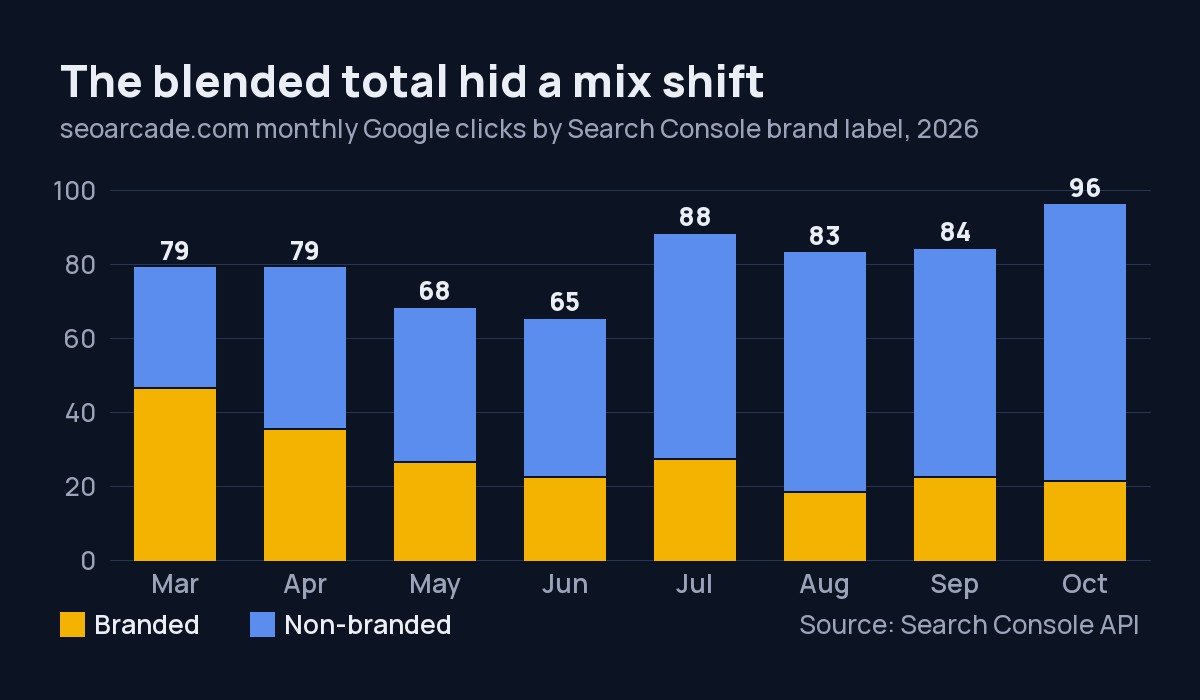
    Stacked bar chart of seoarcade.com monthly Google clicks by Search Console brand label, March to October 2026: branded fell from 46 to 21 while non-branded rose from 33 to 75
    seoarcade.com, Search Console API, monthly clicks by brand label.

    Those are two different conversations with an executive. One is about whether the brand is losing awareness. The other is about whether the SEO programme is reaching new demand. A single line answers neither.

    The averages are worse. Over the full period, seoarcade.com’s branded clicks sat at an average position of 1.4 with a 24% click-through rate. Non-branded clicks averaged position 23 at 0.12%. The blended CTR describes neither group, and it moves whenever the mix moves, even if nothing about your rankings changed.

    What to put in the monthly report

    The brand vs non-brand section does not need to be long. It needs two separate lines, a stated source and the same method every month:

    • Two click lines, never one. Branded and non-branded clicks as separate series, with the total shown below them rather than instead of them.
    • Impressions, CTR and position per bucket. If you report average position at all, report it twice. A blended position is a mix statistic, not a ranking.
    • Non-brand clicks by landing page. The brand label combines with page, device, country and date, so you can show which pages are winning new demand without needing the hidden queries.
    • Source and method in one line. “Search Console API, Google’s brand classification, 1 to 31 October.” If you switched from a regex this month, say so, and do not chart the two methods as one line.
    • An annotation layer. Launches, campaigns, PR hits, podcast appearances, events. You will need it for the brand line, for reasons Rob explains below.

    Non-brand clicks are the line the SEO team owns. Brand clicks are a line it influences and shares. Label them that way in the report and you avoid the argument later.

    What not to claim from the brand split

    The new label tempts teams to say more than the data supports. Three claims to keep out of the deck.

    “We now know what the hidden queries are.” You do not. Search Console still withholds a large share of queries, and the brand label only tells you which side of the line those clicks fall on. In SEO Arcade’s study of 16 eligible properties, the median one had 71% of its non-branded clicks with no query row, against 27% of its branded clicks. At the median property, 95% of the hidden clicks carried Google’s non-branded label. The full method is in the SEO Arcade study of the branded queries API, and the background on missing queries is in its research on dark clicks in Google Search Console.

    “Our brand share is what the query report says.” If you calculate brand share from visible query rows, you are measuring the bucket Google hides least. The median visible-row brand share in the study was 12.8%; Google’s full split put it at 10.5%. On seoarcade.com the gap was 59% against 30%. A regex report would have told leadership the site was twice as dependent on brand as it was.
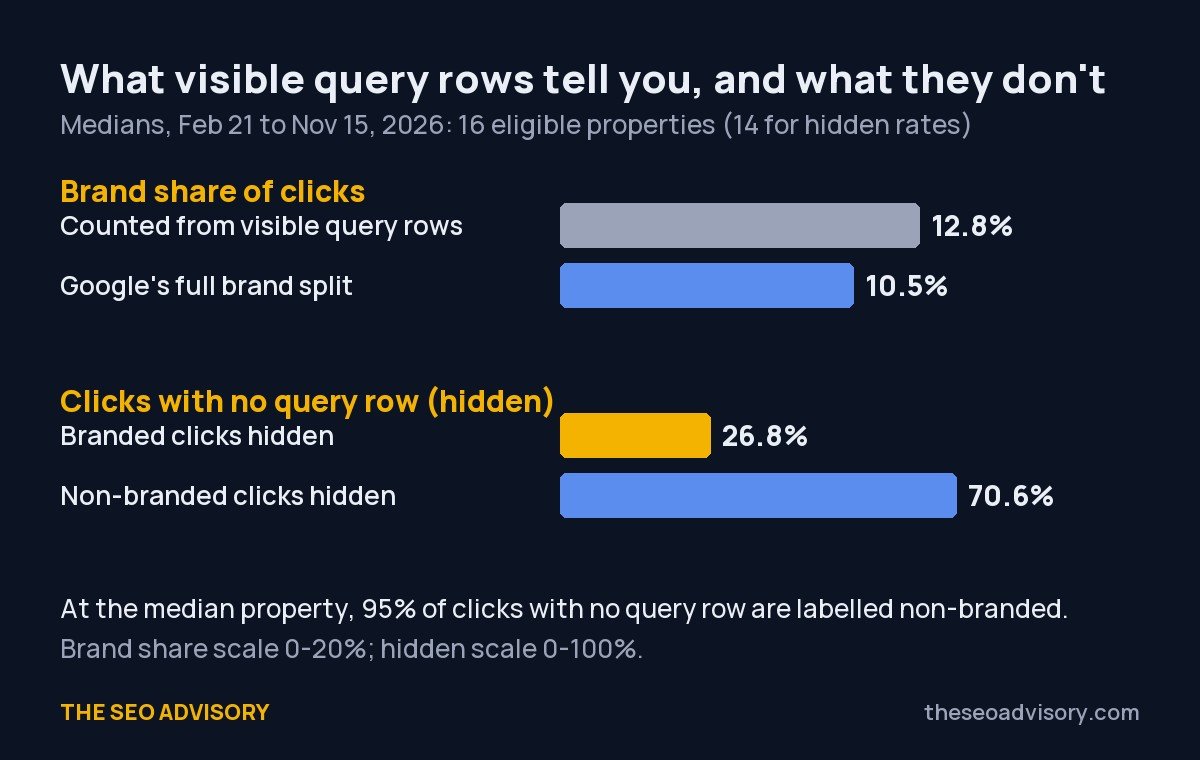
    Bar chart: median brand share of clicks is 12.8% counted from visible query rows versus 10.5% by Google's full split; median 26.8% of branded clicks and 70.6% of non-branded clicks have no query row
    SEO Arcade Search Console study, eligible properties, 21 February to 15 November 2026.

    “Brand went up, so SEO worked.” Maybe. Brand searches respond to everything the company does. Which brings us to Rob.

    How brand demand from other work shows up in search

    When Jeremy Rivera asked Rob how an SEO makes the case for being paid once attribution is gone, part of his answer was about exactly this spillover:

    “you might be getting better visibility for your branded searches. So maybe your homepage traffic is gonna go up, you’re getting shown more frequently. Google trusts your brand more because they know that you’re […] providing a quality website experience.”Rob Bonham, on Unscripted SEO

    The point runs both ways. Good SEO work can lift branded visibility, and so can a trade show, a podcast tour, a paid campaign or a press mention. All of them land in the same branded bucket, usually on the homepage. Rob’s reminder about where that traffic arrives is worth keeping in front of an executive team:

    “your homepage ranks for […] potentially thousands, tens of thousands of keywords.”Rob Bonham, on Unscripted SEO

    So treat the branded line as a shared demand signal. When it rises, check the annotation layer first: what else did the company do that month? If a campaign lines up with the lift, say so, and give the campaign the credit. If nothing else explains it and the SEO work does, make the case as a correlation and label it as one. We set out how to make that case without overclaiming in how to prove value when attribution is gone.

    This framing protects the SEO team as much as it constrains it. Brand demand can fall for reasons nobody in SEO controls — a quiet quarter for PR, a cut paid budget, a competitor’s launch. If the report has always said the brand line is shared, a drop in it is a company conversation, not a verdict on the SEO programme. Rob’s wider argument, that SEO does not sit in a silo, is the reason to build the report this way.

    A brand vs non-brand report leadership can trust

    If you are rebuilding the section this month, this is the version we would hand an executive team:

    • Headline metric: non-branded clicks, month on month, with the pages that drove the change.
    • Context metric: branded clicks, beside the company activity annotated for the same period.
    • Per-bucket CTR and position, and no blended averages.
    • A method note naming the source, the date range and whether the property is eligible for the classification.
    • One sentence on what the data cannot show: the hidden queries are still hidden, and most of them are non-brand.

    The split will not make the SEO number bigger. In most cases it makes the non-brand number smaller and more honest, which is the version a CFO will still believe next quarter.

    Rob’s full conversation: Rob Bonham on SEO in the agentic age on the Unscripted SEO Podcast. Quotes are verbatim from the raw transcript; […] marks removed filler. Study data: SEO Arcade, Search Console API, 21 February to 15 November 2026, eligible properties only. More in our hub on SEO in the AI Era, or bring the reporting in-house through an advisory engagement or fractional SEO management.
    THE SEO ADVISORY
    Get to Know Rob Bonham
    Fractional SEO Manager & SEO Advisor

    Work with Rob

    Want a second read on your SEO reporting?

    Rob advises in-house and agency SEO teams on strategy, including what to put in front of leadership.
  • How to Get Technical SEO Approved: Lead With the Global Fix

    How to Get Technical SEO Approved: Lead With the Global Fix

    Advisory Note — SEO in the AI Era

    How to get technical SEO approved

    Lead with the one fix that applies to every template, prove it moved something, then report the win to every team it touched. A backlog of fifty page-level tickets gets parked. One global fix with a before-and-after gets the next one funded.

    Most technical SEO work does not die because engineering disagrees with it. It dies in the queue, behind product work that has an owner, a deadline and a revenue number attached. If you run SEO in-house or for an agency client, the audit is rarely the hard part. Getting the fixes shipped is.

    Erika Braeger, Director of Strategy at Ten Speed, spends most of her week on exactly this. One of her clients set out to clear two years of technical debt in a single quarter. Her answer to how she gets enterprise teams to say yes is the most useful sequencing advice we have heard on the subject:

    “I try to stick with the global items first, the big ticket items, because that’s what’s going to move the needle.”Erika Braeger, Ten Speed

    What follows is how we would turn that into a plan you can put in front of an engineering lead and a budget holder.

    Technical SEO tickets stall because they arrive as a list

    A crawl export turns into a spreadsheet, the spreadsheet turns into forty tickets, and each ticket describes a symptom on one URL. To an engineering manager that reads as forty small, unranked requests from a team that cannot say which one matters. So none of them get prioritised.

    The fix is not a better spreadsheet. It is a different unit of work. Engineering plans in templates, components and releases. If your request names a template and says it affects every page built on it, you are speaking their language. If it names a URL, you are asking them to do your triage for you.

    Erika’s two most common findings show why this matters. The first is page speed that clients kept deferring until page weight became a problem for crawlers as well as people. The second is redirect debt: a URL gets retired or renamed without a redirect, and because it was linked from all over the site, one decision produces 3xx and 4xx errors everywhere. Both are global problems. Both get reported page by page.

    Before any of this, confirm the pages are indexed at all. There is no point arguing for speed on a template Google is not indexing, which is why we put the index check before the strategy.

    Sample five pages before you write a single ticket

    A single page test is the most common way a technical SEO case falls apart in the meeting. Somebody runs the homepage through a speed tool, it looks fine, and the request is dead. Erika’s recommendation for anyone starting this work is to test a spread of pages instead:

    “Don’t sample only a singular page because not every page is going to tell the same story. And if you are checking page speed across, say a sample of four or five pages of your site, then you’re going to be able to identify what the global fixes are and be able to make a bigger impact early on as you work down your list.”Erika Braeger, Ten Speed

    Pick one page per major template: a product or service page, a blog post, a category or hub page, a landing page and the homepage. If the same culprit shows up on four of five, you have found a global fix. If it shows up on one, it is a page-level ticket and can wait.

    Look at page weight while you are there. Google’s documentation says that Googlebot crawls the first 2MB of a supported file type when crawling for Search. Erika uses two megabytes as the line where she starts asking what is adding the weight: a video, an image, a motion graphic, a form, a reCAPTCHA. A template that sits close to that line is a clear, documented reason to act, and it is a reason that comes from Google rather than from the SEO team.

    Then add a comparison. When a client is losing ground, Erika benchmarks page speed against the two or three competitors who have pulled ahead and shows where the biggest gap sits. A leadership team that will not fund “make the site faster” will often fund “close the gap with the competitor who took our position”.

    Lead with the fix that makes the biggest splash

    Once you know which problems are global, rank them by how many pages they touch and how directly they change what a user or crawler gets. Third-party scripts that fire before the main content, oversized images on a shared template, a hero image set to lazy load, a retired section of the site still linked from pages across it. Each one is a single change with a site-wide effect.

    Quote card: Erika Braeger of Ten Speed on working with the pieces that make the biggest splash first to get buy-in for technical SEO
    Erika Braeger on the Unscripted SEO Podcast, 2026.

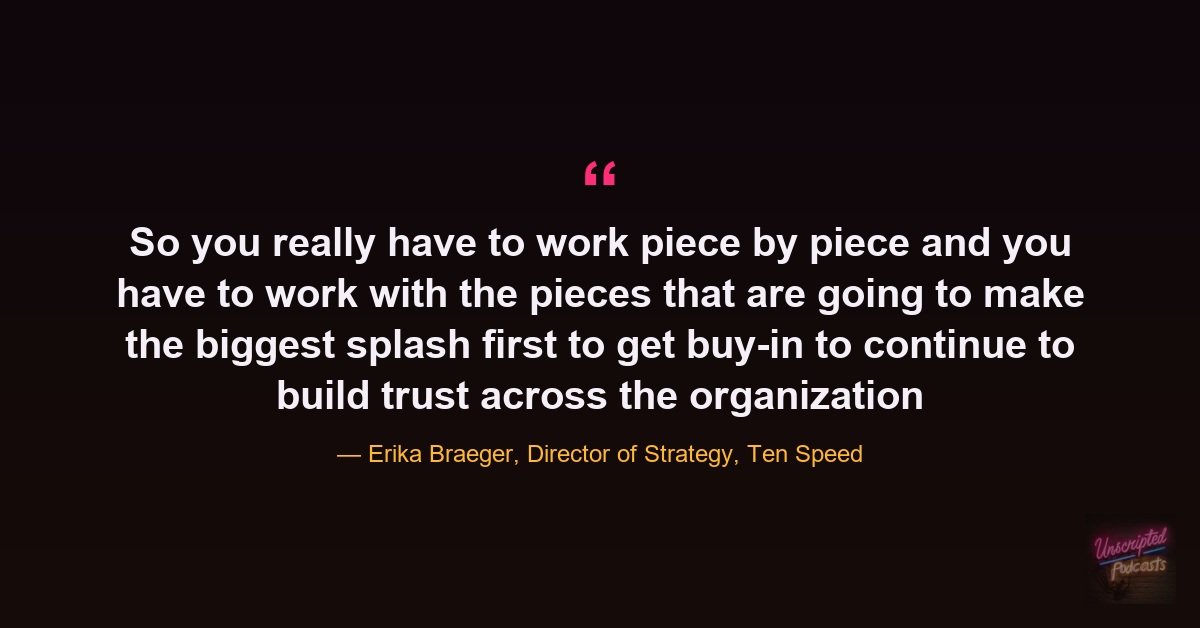
    The first fix carries more weight than its own result. It is the evidence you will use to get the second one approved. Erika describes the sequence as a trust-building exercise:

    “you really have to work piece by piece and you have to work with the pieces that are going to make the biggest splash first to get buy-in to continue to build trust across the organization before you can go for, I guess, the fruit at the top of the tree.”Erika Braeger, Ten Speed

    Our read, and it is a judgement rather than a finding: the highest-value item on an audit is often the wrong first ask. If it needs a re-platform or a quarter of engineering time, it will be deferred. Start with the global fix that is cheap to ship and easy to measure, and save the expensive one for when you have a result to point to.

    Bring options, not a demand

    Developers know their own environment better than the SEO team does. A request that dictates the implementation invites a debate about the implementation. Erika avoids that by handing the team a range:

    “I like to present to them like a good, better, best when it comes to image optimization.”Erika Braeger, Ten Speed

    For a heavy template, that might look like this:

    • Good. Compress and correctly size the images already there. Often a plugin or a build step, little engineering time.
    • Better. Make sure lazy loading only applies below the fold, so the hero loads first, and defer third-party scripts until after the main content.
    • Best. Rework the component: replace, modify or remove the element adding the most weight, which is the decision tree Erika works through for any page near two megabytes.

    Options change the conversation from “will you do this” to “which of these fits this sprint”. The team keeps ownership of how. You keep the outcome. The same instinct applies to bigger projects, where migrations fail on business goals rather than redirects.

    If you want the working method for finding those global fixes, SEO Arcade has a step-by-step SOP for finding global page speed fixes built from the same episode.

    Report the first win to every team it touches

    The step most SEO teams skip is the one that pays for the rest of the roadmap. When the global fix ships and something moves, the result should not stay in the SEO report. Erika’s practice is to go to all of the teams the win touches, communicate it, and show how each further technical implementation will help them too.

    Keep the claim honest. Say what changed, say what moved, and keep the two apart until the data supports joining them. Faster templates can line up with better crawl coverage or conversion, but timing alone does not prove cause. We wrote more about proving value when attribution is gone, and the same rules hold here.

    Done well, this turns the SEO team from the department that files tickets into the one that hands other teams wins. That is the trust Erika is talking about, and it is what gets the item at the top of the tree approved.

    A technical SEO buy-in plan for your next quarter

    If you have one meeting with an engineering lead and a budget holder, bring this:

    • A five-page sample across your main templates, with the problems that repeat marked as global.
    • One global fix, chosen because it touches the most pages and ships fastest, not because it scores highest on the audit.
    • Three options for implementing it, so the team chooses the how.
    • A competitor comparison or a documented threshold, such as Google’s 2MB crawl limit, that makes the case without relying on the SEO team’s word.
    • A date to report back, and a list of the teams who will hear about it.

    The rest of the audit can wait. One shipped global fix with a result attached will get you further than the full list sent all at once.

    Erika’s full conversation: Erika Braeger on machine readability and page speed on the Unscripted SEO Podcast, and Jeremy Rivera’s take on telling one story to machines. More in our hub on SEO in the AI Era, or bring the sequencing in-house through an advisory engagement or fractional SEO management.
    THE SEO ADVISORY
    Get to Know Rob Bonham
    Fractional SEO Manager & SEO Advisor

    Free download

    Get to know me — in 5 minutes

    How Rob thinks about SEO in the AI era and how he works. No form, no gate.

  • How Long Does SEO Take to Work? An Advisor’s Honest Answer

    How Long Does SEO Take to Work? An Advisor’s Honest Answer

    Advisory Note — Authority & Footprint

    How long does SEO take to work?

    It depends on what you changed. Fixes to pages that already rank can show up within weeks. New pages chasing established terms usually take far longer, and most never get there. Here is how to tell which clock you are on.

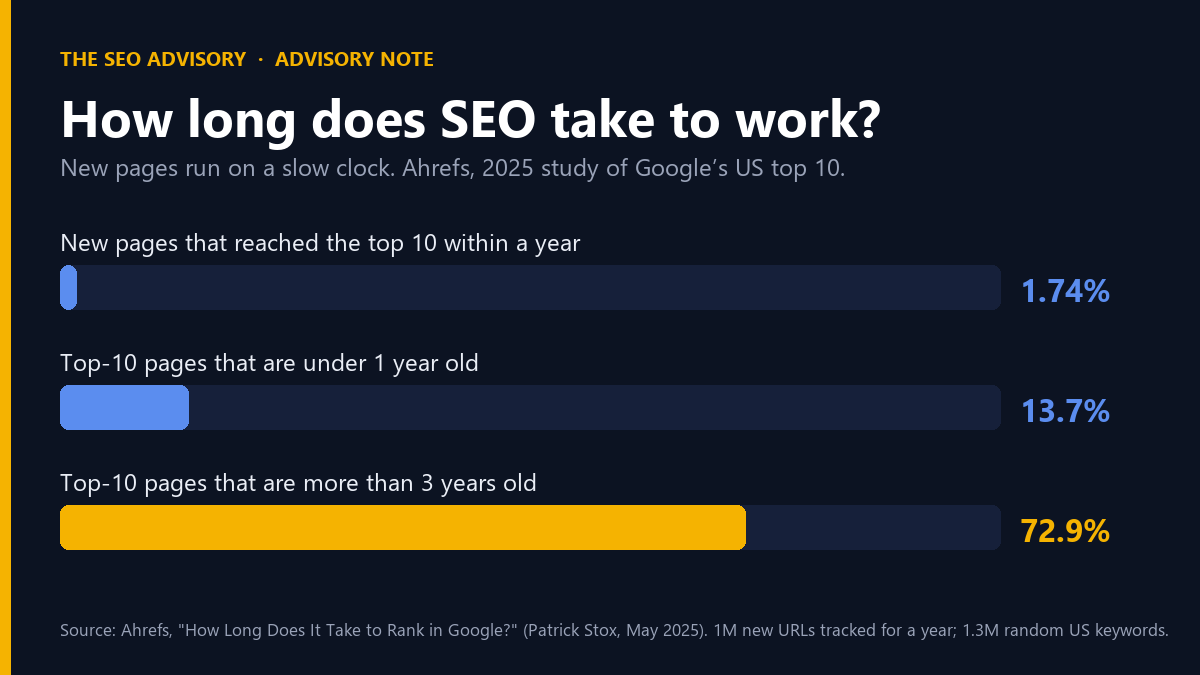
    SEO runs on two clocks, and the honest answer depends on which one you are paying for. Changes to pages Google already ranks can register as soon as those pages are recrawled, which Google says can take anywhere from a few days to a few weeks. New pages aimed at competitive queries run much slower. When Ahrefs tracked a million newly published URLs for a year, only 1.74% of them reached the top 10.

    An advisor who gives you one number for both has not looked at your site yet. You should be asking for two.

    New pages run on a slow clock

    The slow clock is slow because the pages you are competing with have been there for years. Patrick Stox’s 2025 study for Ahrefs, built on 1.3 million random US keywords, found that 72.9% of the pages in Google’s top 10 are more than three years old, up from 59% when the same study ran in 2017. The average page in position one is five years old. Pages under a year old make up 13.7% of top-10 results, down from 22%.

    Bar chart from the Ahrefs 2025 study: 1.74% of new pages reached the top 10 within a year, 13.7% of top-10 pages are under one year old, and 72.9% are more than three years old
    Ahrefs, “How Long Does It Take to Rank in Google?” (May 2025). New URLs first seen September 2023, tracked for one year.

    There is a second number in the same study that matters more for planning. Of the new pages that did make the top 10, 40.82% got there within a month. Our read, and it is a judgement rather than a finding: when a new page is going to win, it tends to show signs early. A page that has sat on page five for six months is not usually one more month of patience away from page one. It needs a better page, more authority behind it, or a different target.

    Work on pages that already rank runs fast

    The fast clock covers anything that changes a page Google already knows and already shows. Rewriting a title that gets impressions but no clicks. Fixing an indexing problem on a template. Adding internal links to a page sitting at position eleven. None of that waits for a domain to age. It waits for a recrawl, and then for enough searches to tell you whether it moved.

    Before any of this, check that the pages are in the index at all. A page Google has not indexed has no timeline, which is why we put the index check before the strategy.

    Most engagements should start on the fast clock for a simple reason: it produces evidence within a quarter, and evidence is what lets you decide whether to fund the slow work.

    Fast results from volume are borrowed

    The shortcut being sold hardest right now is volume. Publish fifty or a hundred AI-assisted pages a month and the graph goes up. Rob Bonham, who runs this practice, described how that ends for the agency that sells it on the Unscripted SEO podcast:

    “You’re gonna work yourself into a hole. And you might be you know looking like a like a hero, you know, for maybe a month, a few months, who knows, maybe six months out. But you know, as soon as as soon as that site starts to tank, and it it and it surely will after you know a period, then then they’re gonna start looking at their their agency sideways”Rob Bonham, The SEO Advisory

    Google’s spam policies name the pattern directly as scaled content abuse. The timeline matters here because it hides the problem. A programme that looks fast in month three and collapses in month eight looked like the best decision you made for five months. We cover the mechanics in why publishing 100 AI pages will tank your rankings.

    What a credible timeline looks like in a proposal

    Google’s own guidance on hiring an SEO gives you the question to ask: “What kind of results do you expect to see, and in what timeframe?” The same page says plainly that no one can guarantee a #1 ranking on Google. So the answer you want is not a date for a ranking. It is a plan that says what will be measurable, and when.

    Rob’s advice to consultants writing those plans works just as well for a buyer reading one:

    “you’re giving your your roadmap of six months or twelve months, whatever it is, you’re including deliverables that you can reasonably fulfill on.”Rob Bonham

    In practice, a proposal worth signing separates three things:

    • What should move inside 90 days. Indexed pages, impressions and clicks on pages that already rank, and the specific fixes expected to change them.
    • What runs on the slow clock. New pages and new topics, with an honest note that most new pages in competitive spaces do not reach page one inside a year.
    • When you stop. A checkpoint, with the metric that would tell both sides the work is not paying for itself. If nobody will name that condition, use the four questions we would ask any advisor.

    Measurement has its own problem now, because a growing share of discovery never produces a trackable click. Read how to prove value when attribution is gone before you agree on what counts as “working”.

    What these numbers cannot tell you

    The Ahrefs figures describe random keywords, most of them low-volume, across the whole web. Your market may move faster or slower. And page age correlates with ranking without causing it: older pages have had longer to collect links, mentions and engagement. Pages do not ripen like fruit. The things that make a page rank take time to accumulate, and nobody can sell you the accumulation in advance.

    So ask for the two clocks separately. If the proposal in front of you has one date on it, send it back.

    Rob’s full conversation: Rob Bonham on SEO in the agentic age on the Unscripted SEO Podcast, and our episode recap. More in our hub on Authority & Footprint, or set the timeline with us through an advisory engagement or fractional SEO management.
    THE SEO ADVISORY
    Get to Know Rob Bonham
    Fractional SEO Manager & SEO Advisor

    Free download

    Get to know me — in 5 minutes

    How Rob thinks about SEO in the AI era and how he works. No form, no gate.

  • The Tools Got Cheap. The Judgment Did Not.

    Advisory Note — SEO in the AI Era

    The tools got cheap. The judgment did not.

    Three founders building SEO software sat on the first Unscripted SEO panel and, without meaning to, made the case for advisory work better than we could. Notes for in-house and agency teams.

    Patrick Stox, Ben Wills and Ben Senescu joined Jeremy Rivera for the first panel episode of the Unscripted SEO Podcast. Between them they cover two decades inside Ahrefs and IBM, a quarter century of SEO plus a detour through embedded engineering, and a tool built from scratch in seven months by one person. Nothing was pre-briefed.

    Read as a builders’ conversation, it is a good listen. Read as a buyer of SEO software or a manager of an SEO team, it is a warning about where your leverage actually sits now.

    The build constraint moved, and the bottleneck moved with it

    Patrick Stox described himself as the one non-engineer on the call, said he could not have built most of his tooling before, and now has roughly a hundred and four free tools live on his own domain. Ben Senescu, running OpenSEO alone, said a feature that works ninety-five percent of the time is now easy. Ben Wills, who writes C for a living, had to run a full database refactor because the models made architectural decisions he had explicitly told them not to make.

    “AI can produce stuff, but it doesn’t have the taste to decide, do we use a B-tree, or do we use binary search on a sorted list. That curation is your taste. That is the wisdom you’re embedding into the application.”Ben Wills, OppAlerts

    The word he used was taste, and it is the same argument this practice makes about SEO programmes. The production step is no longer the expensive one. Deciding what should exist, and what should be pulled back out, is the expensive one — and it is the step that does not get cheaper when the tooling does.

    Patrick made the commercial version of it from the other side of the table:

    “If Ahrefs had listened to customers, they would be a low-cost link tool, something like Majestic still.”Patrick Stox, ex-Ahrefs

    Features shipped there that were genuinely good, did not get used enough to justify their own maintenance, and were killed. The test was never quality. It was whether the thing would earn its existence.

    What this changes about your stack

    Three practical consequences for a team choosing tools this year.

    • Cheap capable tools change who can do the work, not what good work is. Senescu’s customer base turned out to be entrepreneurs doing SEO for the first time, reachable at a ten dollar price point rather than a hundred and ten. That widens the field of people who can run a process. It does not widen the field of people who can judge one.
    • A tool that does everything is a tool nobody has curated. Senescu’s constant question is what the small next thing should be, against a queue of community pull requests that would let him claim the tool does everything. Apply the same scepticism to a vendor roadmap that keeps growing.
    • Budget for judgment, not for seats. If output has collapsed in price and curation has not, the line item that protects your results is the one that decides what to stop doing.

    Two surfaces, two timelines

    The most useful exchange came when Senescu asked the other two how to get OpenSEO recommended by ChatGPT and Claude. Patrick split the problem in a way that is directly applicable to any brand that is not yet a household name in its category.

    “You’ve got a while before you’re really in the training data as a known entity. For now, it’s the retrieved pages where you’ll want to be found.”Patrick Stox

    Being in the model is slow and largely passive. Being on the pages a model fetches at answer time is work you can scope this quarter: identify the roundups and comparison pages that get retrieved for the question your buyer actually asks, and make sure your one genuine differentiator is stated on them. Ben Wills added the outreach shape — category lists, curated directories, publishers who already maintain the list you want to be on.

    For teams used to reporting on rankings, note what this reframes. There is no single position to hold. Ben Wills’s own testing found that changing one word in a prompt — naming a Corolla instead of a BMW when asking about a trip — changes which businesses come back, and that ChatGPT’s memory can carry that context into an unrelated conversation days later. Any visibility number you are shown is one person’s result, in one context, on one day. Treat it accordingly.

    The risk that should reach your risk register

    Patrick’s closing warning is the one worth taking to a leadership conversation.

    “Any tactic that is abused will be shut down… When Penguin came along it hurt for a few years, and then Google just said, all those bad links you built, we just forgive you. That may not be the case in all these new systems. They might hold a grudge for the next 10, 20, 30 years.”Patrick Stox

    The historical pattern was: abuse a tactic, absorb a penalty, get forgiven. He is not confident that forgiveness is on offer this time. That turns a short-term tactical decision into a long-horizon liability, which is exactly the sort of trade an in-house team should not be making without an adult in the room.

    Senescu named the two offers currently landing in inboxes — a couple of thousand a month to spam every relevant forum, or a hundred a month for an automated link exchange. His read is that they may work briefly and are a distraction from learning to market the business. Ours is blunter: they are a decade-long bet placed by someone who will not be around to settle it.

    The apprenticeship still exists

    Ben Wills trained agency analysts with a kitchen rule: if you are going to be a sushi chef, the first year you just make rice. Keyword research and nothing else, across ten, twenty, fifty sites, until the relationship between a query and an intent stops being a slide and becomes instinct. The cheap-tools half of that is true here too: a keyword research tool that shows the live search results behind every number now starts at $10 a month. The instinct still takes the year.

    He thinks prompting deserves the same apprenticeship now — sit with it, work out how the answer gets built, work out what it takes to be in it. That is not a course you can buy for your team. It is hours you have to protect for them.

    Which is the whole argument in one line: the tools got cheap, the judgment did not, and the judgment is now the only part worth paying for.

    Full panel: SEO SaaS Panel: Patrick Stox, Ben Wills and Ben Senescu on the Unscripted SEO Podcast. Their solo interviews: Patrick Stox, Ben Wills, Ben Senescu. More in our hub on SEO in the AI Era, or bring the judgment in-house with fractional SEO management and advisory engagements.
    THE SEO ADVISORY
    Get to Know Rob Bonham
    Fractional SEO Manager & SEO Advisor

    Free download

    Get to know me — in 5 minutes

    How Rob thinks about SEO in the AI era and how he works. No form, no gate.

  • Half Your SEO Team Is Doing PR

    Advisory Note · Team Structure

    Half Your SEO Team Is Doing PR

    An advisory read on Zak Ali: if the job is digital PR, that is an org chart decision, not an opinion piece.

    Most commentary about SEO becoming public relations stops at the observation. For an in-house lead, the observation is not the interesting part — the interesting part is that if it is true, it is a staffing question, a reporting-line question and a budget question, and those have to be answered by someone with the authority to answer them.

    Zak Ali, who leads SEO at Finder in the US, is one of the few practitioners who has actually made the organisational change rather than writing about it.

    The Two Types Of SEO Left

    His formulation, on the Unscripted SEO Podcast:

    there’s two types of SEOs that exist today. There are the technical SEOs, and there are SEOs who haven’t realized yet that their job is digital PR and branding.— Zak Ali, Finder US

    He adds that you have to steer into it and see where the writing is on the wall — and then describes what steering into it cost him. In May of the previous year he decided, in his words, to kill the SEO team and have a generalist marketing team instead. He is candid that it was rough at the beginning: telling people who had spent years building a specialism that they were growth marketers now.

    For a governance reader, that is the material fact. This is not a prediction. It is a practitioner describing a restructure he executed, including the part where it was uncomfortable. Whether you agree with the conclusion, the honest version of the argument includes a real organisational cost.

    The framing that gets him there is worth keeping attached, because it is the business case. His view is that the role of every SEO is audience cultivation — getting people in, converting them, and retaining them — and that “retention should be a core KPI of every SEO.” The PR conclusion follows from the audience premise rather than standing on its own.

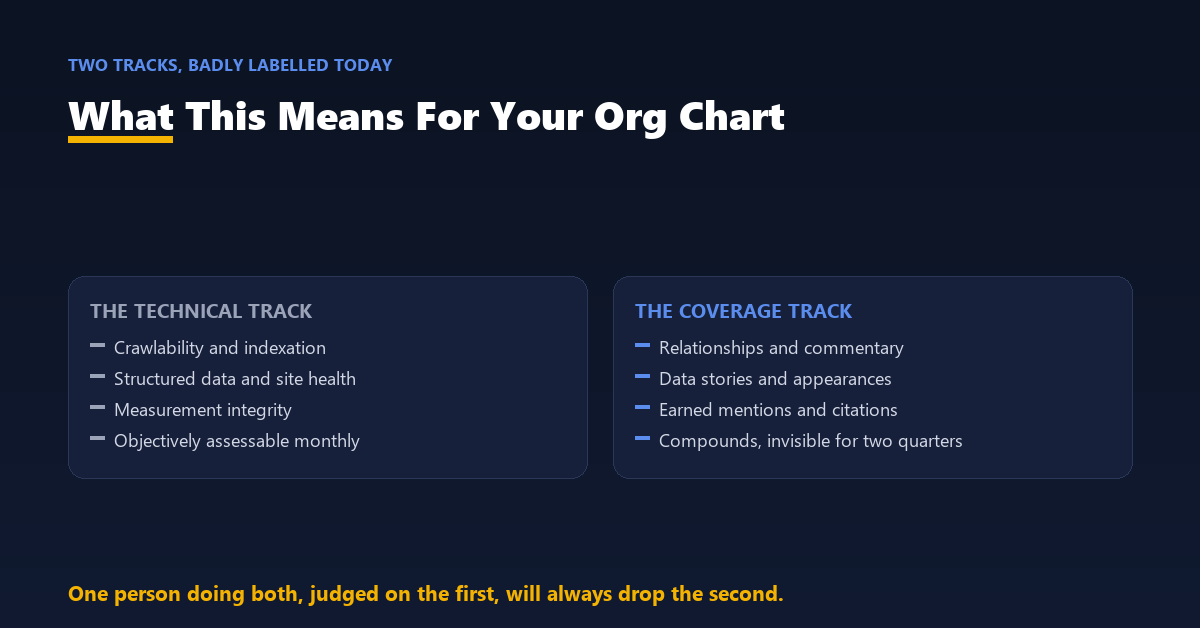
    What This Means For Your Org Chart

    An org chart splitting an SEO function into a technical track and a communications and coverage track.
    Two tracks, two skill sets, two definitions of a good month.

    Our own reading, not Ali’s prescription. His answer was to dissolve the specialism entirely; that is one valid response and it is not the only one. The more common situation is an SEO function that already contains both kinds of work, badly labelled, reviewed against a single set of metrics that suits only one of them.

    • The technical track. Crawlability, indexation, structured data, site health, measurement integrity. Objectively assessable, mostly on-site, and it does not stop mattering because the other track exists.
    • The coverage track. Relationships, commentary, data stories, appearances, earned mentions. Slow to start, compounding, and impossible to evaluate on a monthly ranking report.

    The failure most in-house teams are living with is one person expected to do both, assessed on the metrics of the first. That person will always deprioritise the coverage work, because it does not show up in the report they are judged on — which is a management design fault, not a performance problem.

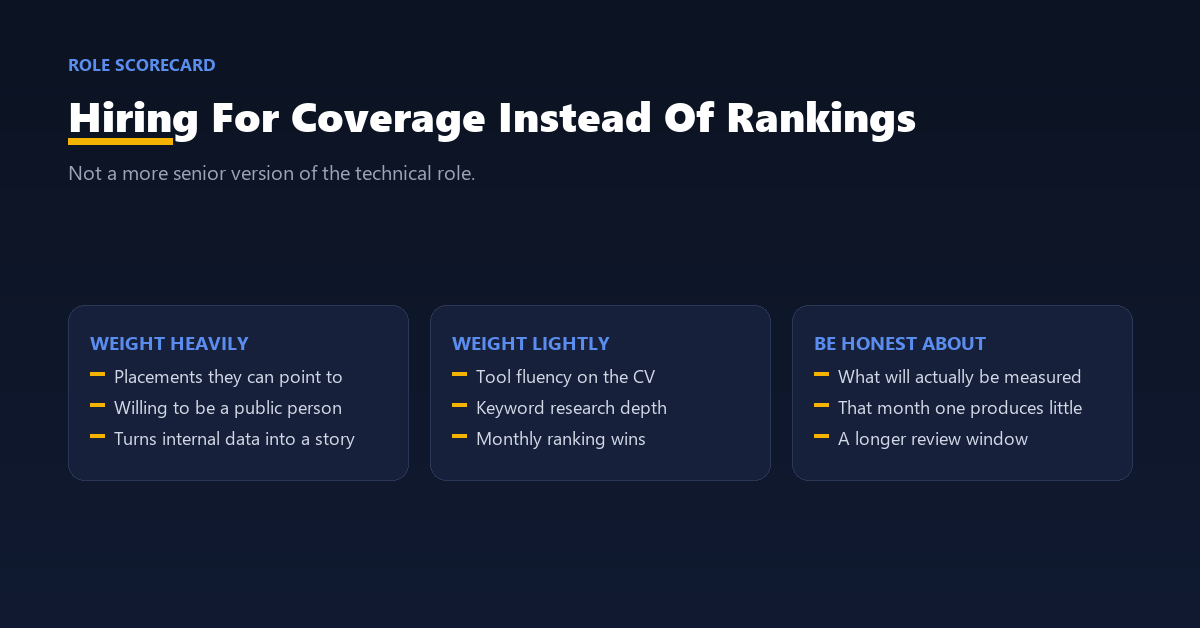
    Hiring For Coverage Instead Of Rankings

    A role scorecard weighting relationship building and media placement above keyword tooling experience.
    The scarce skill is not tool fluency.

    If you accept the split, the second role is not a more senior version of the first and should not be recruited as one. Our scorecard for it:

    1. Evidence of earned coverage. Specific placements they can point to and explain how they got. Weight this above every tool on the CV.
    2. Willingness to be a public person. The work involves appearing, being quoted and being disagreed with. Not everyone wants that and it is not a defect.
    3. Comfort with data as a story. Can they take an internal number and make it something a journalist would run?
    4. Relationship stamina. This role produces very little in month one and a great deal in month nine. Hire someone who has demonstrably worked at that tempo.
    5. Enough technical literacy to be credible. Not to do the technical work — to talk to the person who does without either of them switching off.

    And be honest in the job description about what will be measured, because hiring someone for coverage and then reviewing them on rankings produces a resignation in nine months.

    Reporting Lines That Stop The Turf War

    The predictable conflict is with communications or PR, who reasonably consider media relationships their function and will not enjoy a second team briefing the same journalists.

    Our recommended structure, from having watched this go wrong: one owner of external relationships, wherever it sits, and the other function contributes to it rather than running a parallel programme. If comms owns relationships, the SEO coverage lead supplies the data stories, the technical angles and the search-informed topics, and comms places them. If SEO owns it, comms gets right of review. What does not work is both teams pitching independently, because the journalist notices before the CMO does.

    The metric question resolves the same way. A coverage function reviewed on rankings will produce rankings work. Review it on placements, mentions, citations and branded search — and accept a longer assessment window than a technical roadmap needs, because the first two quarters genuinely look like nothing is happening.

    Source: Zak Ali (Finder US), interviewed on the Unscripted SEO Podcast. The quote is verbatim and the restructure described is his. The org chart, scorecard and reporting-line recommendations are The SEO Advisory’s own. Related: integrated marketing, authority and footprint, and fractional SEO.

  • The Brief Is Where The Human Belongs

    Advisory Note · AI Governance

    The Brief Is Where The Human Belongs

    An advisory read on Nick Eubanks: which stage of the content process you automate decides whether anything proprietary survives.

    Most in-house content teams have already adopted AI. The governance question is no longer whether to allow it — that decision was made informally, by individuals, some time ago. The question is which step of the process it occupies, and almost nobody has decided that deliberately.

    Nick Eubanks, speaking on the Unscripted SEO Podcast, argues that the common arrangement is the wrong way round.

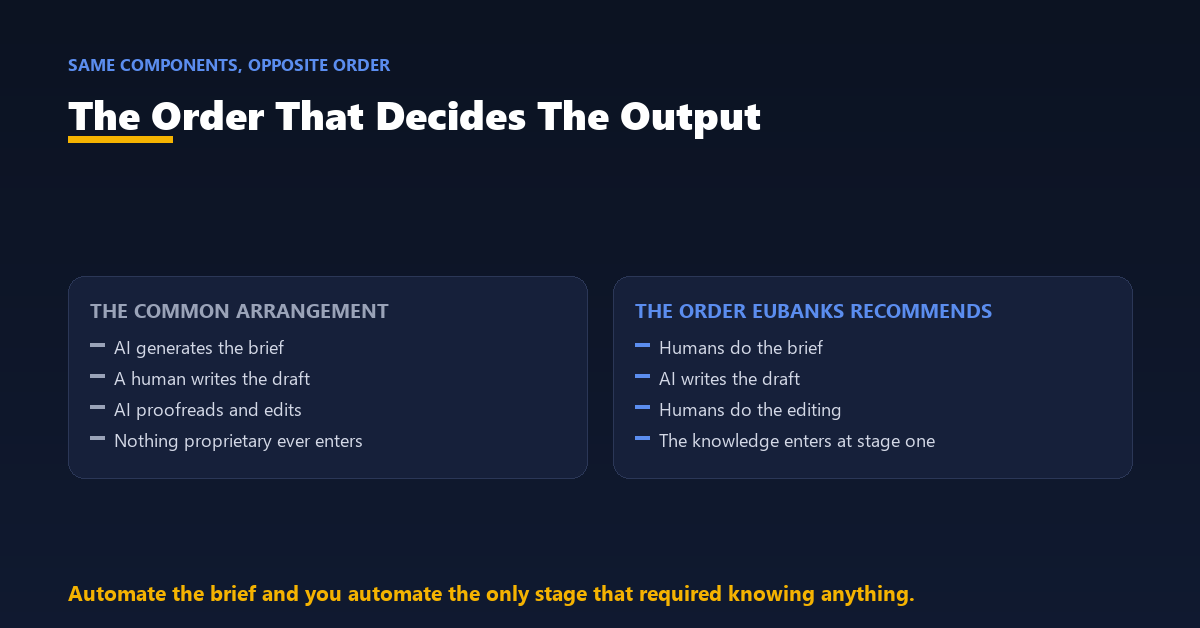
    A Lot Of Agencies Have The Order Backwards

    Two opposing content pipelines showing AI-first drafting versus human-first briefing and their quality outcomes.
    Same components, opposite order, materially different output.

    Eubanks is emphatic that building workflows around AI is not optional — in his words he does not think there is really an option any more. His objection is about placement. He describes agencies and in-house teams designing their processes so that the steps AI is used for are, in his view, not the best ones.

    The specific example is briefs. Creating a good content brief was always painful and reasonably expensive, so the obvious move was to automate it — answer five questions in a form, generate the brief, still charge for it, and take five minutes instead of an hour. Then a human writes the draft and AI proofreads. His verdict on that arrangement:

    I think it’s completely backwards. Where I think things are better… the best results that I’ve seen from a content perspective is where it’s humans actually doing the brief still and then it’s AI writing the draft and then it’s humans doing the editing.— Nick Eubanks

    A note on precision, because this claim travels badly. Eubanks says “a lot of people, a lot of agencies… or maybe even in-house teams” are designing it wrongly — he does not claim a majority, and we are not going to upgrade his estimate for him. What he does claim confidently is which order produces the best results he has seen.

    Governance For Teams Already Using AI

    The reason this matters at board level, rather than as a production preference, is that the automated step determines where the organisation’s knowledge enters the work — or whether it enters at all.

    Automate the brief and you have automated the only stage where anyone was required to decide what the company uniquely knows, who the piece is for, and what claim it exists to make. Every downstream step then operates on a synthesis of what is already publicly available. The output can be perfectly competent and still contain nothing proprietary, which is a strategic outcome disguised as a workflow choice.

    Our own governance framing, not Eubanks’: a content policy should specify the stage rather than the tool. Tools change quarterly; the stage is stable, auditable, and can be written into a scope of work an agency signs.

    What Only A Human Can Put In A Brief

    If the brief is the protected stage, it has to be worth protecting. The things that can only originate with a person, in our experience of reviewing them:

    • The commercial reason the page exists. Which product it supports, which objection it removes, what happens if the reader is persuaded.
    • The reader as the business actually knows them. Not a persona document — the specific thing sales hears on every call.
    • The claim the organisation is willing to defend. A brief without a position produces a draft without one.
    • The proprietary input. The internal number, the named expert to interview, the case with permission to use. This is the entire difference between your page and a competitor’s.
    • The things not to say. Regulatory limits, claims legal has refused, positions the company has moved away from. A model has no way to know any of it.

    That last item is one an advisory sees fail more than any other, and it is the cheapest to fix: a written list of prohibited claims, attached to every brief.

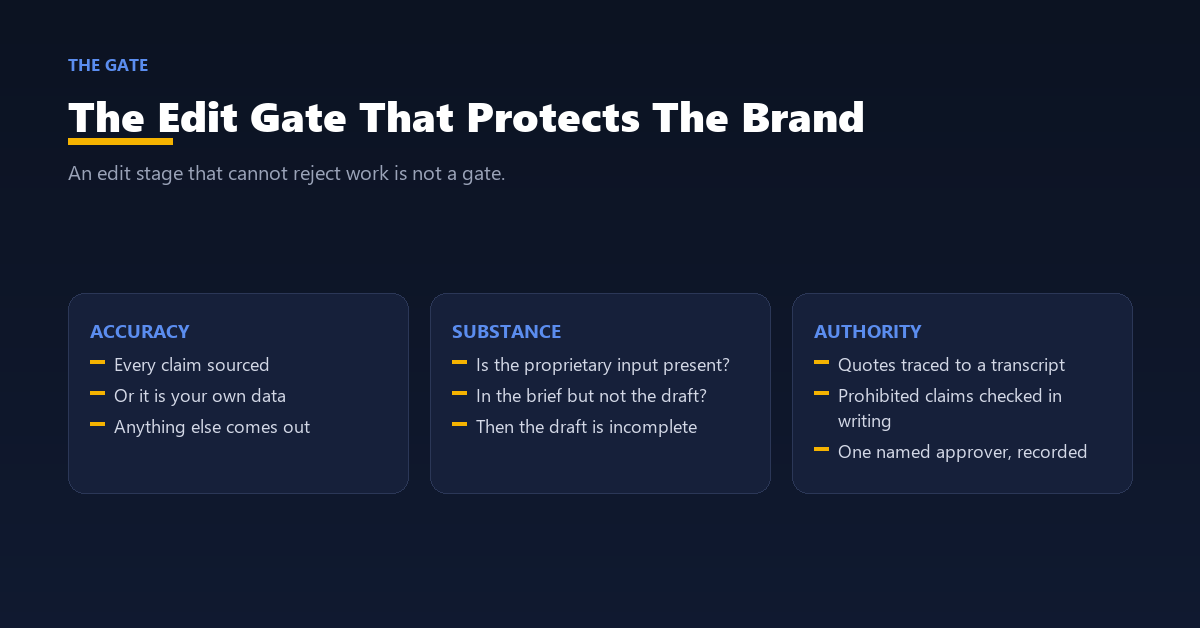
    The Edit Gate That Protects The Brand

    An editorial approval gate checking factual accuracy, first-hand experience and brand voice before publication.
    A named approver, four checks, and the authority to send it back.

    The third stage in Eubanks’ order is humans editing, and in governance terms an edit stage that cannot reject work is not a gate. Our recommended minimum:

    1. Factual accuracy, claim by claim. Every assertion either has a source or is the company’s own data. Anything else comes out.
    2. First-hand experience present. Does the piece contain what the brief said only this organisation could contribute? If it was in the brief and not in the draft, the draft is incomplete.
    3. Quotes verified against a source. Anything in quotation marks traced back to a transcript or recording. A tidied quote is a fabrication.
    4. Prohibited claims absent. Check against the written list, not against memory.
    5. A named approver. One person, recorded. Approval by committee is approval by nobody.

    None of that is a constraint on using these tools. It is what makes using them defensible — which is the difference between a policy a board can sign and a practice that happens to be going well.

    Source: Nick Eubanks, interviewed on the Unscripted SEO Podcast. The quote is verbatim and the view is his; where he qualified his claim, we have kept the qualification. The governance framing, the brief contents and the edit gate are The SEO Advisory’s own. Related: Stewards of the AI, why publishing 100 AI pages will tank your rankings, and SEO in the AI era.

  • Migrations Fail On Business Goals, Not Redirects

    Advisory Note · Governance & Scope

    Migrations Fail On Business Goals, Not Redirects

    An advisory read on Erika Braeger: the question that decides a migration is asked before the date is set, not after the launch.

    Migrations are where advisory work earns its fee, and not for the reason clients expect. By the time an advisor is asked about redirect mapping, the decisions that determine whether the project succeeds have already been made by somebody else, usually months earlier, usually for reasons nobody wrote down.

    Erika Braeger of Tenspeed, speaking on the Unscripted SEO Podcast, starts in a different place from most technical practitioners.

    Never Rush A Website Migration

    Her first piece of advice on the subject is unadorned:

    Don’t rush a website migration, I will say. Never rush a website migration.— Erika Braeger, Tenspeed

    Read from a governance seat, that is a statement about scheduling authority rather than about technical care. Migrations get rushed because a launch date was announced before the scope was understood — tied to a rebrand, a campaign, a board meeting, a contract expiry. Once that date exists, every subsequent decision is made under a constraint nobody chose on the merits.

    The practical implication for an in-house lead: the moment to influence a migration is when the date is being set, not when the redirect map is being built. If you are consulted after the date is fixed, you have been consulted about implementation, not about the project.

    The Question That Reframes The Whole Project

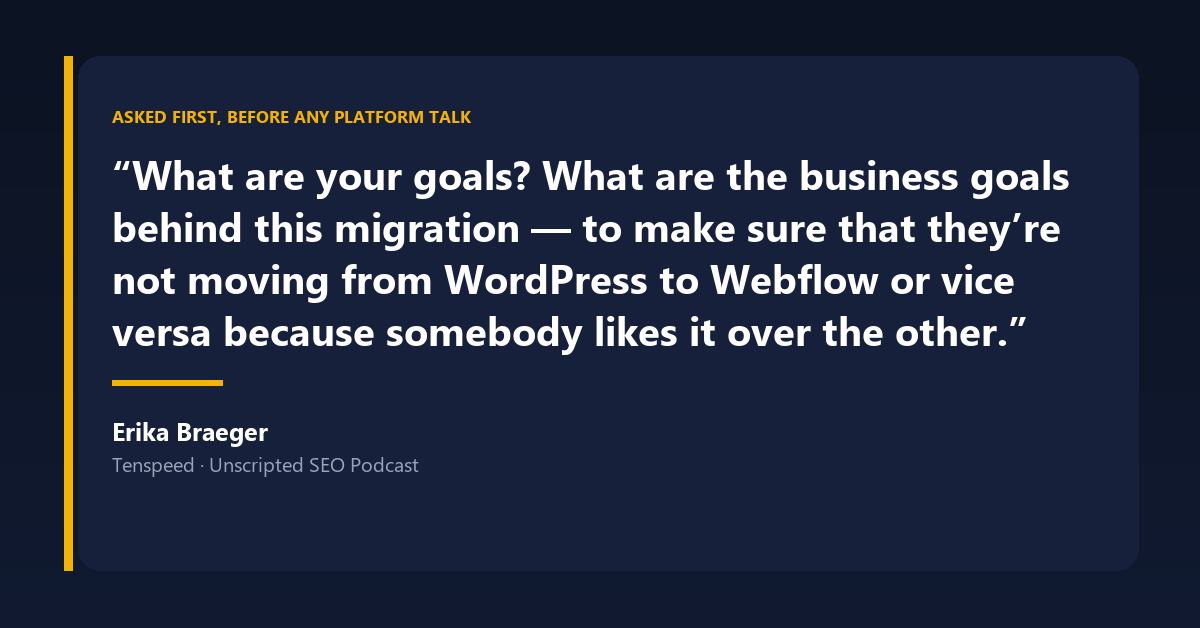
    Erika Braeger quote card asking what the business goals behind a migration actually are before any technical work begins.
    The first question is not technical. It decides whether the technical work is worth doing.

    What she asks first is not about platforms:

    when I’m working on a website migration with a client, one of the first questions I ask is like, what are your goals? What are the business goals behind this migration to make sure that they’re not moving from WordPress to Webflow or vice versa because somebody likes it over the other.— Erika Braeger, Tenspeed

    The failure mode she is naming is preference dressed as strategy. A new marketing hire is fluent in one platform. A designer prefers a particular editor. A developer wants to work in a stack that is better for their next job. None of those are illegitimate considerations, and none of them is a business case — but each can produce a project costing six figures in fees and organic revenue.

    The question is diagnostic in a way that is useful even when the answer is good. A migration with a real goal — the platform cannot support the commerce roadmap, the licence is being withdrawn, three acquisitions need consolidating — produces a scope you can prioritise against, because you can ask of any decision whether it serves the goal. A migration without one produces scope that expands indefinitely, since nothing can be ruled out.

    Where Advisory Adds More Value Than Execution

    Braeger’s own framing of the discipline is worth pairing with this. Her concern with CMS changes is that they are undertaken casually. Our reading, as an advisory rather than as her recommendation, is that this creates four points where an outside seat is worth more than another pair of implementation hands:

    • Before the date is set. Testing whether a business goal exists, and saying so plainly if it does not. This is the highest-value hour in the entire project and it is almost never bought.
    • At scope definition. Deciding what is explicitly not changing. A migration that simultaneously changes platform, information architecture, URL structure, design and copy cannot be diagnosed afterwards, because every variable moved at once.
    • At the go/no-go. Somebody has to be able to say the date should move, and be structurally capable of saying it. An agency being paid to deliver on that date is not that person.
    • After launch. When the delivery team has rolled off and the effects are still arriving.

    The second point is the one most often skipped and most often fatal. Not because changing several things is technically harder, but because it makes the post-launch conversation unresolvable — nobody can attribute a decline, so everybody defends their own component and no one fixes anything.

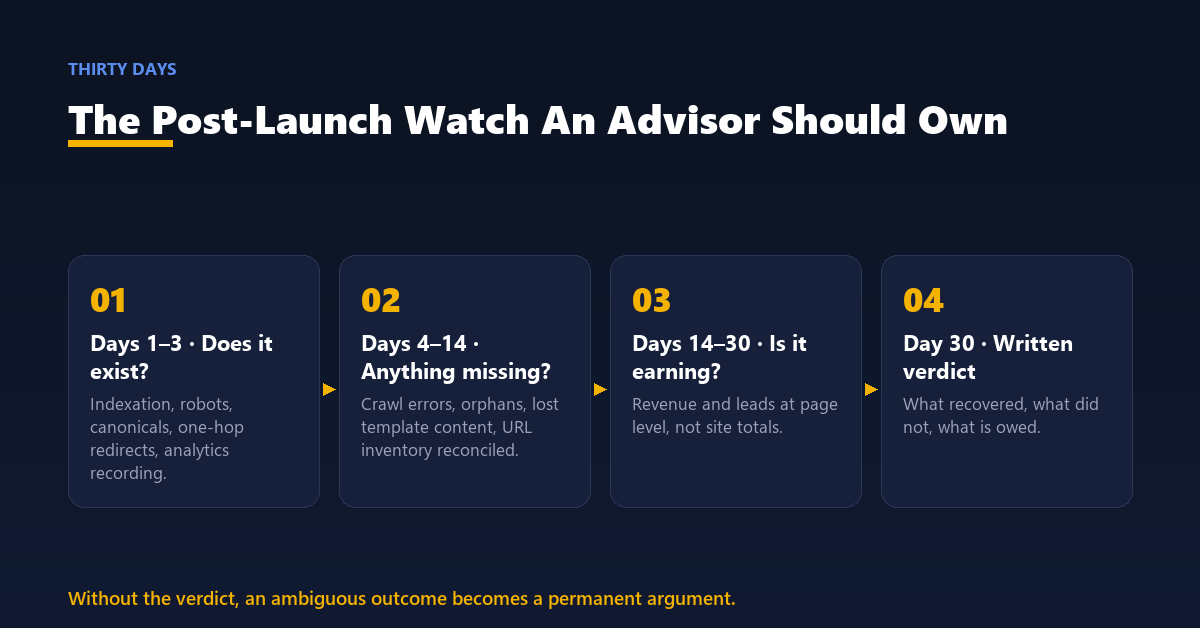
    The Post-Launch Watch An Advisor Should Own

    A thirty-day post-migration monitoring plan covering indexation, revenue and crawl health checkpoints.
    Somebody has to own the month after the delivery team has gone.

    Our own thirty-day watch, offered as advisory practice. The structural argument for an advisor owning it is simply that the people who built the thing are gone, and the people who remain do not know what normal looks like.

    1. Days 1–3: does it exist? Indexation of the pages that matter, robots and canonical directives, redirects resolving in one hop rather than a chain, the analytics and Search Console properties actually recording.
    2. Days 4–14: is anything missing? Crawl errors, orphaned pages, templates that lost content in translation, and the pre-launch inventory of URLs checked against what now exists.
    3. Days 14–30: is it earning? Revenue and lead volume against the same period before, at page level rather than site level, because a site total can stay flat while the commercial pages collapse.
    4. Day 30: the written verdict. A short document saying what recovered, what did not, and what is now owed. Without it, an ambiguous outcome becomes a permanent argument.

    None of this prevents a bad migration. What it prevents is a bad migration that nobody can prove happened, which is the version that costs the most, because it cannot be fixed and it cannot be learned from.

    Source: Erika Braeger (Tenspeed), interviewed on the Unscripted SEO Podcast. Quotes are verbatim and are her views. The scoping, go/no-go and thirty-day watch are The SEO Advisory’s own practice. Related: integrated marketing, fractional SEO, and more notes on the blog.

  • Before The Strategy, Check The Index

    Advisory Note · Diagnostics & Governance

    Before The Strategy, Check The Index

    An advisory read on Matt Mellinger: confirm the pages are indexed before anyone diagnoses anything more sophisticated.

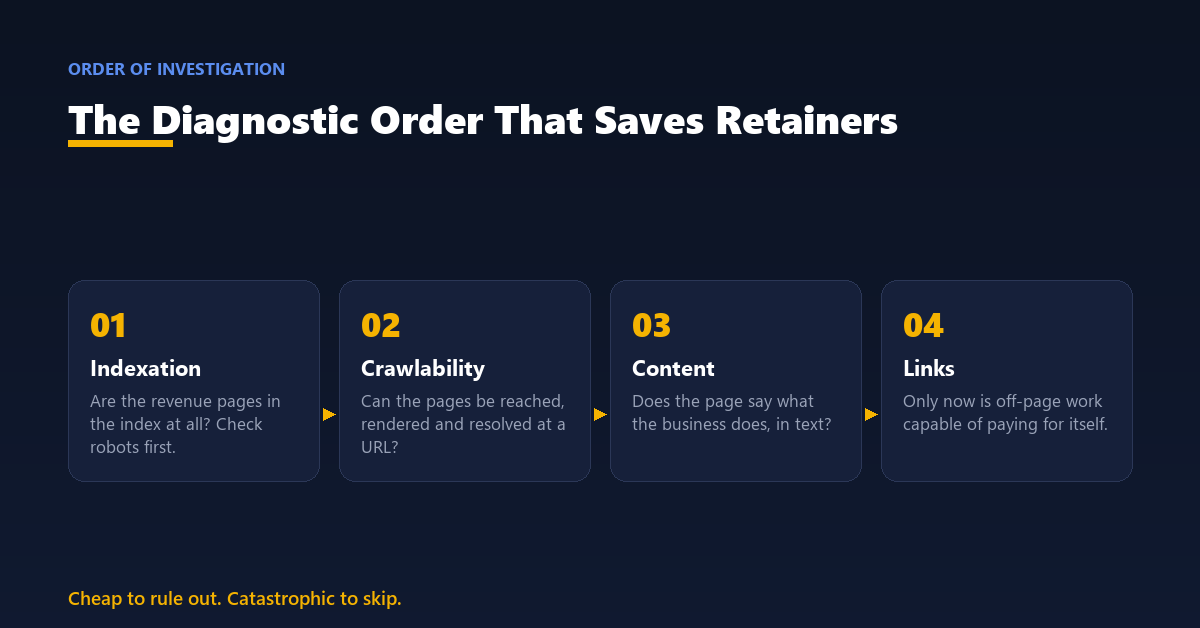
    An advisory engagement is mostly a sequencing problem. The client already has opinions about what is wrong, the incumbent agency has a different set, and the advisor’s job is to impose an order of investigation that stops everyone paying for sophisticated work on top of a broken foundation. Matt Mellinger, co-founder of SEO Gets and of the agency Local SEO Partners, gave a blunt account on the Unscripted SEO Podcast of what that order should start with.

    The Diagnostic Order That Saves Retainers

    A diagnostic sequence beginning with indexation, then crawlability, then content and only finally links.
    Nothing further down the list can be diagnosed while the first item is unresolved.

    Mellinger’s complaint is not about bad strategy. It is about work being sold at a level of sophistication the site cannot yet benefit from. He describes small business owners coming to him after paying retainers of several hundred to several thousand a month, and finding basics missing:

    I’m not kidding when I say that they didn’t have meta descriptions, they didn’t have proper title tags. There was a case that the site wasn’t even being indexed. They had a robots TXT.— Matt Mellinger, SEO Gets / Local SEO Partners

    For an in-house lead or a board reviewing an agency, the governance point is that this is not detectable from a reporting deck. Every one of those engagements produced a monthly report. None of the reports said the site was not indexed, because reports are built from the metrics the agency chose, and an agency that has not checked indexation will not report on it.

    Mellinger On Paying For SEO On An Unindexed Site

    His summary of that situation is the sentence we would put at the top of any first advisory session:

    you’re paying an SEO company and your site isn’t even indexed.— Matt Mellinger, SEO Gets / Local SEO Partners

    Mellinger is candid that this is a heated subject for him — he describes the industry as having a churn-and-burn segment where agencies calculate that clients can be replaced within twelve months whether or not results arrive, and he says his own father was on the receiving end of it. When he asked that provider for six months of Search Console data, he was told they did not have it. His response at the time: “then how are you knowing what’s working?”

    That question is the one an advisor exists to ask on the client’s behalf, early, while it is still cheap to ask. It is worth noting that Mellinger is describing his own experience of a segment of the market, not presenting a survey; the strength of the language is his. The procurement lesson stands regardless of how widespread you believe the behaviour is.

    His advice to owners choosing a provider is refreshingly unsophisticated and we have adopted it into our own reference-checking. Ask for contact details of clients who got results and actually speak to them — in his words, “give me a phone number or an email or contact information of someone that you have helped that has gotten results that I can talk to.” And set an explicit expectation: which keywords, what should have happened in six to twelve months, and what you will do if it has not.

    Page-Level Reading Beats Site Totals

    The second thing worth taking from Mellinger is technical, and it changes how an advisor should read any Search Console report handed to them. He is building a Search Console tool, so he has been examining the data closely for a case study, and he describes a finding about where the complete picture lives.

    His account: when you export query-level data, the proportion of clicks the queries account for varies enormously — he cites a range from roughly five per cent on a very small site up to around seventy per cent — because of anonymised queries. But: “if you look at the page level, it shows you 100 % of the clicks almost every time.” His conclusion is direct — if you want more accuracy you need to go to the page level, “which most people don’t.”

    He also reports an anomaly he triple-checked, where exported page-level impressions exceeded the chart total for a twelve-month period, and is upfront that it did not make sense to him. We are repeating that with the same caveat he gave it: it is one observation from a study that was in progress at the time of recording, not a settled finding.

    The governing principle he draws from it is the useful part for a client conversation. The only numbers he treats as exact are leads and revenue — everything else is directional and should be read for patterns, trends and anomalies rather than absolute values. As he puts it, numbers tell a story, and a number without context means nothing. That is a standard an in-house lead can hold a reporting pack to.

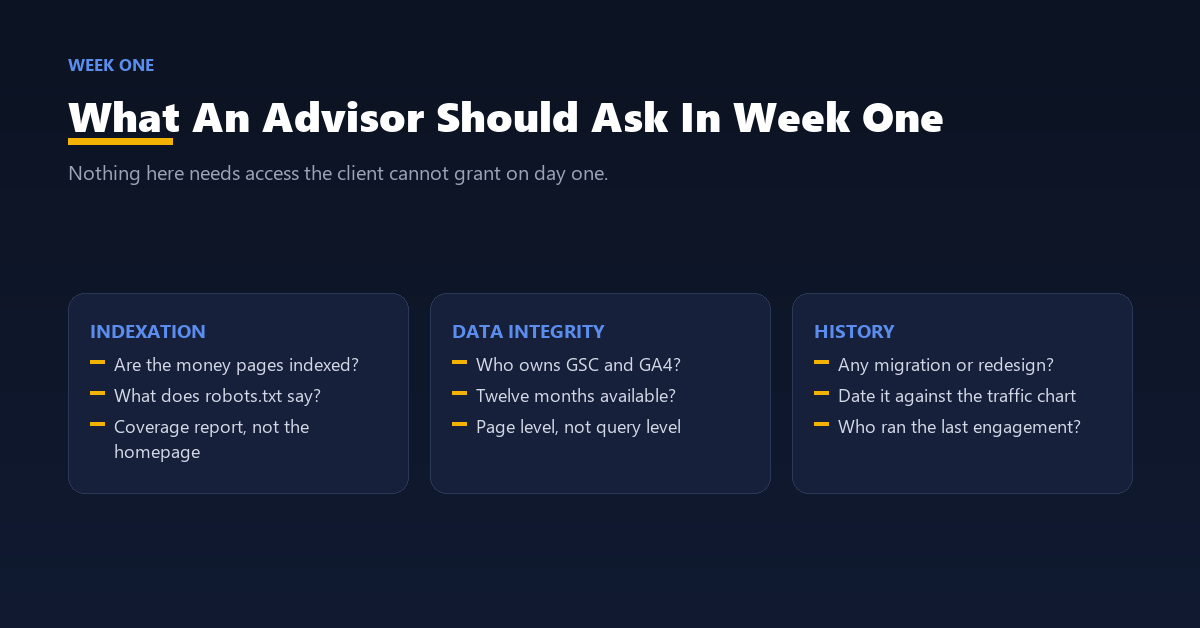
    What An Advisor Should Ask In Week One

    A week-one discovery question list covering indexation, analytics integrity, ownership and past migrations.
    Four questions that decide whether anything else in the engagement can be trusted.

    Our own week-one list, informed by the above rather than dictated by it. None of these require access to anything the client cannot supply on day one.

    • Are the pages that matter actually in the index? Not the homepage. The revenue pages. Check coverage and check the robots file before forming any other hypothesis.
    • Who owns the Search Console and analytics properties? If the answer is the outgoing agency, that is both a data-continuity problem and a negotiating one.
    • Can we see twelve months of data, at page level? If it does not exist, you have learned something more important than anything in it.
    • Has anything structural changed — a migration, a redesign, a CMS move? Date it, then line it up against the traffic chart before anyone theorises about algorithms.

    The purpose of putting indexation first is not that it is usually the answer. It is that it is cheap to rule out and catastrophic to miss, and an engagement that skips it can spend a quarter producing excellent work that no search engine has seen.

    Source: Matt Mellinger (SEO Gets / Local SEO Partners), interviewed on the Unscripted SEO Podcast. Quotes are verbatim from the episode transcript and are his views, not The SEO Advisory’s. Where we have added process, it is labelled as our own. If you want this run as a formal week-one review, that is the advisory; more notes are on the blog, and the AI-governance companion is Stewards of the AI.

  • An Advisor’s Rule For Judging A Link

    Advisory Note · Authority & Footprint

    An Advisor’s Rule For Judging A Link

    Relevance beats DA. Verification beats trust. Two practitioner standards worth building into your approval gate.

    At The SEO Advisory we read practitioner interviews from a governance seat: not “is this a clever tactic,” but “what standard should an in-house lead be able to hold an agency to?” Two recent conversations on the Unscripted SEO Podcast — with Bradley Benner of Semantic Links and Kristiyan Yankov of Above Apex — land on the same operating rule from opposite directions. Neither is selling you a metric. Both are describing a gate.

    The Metric In-House Teams Still Report

    Domain Authority and Domain Rating survive for an unglamorous reason: they are a single number, they are comparable month over month, and they fit on a slide. Nobody has to explain them. That is a reporting virtue, not an accuracy one — these are third-party estimates built by tool vendors, not signals Google publishes.

    Benner, who runs an off-page agency built specifically around this problem, is blunt about where that leaves you:

    It’s not some stupid third party metric like DA or DR or trust flow or anything else that matters about whether a link is valuable or not. What matters is whether it’s relevant.— Bradley Benner, Semantic Links

    He is not talking theoretically. He describes agencies still selling outdated work to local businesses and calls it what he thinks it is — unethical — on the grounds that if you sell a service you are obliged to keep up with what currently works. Whatever you make of the strength of that language, the underlying point is a procurement point: a metric that is easy to report is not the same as a metric that predicts value, and if your programme is judged on the easy one, that is what your agency will optimise for. This is the same argument we make in Footprint Beats Tricks from a different angle.

    Relevance As The Governing Standard

    Benner’s framing is that the SEO’s job has changed shape. As he puts it, the work is now “creating associations, strengthening those associations, and helping, forcing the models and the algorithms to recognize those associations” — between the brand, its products or services, and the places it serves. A link is valuable to the degree it strengthens one of those associations, and irrelevant links strengthen nothing.

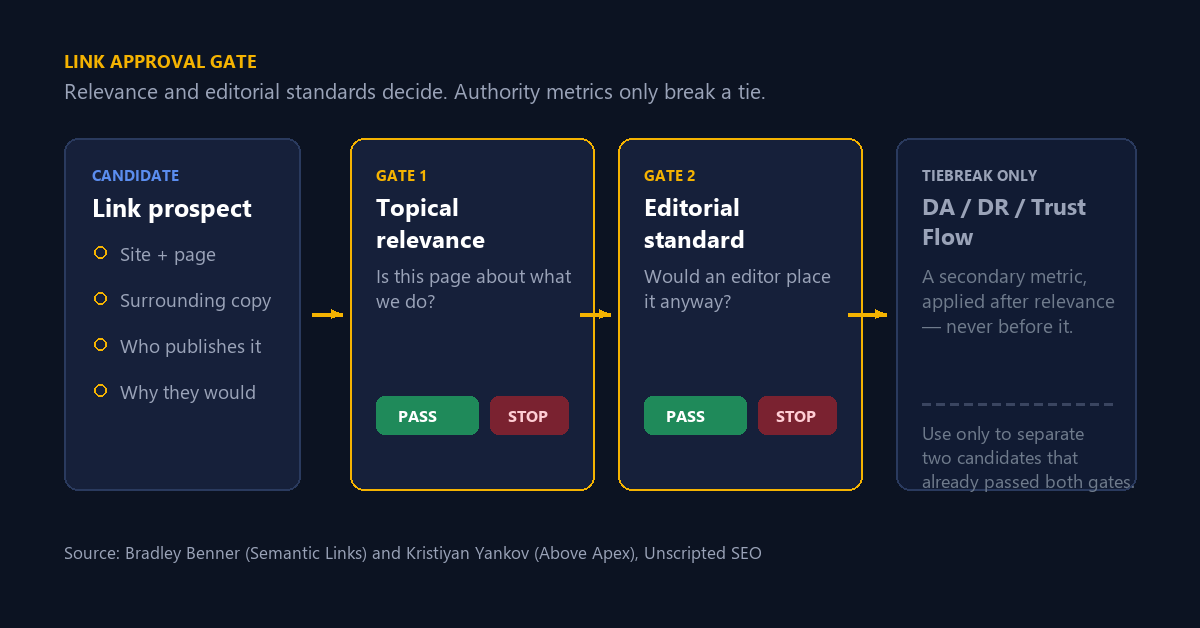
    A link approval gate scoring candidates on topical relevance and editorial standards before any authority metric is considered.
    Relevance and editorial standards decide. Authority metrics only break a tie.

    Usefully for anyone writing a policy, he describes relevance as layered rather than binary — “three layers or levels of relevance matching that can be achieved when you’re doing link building”:

    • The passage. Is the link placed inside content that is genuinely about the subject, near entities related to the business and the area it serves?
    • The publication. Are the overall topical themes of the host site relevant to what is being linked to?
    • The publication’s own profile. What is the relevance of the backlinks already pointing at that referring domain?

    One nuance gets lost when this gets compressed into “DR is dead,” and it matters for policy drafting. Benner does not ban authority metrics; he demotes them. His own words: if you want to use DA, DR or Trust Flow “as kind of a secondary metric after determining that a potential link source is relevant to what it’s going to be linking to, then fine.” His rule is sequence. “But you should look at relevance first.”

    That is a far more implementable standard than an outright ban, because it survives contact with a real shortlist. Two candidates both clear the relevance bar; you have budget for one; the tiebreak is allowed to be a number. What is not allowed is the number doing the deciding before relevance has been tested. If you are building the wider case for why this is where authority actually comes from, that is the argument collected in Authority & Footprint.

    Verify, Do Not Trust: A Screening Gate

    Yankov supplies the second half. Asked at the top of his interview why anyone should trust him, he declined the premise:

    You shouldn’t trust anyone. You should verify. You should verify, especially in our industry.— Kristiyan Yankov, Above Apex

    In practice that means looking at five to ten metrics as a starter rather than domain rating alone, and then applying human judgment to the thing itself — is this a genuine website that serves a purpose rather than a PBN, does it carry relevant content, is the link seamlessly integrated into the actual copy of the article. His test for whether that judgment is trustworthy is the most quotable line either guest offered:

    If I look at a link-building opportunity and it makes sense to me, it would be the same for Google, because Google is definitely not more stupid than me. It’s quite the opposite — it’s actually smarter.— Kristiyan Yankov, Above Apex

    There is a risk calibration buried in his answer that in-house leads should hear, because it changes the tone of the conversation with finance. Yankov’s reading of the leaked Google documentation, and of the analysts who worked through it, is that low-quality links are set aside rather than punished — Google “disregards them entirely” and does not count them. On that reading, the usual consequence of a badly-vetted link programme is not a catastrophe. It is a wasted budget: months of invoices buying links that were quietly ignored.

    We would treat that as his considered opinion rather than settled fact, and we would not use it to justify carelessness. But it does reframe the ask. You are not asking your board to fund a safety measure against a penalty. You are asking them to stop paying for links that do not count.

    Writing The Policy Your Agency Must Follow

    Two practitioners, two sentences, one gate. Relevance first, then verify. The advisory job is turning that into something a marketing coordinator can apply on a Tuesday without you in the room.

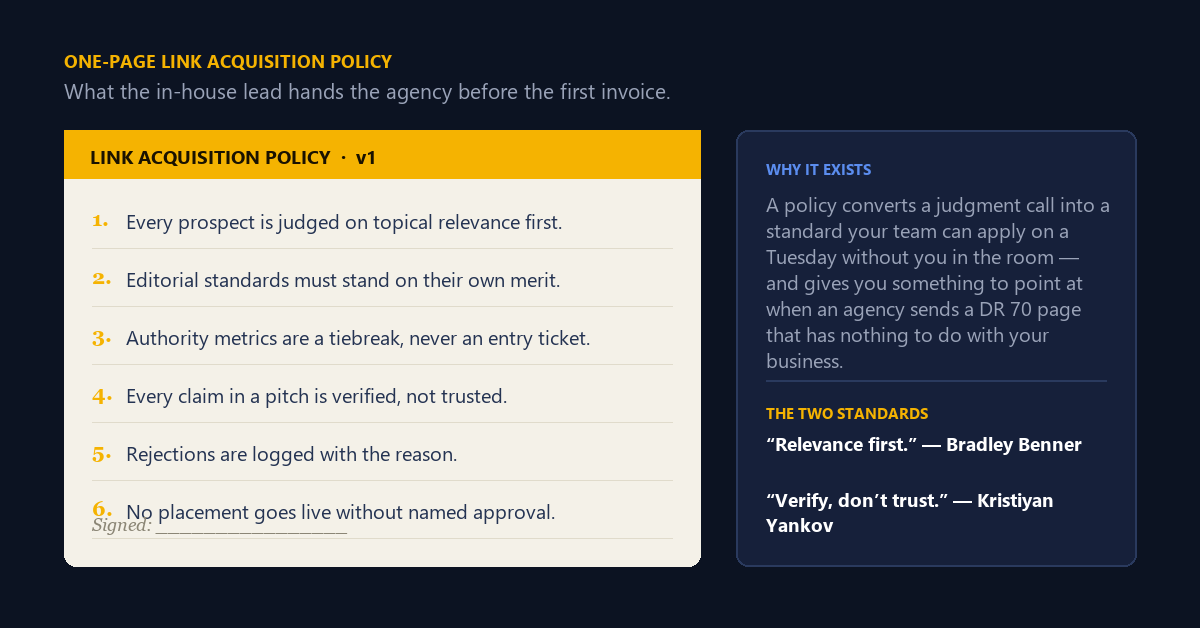
    A one-page link acquisition policy document an in-house lead can hand to an external agency.
    A one-page standard is easier to enforce than a strong opinion.

    A workable one-pager reads roughly like this. Every prospect is assessed on topical relevance before any authority metric is opened. The placement must stand on editorial merit — a reader arriving on that page should find the link useful for reasons that have nothing to do with search. Authority metrics are permitted only as a tiebreak between candidates that have already passed. Every claim in an agency’s pitch — traffic, editorial standards, who actually publishes there — is verified rather than accepted. Rejections are logged with the reason, so the standard compounds into institutional knowledge instead of living in one person’s head. And no placement goes live without a named approver.

    The last two lines are the ones teams skip and then regret. A rejection log is what stops your third agency re-pitching the site your first agency was turned down from. A named approver is what makes the standard real rather than aspirational.

    None of this requires you to abandon the number your board likes. It requires you to move it to the end of the process, where it can no longer do any damage.

    Sources: Bradley Benner (Semantic Mastery / Semantic Links) and Kristiyan Yankov (Above Apex), interviewed on the Unscripted SEO Podcast. Quotes are verbatim. If you want this turned into a live approval gate for your team, that is exactly the work described in the SEO advisory.

  • Fractional Is a Relationship Word, Not a Search Word

    Advisory Note · Fractional SEO

    Fractional Is a Relationship Word, Not a Search Word

    Six operators who sell fractional roles — a CCO, a CFO, a director of operations, two consultants — plus one CMO who flatly refuses to. Here is what they reveal about when the model works, and when it is the wrong answer.

    “Fractional” went from nowhere to everywhere in about five years. As one host put it on the Unscripted podcast: nobody was fractional unless they were in their math class. Now there are fractional CMOs, CFOs, CTOs, COOs — and fractional SEO, which is what we do here.

    That speed should make a buyer suspicious. So rather than argue our own case, we went back through a run of interviews with people who actually sell the model — and one senior marketer who refuses to — and read them from the advisory seat. The most useful finding is a warning, and it comes from an SEO problem.

    The category has a demand problem

    George Little runs Brand Zap, positioned deliberately between a freelancer and a full agency. He uses the word “fractional” — but only in conversation, never as the offer. He learned that the expensive way.

    I had another version of this company that did not succeed a couple of years ago that was basically trying to push fractional creative director. No market for it, no search around it. Speaking of SEO, that’s really a good place to start. Is anyone even Googling this? And they weren’t.— George Little, Brand Zap

    This is the whole lesson in one anecdote, and it is a search lesson before it is a positioning lesson. He had named his company after the shape of the contract rather than the problem being solved. Buyers were searching for agencies, for freelancers, and for the consultant in between — not for a staffing arrangement.

    George now reserves the term for describing how the relationship feels once it has started: “I use the term only when like discussing the relationship, that sort of feel of the relationship for folks.” That is the correct use. Fractional is a good word for explaining an engagement and a bad word for winning one.

    What it actually means, stated plainly

    Joshua Altman runs Beltway Media as a fractional Chief Communications Officer, and gives the cleanest definition in the set:

    Fractional means we’re contractual, we’re part time workers, we’re fully integrated into the client’s company and team. So instead of having a forty hour a week chief communications officer, you have someone twenty five percent of that, one quarter, fractional.— Joshua Altman, Beltway Media

    Note the load-bearing phrase: fully integrated into the client’s company and team. That is what separates fractional from an agency retainer. An agency sits outside and reports in. A fractional executive sits inside and owns the function. If a proposal does not describe integration, it is a retainer wearing a better word.

    The real trigger: somebody got stuck owning a function

    The most useful thing Joshua said was not a definition — it was a description of who calls him:

    One of the people we take over from the most are owners and founders or an early hire because they kind of just got stuck owning a function because they built the website, so now this is all on them. You have a lot of CTOs who built the website whenever it was built and now suddenly they’re in charge of all things digital. And they don’t want to. That’s not their job.— Joshua Altman

    Any SEO advisor will recognise this immediately, because it is the single most common way SEO ends up owned inside a company. Nobody decides to own SEO. Somebody built the site, or ran one campaign that worked, or was in the room when the agency was fired — and it stuck to them. They are now responsible for a discipline they did not choose, cannot benchmark, and have no time to keep current in.

    That is the honest trigger for fractional SEO. Not “we need more traffic.” It is “this function has an accidental owner.”

    Why the outside seat gets listened to — and why that is a problem

    Ash Nallawalla is a fractional enterprise SEO consultant and author of Accidental SEO Manager — the closest analogue in this group to what we do. He tells a story about one of Australia’s top four banks: hired as an outside consultant, given a four-hour audit presentation with a manager he “couldn’t normally get for a one-hour meeting,” promised a conservative 10% traffic lift in twelve months, and delivered it in eight days after implementation. Traffic doubled in eight months. Three years later it had tripled.

    Then he says the part that should make every buyer of fractional services pause:

    I’ve never had it since, because once you’re inside a company you’re no longer treated as the expert. So my lesson is: don’t reserve that trust for outside consultants. Give your internal expert the same weight.— Ash Nallawalla, author of Accidental SEO Manager

    Read that carefully, because it cuts against our own commercial interest. Ash is saying his outside results came partly from a trust premium granted to outsiders — 100% acceptance of recommendations, no prioritisation fights — not purely from superior skill. The mechanism that makes fractional work is partly organisational psychology.

    The advisory reading: if you hire fractional expertise and then treat it like internal staff to be overruled, you have bought the cost without the mechanism. And if you already have a capable internal person you routinely overrule, your first move is not to hire us. It is to stop doing that.

    The seniority argument

    Ash’s standing complaint is about where the function sits:

    My soapbox is that the SEO, or the SEO manager, needs to sit higher in the hierarchy. I’d call the role something like a chief webmaster, or, if you don’t like that term, a chief web success officer — because web success spells company success.— Ash Nallawalla

    His example is mundane and devastating: a security team bought a firewall to stop scrapers, whitelisted Google, and unknowingly throttled their own SEO’s crawling from five million URLs a day to five million over two or three weeks. Nobody was wrong. The SEO was simply too far down the org chart to be in the conversation.

    He also offers a real number on the trend. When he wrote the first edition of his book, roughly one person on LinkedIn held a chief-webmaster-style title. By the second edition this year, around 300 did.

    This is the structural case for the fractional model in SEO specifically. Most companies cannot justify a full-time senior SEO leader, but the decisions that wreck organic performance — domain strategy, subdomain-versus-folder, replatforming, a firewall purchase — are all made at a level the junior owner never attends. Fractional buys seniority at the tier where the damage happens.

    The operator in the middle

    Lloyd Thompson runs Virtual DOO, a fractional director of operations practice, and describes the role in one line:

    The operator is that person who sits between the founder and the team.— Lloyd Thompson, Virtual DOO

    The same geometry applies to SEO. The valuable fractional SEO is not the one producing more deliverables; it is the one standing between the owner’s intent and whoever executes — the agency, the developers, the content team — translating in both directions. Lloyd’s other observation transfers cleanly too: teams keep believing the next tool will solve the problem, when the fix is to simplify. That is as true of an SEO stack as an ops stack.

    Meaghan Wall runs the same pattern in finance as a fractional CFO, and Grant Simmons arrived at the model the way many senior practitioners do — agency, then brand, then consultant. The shape recurs across every function. That is a signal, not a fashion.

    The honest counterargument

    Matt Tyner is CMO at Bone Dry Roofing, one of the largest residential family-owned roofing contractors in the US, with fifteen-plus years in home services. Asked directly whether he was a fractional CMO, he was blunt:

    My experience has been completely internal. So I have not been a freelancer. I have not been a fractional CMO. When I’ve worked somewhere, it’s been you get 100% of my time.— Matt Tyner, CMO, Bone Dry Roofing

    He is right for his situation, and it is worth being precise about why. His core argument elsewhere in that conversation is that marketing makes the promise and operations keeps it — which requires walking hand in hand with operations daily. Where marketing success depends on continuous, deep coupling with how the work actually gets delivered, a quarter of someone’s attention genuinely will not do it.

    Matt also identifies the failure mode that gives every outsourced model a bad name: layers. A marketing person hires the agency, the agency has an ops team, the ops team briefs the SEO — and by then the specialist has no route to propose anything meaningful. Fractional is defensible only insofar as it removes those layers. If it adds one, it is worse than an agency.

    The advisory read

    Taken together, these conversations produce a fairly strict test. Fractional is the right structure when the function has an accidental owner, when the damaging decisions happen above that owner’s level, and when the work is advisory and directional rather than continuous and operational. It is the wrong structure when the function must be coupled to daily delivery, when you would not extend the same trust you would give an outside consultant, or when it inserts one more layer between intent and execution.

    And whatever you call it, do not build the offer around the word. Ask what George asked: is anyone even Googling this?

    If the description of an accidental owner sounded like your company, that is the conversation we have on fractional SEO management — and if you are not sure the model fits at all, SEO advisory is the cheaper place to start.

    Sources: interviews from the Unscripted podcast network — Joshua Altman (fractional CCO), Ash Nallawalla (fractional enterprise SEO), Lloyd Thompson (fractional DOO), Meaghan Wall (fractional CFO), Grant Simmons, and Matt Tyner (internal CMO). George Little of Brand Zap is quoted from an Unscripted SEO conversation not yet published. Quotes are verbatim; transcription spacing has been normalised.