
The Brief Is Where The Human Belongs
An advisory read on Nick Eubanks: which stage of the content process you automate decides whether anything proprietary survives.
Most in-house content teams have already adopted AI. The governance question is no longer whether to allow it — that decision was made informally, by individuals, some time ago. The question is which step of the process it occupies, and almost nobody has decided that deliberately.
Nick Eubanks, speaking on the Unscripted SEO Podcast, argues that the common arrangement is the wrong way round.
A Lot Of Agencies Have The Order Backwards
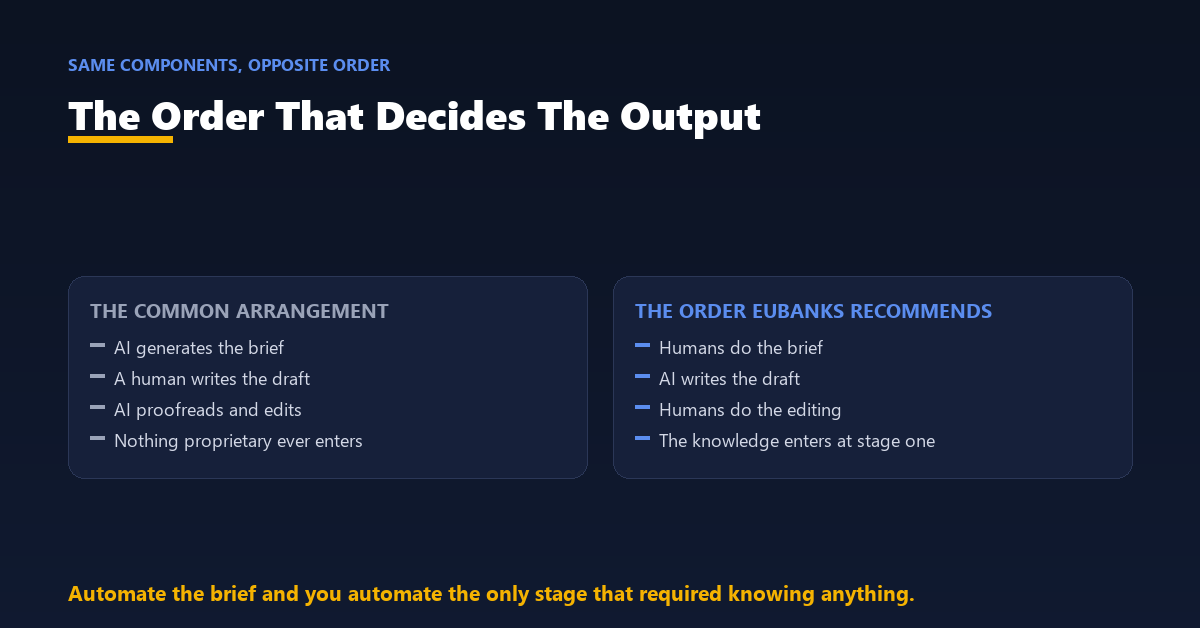
Eubanks is emphatic that building workflows around AI is not optional — in his words he does not think there is really an option any more. His objection is about placement. He describes agencies and in-house teams designing their processes so that the steps AI is used for are, in his view, not the best ones.
The specific example is briefs. Creating a good content brief was always painful and reasonably expensive, so the obvious move was to automate it — answer five questions in a form, generate the brief, still charge for it, and take five minutes instead of an hour. Then a human writes the draft and AI proofreads. His verdict on that arrangement:
A note on precision, because this claim travels badly. Eubanks says “a lot of people, a lot of agencies… or maybe even in-house teams” are designing it wrongly — he does not claim a majority, and we are not going to upgrade his estimate for him. What he does claim confidently is which order produces the best results he has seen.
Governance For Teams Already Using AI
The reason this matters at board level, rather than as a production preference, is that the automated step determines where the organisation’s knowledge enters the work — or whether it enters at all.
Automate the brief and you have automated the only stage where anyone was required to decide what the company uniquely knows, who the piece is for, and what claim it exists to make. Every downstream step then operates on a synthesis of what is already publicly available. The output can be perfectly competent and still contain nothing proprietary, which is a strategic outcome disguised as a workflow choice.
Our own governance framing, not Eubanks’: a content policy should specify the stage rather than the tool. Tools change quarterly; the stage is stable, auditable, and can be written into a scope of work an agency signs.
What Only A Human Can Put In A Brief
If the brief is the protected stage, it has to be worth protecting. The things that can only originate with a person, in our experience of reviewing them:
- The commercial reason the page exists. Which product it supports, which objection it removes, what happens if the reader is persuaded.
- The reader as the business actually knows them. Not a persona document — the specific thing sales hears on every call.
- The claim the organisation is willing to defend. A brief without a position produces a draft without one.
- The proprietary input. The internal number, the named expert to interview, the case with permission to use. This is the entire difference between your page and a competitor’s.
- The things not to say. Regulatory limits, claims legal has refused, positions the company has moved away from. A model has no way to know any of it.
That last item is one an advisory sees fail more than any other, and it is the cheapest to fix: a written list of prohibited claims, attached to every brief.
The Edit Gate That Protects The Brand
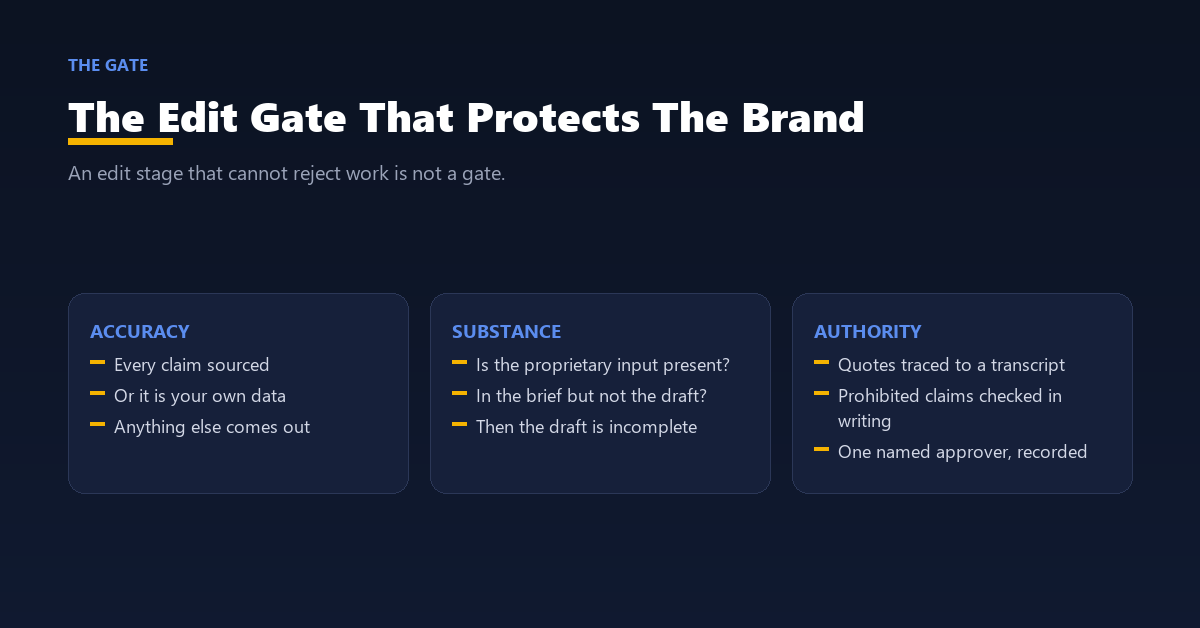
The third stage in Eubanks’ order is humans editing, and in governance terms an edit stage that cannot reject work is not a gate. Our recommended minimum:
- Factual accuracy, claim by claim. Every assertion either has a source or is the company’s own data. Anything else comes out.
- First-hand experience present. Does the piece contain what the brief said only this organisation could contribute? If it was in the brief and not in the draft, the draft is incomplete.
- Quotes verified against a source. Anything in quotation marks traced back to a transcript or recording. A tidied quote is a fabrication.
- Prohibited claims absent. Check against the written list, not against memory.
- A named approver. One person, recorded. Approval by committee is approval by nobody.
None of that is a constraint on using these tools. It is what makes using them defensible — which is the difference between a policy a board can sign and a practice that happens to be going well.