Author: jeremy@seoarcade.com

  • Half Your SEO Team Is Doing PR

    Advisory Note · Team Structure

    Half Your SEO Team Is Doing PR

    An advisory read on Zak Ali: if the job is digital PR, that is an org chart decision, not an opinion piece.

    Most commentary about SEO becoming public relations stops at the observation. For an in-house lead, the observation is not the interesting part — the interesting part is that if it is true, it is a staffing question, a reporting-line question and a budget question, and those have to be answered by someone with the authority to answer them.

    Zak Ali, who leads SEO at Finder in the US, is one of the few practitioners who has actually made the organisational change rather than writing about it.

    The Two Types Of SEO Left

    His formulation, on the Unscripted SEO Podcast:

    there’s two types of SEOs that exist today. There are the technical SEOs, and there are SEOs who haven’t realized yet that their job is digital PR and branding.— Zak Ali, Finder US

    He adds that you have to steer into it and see where the writing is on the wall — and then describes what steering into it cost him. In May of the previous year he decided, in his words, to kill the SEO team and have a generalist marketing team instead. He is candid that it was rough at the beginning: telling people who had spent years building a specialism that they were growth marketers now.

    For a governance reader, that is the material fact. This is not a prediction. It is a practitioner describing a restructure he executed, including the part where it was uncomfortable. Whether you agree with the conclusion, the honest version of the argument includes a real organisational cost.

    The framing that gets him there is worth keeping attached, because it is the business case. His view is that the role of every SEO is audience cultivation — getting people in, converting them, and retaining them — and that “retention should be a core KPI of every SEO.” The PR conclusion follows from the audience premise rather than standing on its own.

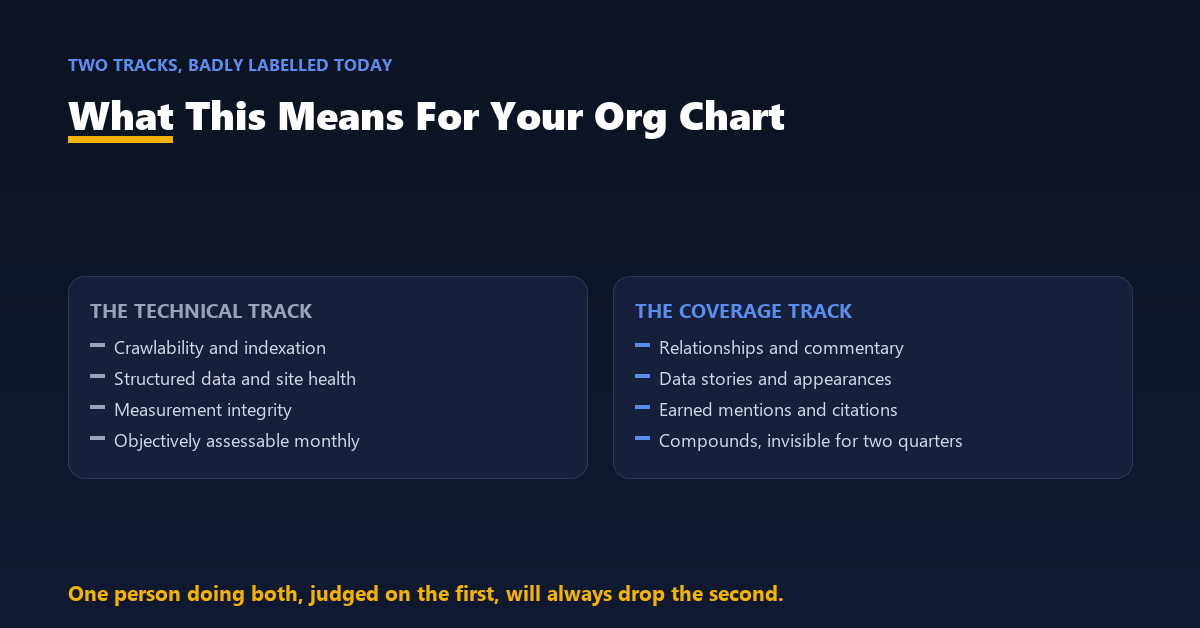
    What This Means For Your Org Chart

    An org chart splitting an SEO function into a technical track and a communications and coverage track.
    Two tracks, two skill sets, two definitions of a good month.

    Our own reading, not Ali’s prescription. His answer was to dissolve the specialism entirely; that is one valid response and it is not the only one. The more common situation is an SEO function that already contains both kinds of work, badly labelled, reviewed against a single set of metrics that suits only one of them.

    • The technical track. Crawlability, indexation, structured data, site health, measurement integrity. Objectively assessable, mostly on-site, and it does not stop mattering because the other track exists.
    • The coverage track. Relationships, commentary, data stories, appearances, earned mentions. Slow to start, compounding, and impossible to evaluate on a monthly ranking report.

    The failure most in-house teams are living with is one person expected to do both, assessed on the metrics of the first. That person will always deprioritise the coverage work, because it does not show up in the report they are judged on — which is a management design fault, not a performance problem.

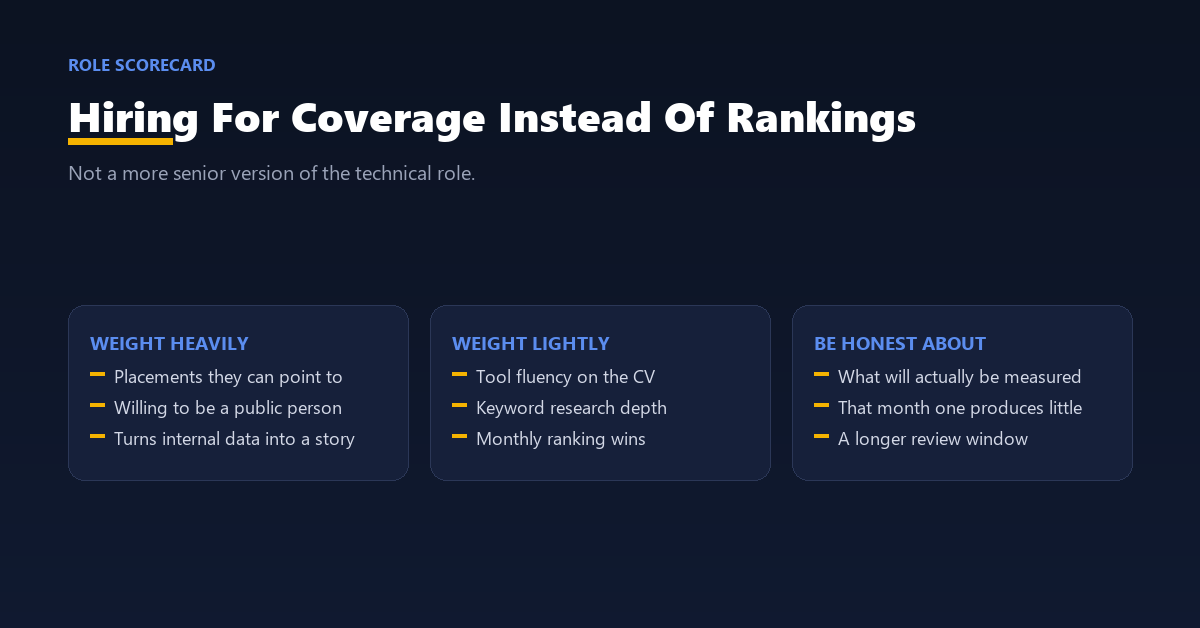
    Hiring For Coverage Instead Of Rankings

    A role scorecard weighting relationship building and media placement above keyword tooling experience.
    The scarce skill is not tool fluency.

    If you accept the split, the second role is not a more senior version of the first and should not be recruited as one. Our scorecard for it:

    1. Evidence of earned coverage. Specific placements they can point to and explain how they got. Weight this above every tool on the CV.
    2. Willingness to be a public person. The work involves appearing, being quoted and being disagreed with. Not everyone wants that and it is not a defect.
    3. Comfort with data as a story. Can they take an internal number and make it something a journalist would run?
    4. Relationship stamina. This role produces very little in month one and a great deal in month nine. Hire someone who has demonstrably worked at that tempo.
    5. Enough technical literacy to be credible. Not to do the technical work — to talk to the person who does without either of them switching off.

    And be honest in the job description about what will be measured, because hiring someone for coverage and then reviewing them on rankings produces a resignation in nine months.

    Reporting Lines That Stop The Turf War

    The predictable conflict is with communications or PR, who reasonably consider media relationships their function and will not enjoy a second team briefing the same journalists.

    Our recommended structure, from having watched this go wrong: one owner of external relationships, wherever it sits, and the other function contributes to it rather than running a parallel programme. If comms owns relationships, the SEO coverage lead supplies the data stories, the technical angles and the search-informed topics, and comms places them. If SEO owns it, comms gets right of review. What does not work is both teams pitching independently, because the journalist notices before the CMO does.

    The metric question resolves the same way. A coverage function reviewed on rankings will produce rankings work. Review it on placements, mentions, citations and branded search — and accept a longer assessment window than a technical roadmap needs, because the first two quarters genuinely look like nothing is happening.

    Source: Zak Ali (Finder US), interviewed on the Unscripted SEO Podcast. The quote is verbatim and the restructure described is his. The org chart, scorecard and reporting-line recommendations are The SEO Advisory’s own. Related: integrated marketing, authority and footprint, and fractional SEO.

  • The Brief Is Where The Human Belongs

    Advisory Note · AI Governance

    The Brief Is Where The Human Belongs

    An advisory read on Nick Eubanks: which stage of the content process you automate decides whether anything proprietary survives.

    Most in-house content teams have already adopted AI. The governance question is no longer whether to allow it — that decision was made informally, by individuals, some time ago. The question is which step of the process it occupies, and almost nobody has decided that deliberately.

    Nick Eubanks, speaking on the Unscripted SEO Podcast, argues that the common arrangement is the wrong way round.

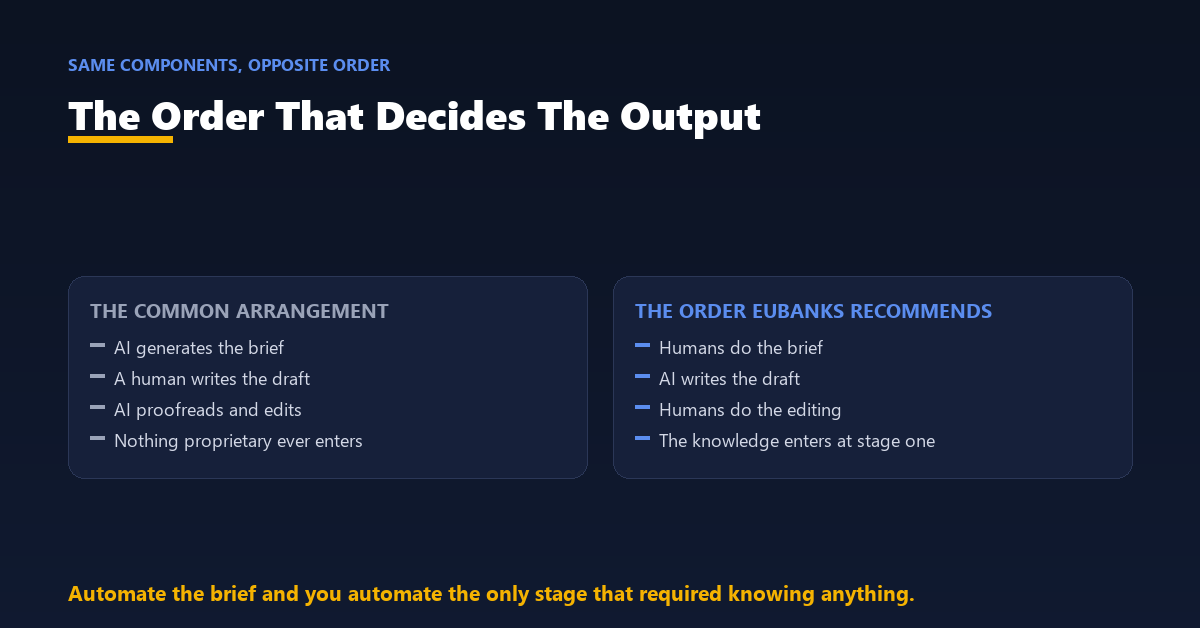
    A Lot Of Agencies Have The Order Backwards

    Two opposing content pipelines showing AI-first drafting versus human-first briefing and their quality outcomes.
    Same components, opposite order, materially different output.

    Eubanks is emphatic that building workflows around AI is not optional — in his words he does not think there is really an option any more. His objection is about placement. He describes agencies and in-house teams designing their processes so that the steps AI is used for are, in his view, not the best ones.

    The specific example is briefs. Creating a good content brief was always painful and reasonably expensive, so the obvious move was to automate it — answer five questions in a form, generate the brief, still charge for it, and take five minutes instead of an hour. Then a human writes the draft and AI proofreads. His verdict on that arrangement:

    I think it’s completely backwards. Where I think things are better… the best results that I’ve seen from a content perspective is where it’s humans actually doing the brief still and then it’s AI writing the draft and then it’s humans doing the editing.— Nick Eubanks

    A note on precision, because this claim travels badly. Eubanks says “a lot of people, a lot of agencies… or maybe even in-house teams” are designing it wrongly — he does not claim a majority, and we are not going to upgrade his estimate for him. What he does claim confidently is which order produces the best results he has seen.

    Governance For Teams Already Using AI

    The reason this matters at board level, rather than as a production preference, is that the automated step determines where the organisation’s knowledge enters the work — or whether it enters at all.

    Automate the brief and you have automated the only stage where anyone was required to decide what the company uniquely knows, who the piece is for, and what claim it exists to make. Every downstream step then operates on a synthesis of what is already publicly available. The output can be perfectly competent and still contain nothing proprietary, which is a strategic outcome disguised as a workflow choice.

    Our own governance framing, not Eubanks’: a content policy should specify the stage rather than the tool. Tools change quarterly; the stage is stable, auditable, and can be written into a scope of work an agency signs.

    What Only A Human Can Put In A Brief

    If the brief is the protected stage, it has to be worth protecting. The things that can only originate with a person, in our experience of reviewing them:

    • The commercial reason the page exists. Which product it supports, which objection it removes, what happens if the reader is persuaded.
    • The reader as the business actually knows them. Not a persona document — the specific thing sales hears on every call.
    • The claim the organisation is willing to defend. A brief without a position produces a draft without one.
    • The proprietary input. The internal number, the named expert to interview, the case with permission to use. This is the entire difference between your page and a competitor’s.
    • The things not to say. Regulatory limits, claims legal has refused, positions the company has moved away from. A model has no way to know any of it.

    That last item is one an advisory sees fail more than any other, and it is the cheapest to fix: a written list of prohibited claims, attached to every brief.

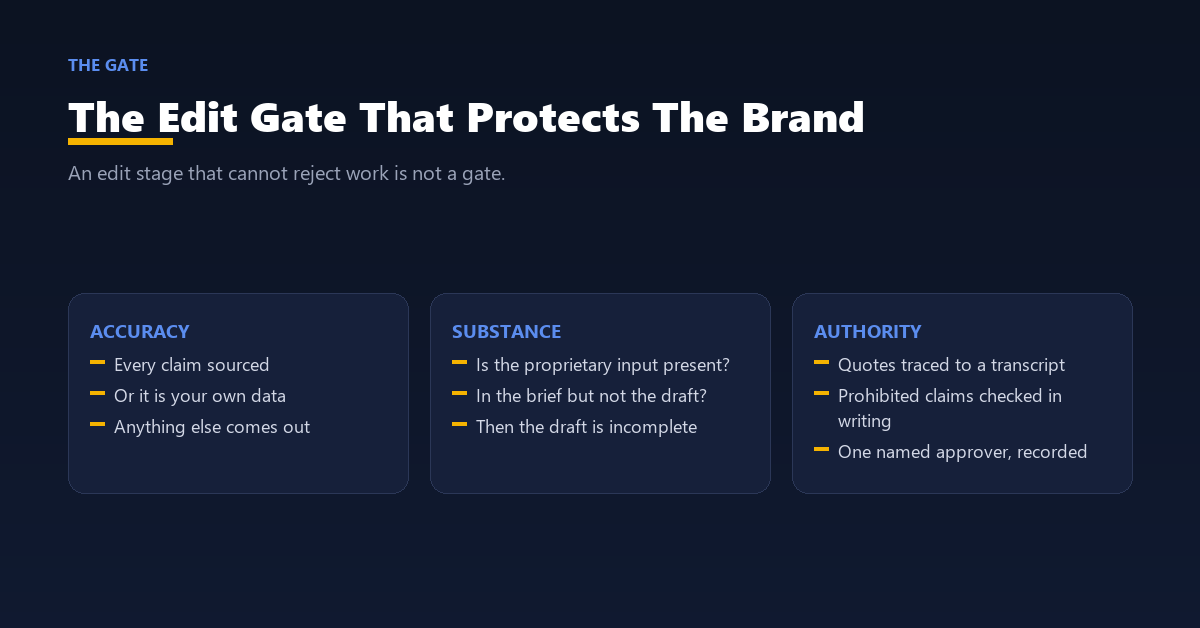
    The Edit Gate That Protects The Brand

    An editorial approval gate checking factual accuracy, first-hand experience and brand voice before publication.
    A named approver, four checks, and the authority to send it back.

    The third stage in Eubanks’ order is humans editing, and in governance terms an edit stage that cannot reject work is not a gate. Our recommended minimum:

    1. Factual accuracy, claim by claim. Every assertion either has a source or is the company’s own data. Anything else comes out.
    2. First-hand experience present. Does the piece contain what the brief said only this organisation could contribute? If it was in the brief and not in the draft, the draft is incomplete.
    3. Quotes verified against a source. Anything in quotation marks traced back to a transcript or recording. A tidied quote is a fabrication.
    4. Prohibited claims absent. Check against the written list, not against memory.
    5. A named approver. One person, recorded. Approval by committee is approval by nobody.

    None of that is a constraint on using these tools. It is what makes using them defensible — which is the difference between a policy a board can sign and a practice that happens to be going well.

    Source: Nick Eubanks, interviewed on the Unscripted SEO Podcast. The quote is verbatim and the view is his; where he qualified his claim, we have kept the qualification. The governance framing, the brief contents and the edit gate are The SEO Advisory’s own. Related: Stewards of the AI, why publishing 100 AI pages will tank your rankings, and SEO in the AI era.

  • Migrations Fail On Business Goals, Not Redirects

    Advisory Note · Governance & Scope

    Migrations Fail On Business Goals, Not Redirects

    An advisory read on Erika Braeger: the question that decides a migration is asked before the date is set, not after the launch.

    Migrations are where advisory work earns its fee, and not for the reason clients expect. By the time an advisor is asked about redirect mapping, the decisions that determine whether the project succeeds have already been made by somebody else, usually months earlier, usually for reasons nobody wrote down.

    Erika Braeger of Tenspeed, speaking on the Unscripted SEO Podcast, starts in a different place from most technical practitioners.

    Never Rush A Website Migration

    Her first piece of advice on the subject is unadorned:

    Don’t rush a website migration, I will say. Never rush a website migration.— Erika Braeger, Tenspeed

    Read from a governance seat, that is a statement about scheduling authority rather than about technical care. Migrations get rushed because a launch date was announced before the scope was understood — tied to a rebrand, a campaign, a board meeting, a contract expiry. Once that date exists, every subsequent decision is made under a constraint nobody chose on the merits.

    The practical implication for an in-house lead: the moment to influence a migration is when the date is being set, not when the redirect map is being built. If you are consulted after the date is fixed, you have been consulted about implementation, not about the project.

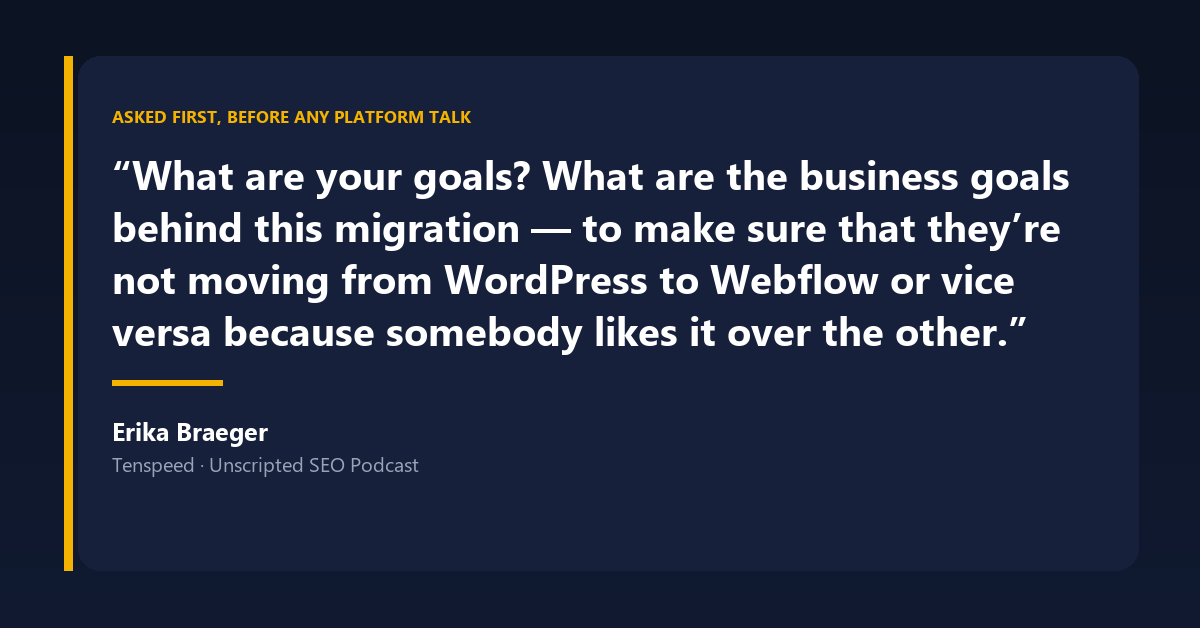
    The Question That Reframes The Whole Project

    Erika Braeger quote card asking what the business goals behind a migration actually are before any technical work begins.
    The first question is not technical. It decides whether the technical work is worth doing.

    What she asks first is not about platforms:

    when I’m working on a website migration with a client, one of the first questions I ask is like, what are your goals? What are the business goals behind this migration to make sure that they’re not moving from WordPress to Webflow or vice versa because somebody likes it over the other.— Erika Braeger, Tenspeed

    The failure mode she is naming is preference dressed as strategy. A new marketing hire is fluent in one platform. A designer prefers a particular editor. A developer wants to work in a stack that is better for their next job. None of those are illegitimate considerations, and none of them is a business case — but each can produce a project costing six figures in fees and organic revenue.

    The question is diagnostic in a way that is useful even when the answer is good. A migration with a real goal — the platform cannot support the commerce roadmap, the licence is being withdrawn, three acquisitions need consolidating — produces a scope you can prioritise against, because you can ask of any decision whether it serves the goal. A migration without one produces scope that expands indefinitely, since nothing can be ruled out.

    Where Advisory Adds More Value Than Execution

    Braeger’s own framing of the discipline is worth pairing with this. Her concern with CMS changes is that they are undertaken casually. Our reading, as an advisory rather than as her recommendation, is that this creates four points where an outside seat is worth more than another pair of implementation hands:

    • Before the date is set. Testing whether a business goal exists, and saying so plainly if it does not. This is the highest-value hour in the entire project and it is almost never bought.
    • At scope definition. Deciding what is explicitly not changing. A migration that simultaneously changes platform, information architecture, URL structure, design and copy cannot be diagnosed afterwards, because every variable moved at once.
    • At the go/no-go. Somebody has to be able to say the date should move, and be structurally capable of saying it. An agency being paid to deliver on that date is not that person.
    • After launch. When the delivery team has rolled off and the effects are still arriving.

    The second point is the one most often skipped and most often fatal. Not because changing several things is technically harder, but because it makes the post-launch conversation unresolvable — nobody can attribute a decline, so everybody defends their own component and no one fixes anything.

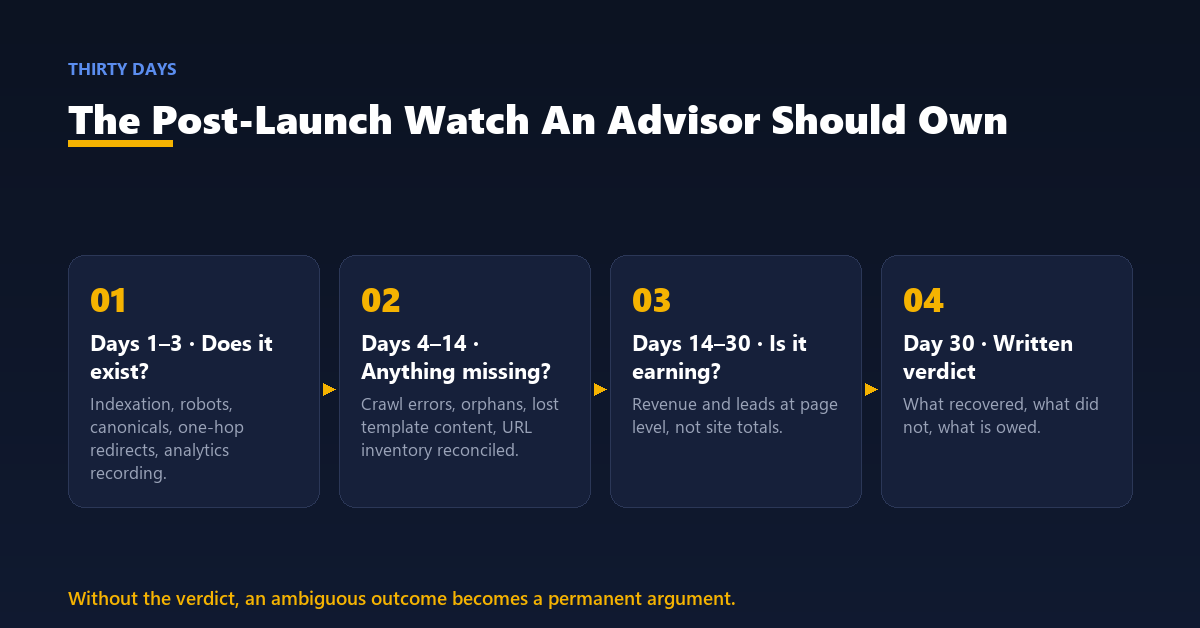
    The Post-Launch Watch An Advisor Should Own

    A thirty-day post-migration monitoring plan covering indexation, revenue and crawl health checkpoints.
    Somebody has to own the month after the delivery team has gone.

    Our own thirty-day watch, offered as advisory practice. The structural argument for an advisor owning it is simply that the people who built the thing are gone, and the people who remain do not know what normal looks like.

    1. Days 1–3: does it exist? Indexation of the pages that matter, robots and canonical directives, redirects resolving in one hop rather than a chain, the analytics and Search Console properties actually recording.
    2. Days 4–14: is anything missing? Crawl errors, orphaned pages, templates that lost content in translation, and the pre-launch inventory of URLs checked against what now exists.
    3. Days 14–30: is it earning? Revenue and lead volume against the same period before, at page level rather than site level, because a site total can stay flat while the commercial pages collapse.
    4. Day 30: the written verdict. A short document saying what recovered, what did not, and what is now owed. Without it, an ambiguous outcome becomes a permanent argument.

    None of this prevents a bad migration. What it prevents is a bad migration that nobody can prove happened, which is the version that costs the most, because it cannot be fixed and it cannot be learned from.

    Source: Erika Braeger (Tenspeed), interviewed on the Unscripted SEO Podcast. Quotes are verbatim and are her views. The scoping, go/no-go and thirty-day watch are The SEO Advisory’s own practice. Related: integrated marketing, fractional SEO, and more notes on the blog.

  • Before The Strategy, Check The Index

    Advisory Note · Diagnostics & Governance

    Before The Strategy, Check The Index

    An advisory read on Matt Mellinger: confirm the pages are indexed before anyone diagnoses anything more sophisticated.

    An advisory engagement is mostly a sequencing problem. The client already has opinions about what is wrong, the incumbent agency has a different set, and the advisor’s job is to impose an order of investigation that stops everyone paying for sophisticated work on top of a broken foundation. Matt Mellinger, co-founder of SEO Gets and of the agency Local SEO Partners, gave a blunt account on the Unscripted SEO Podcast of what that order should start with.

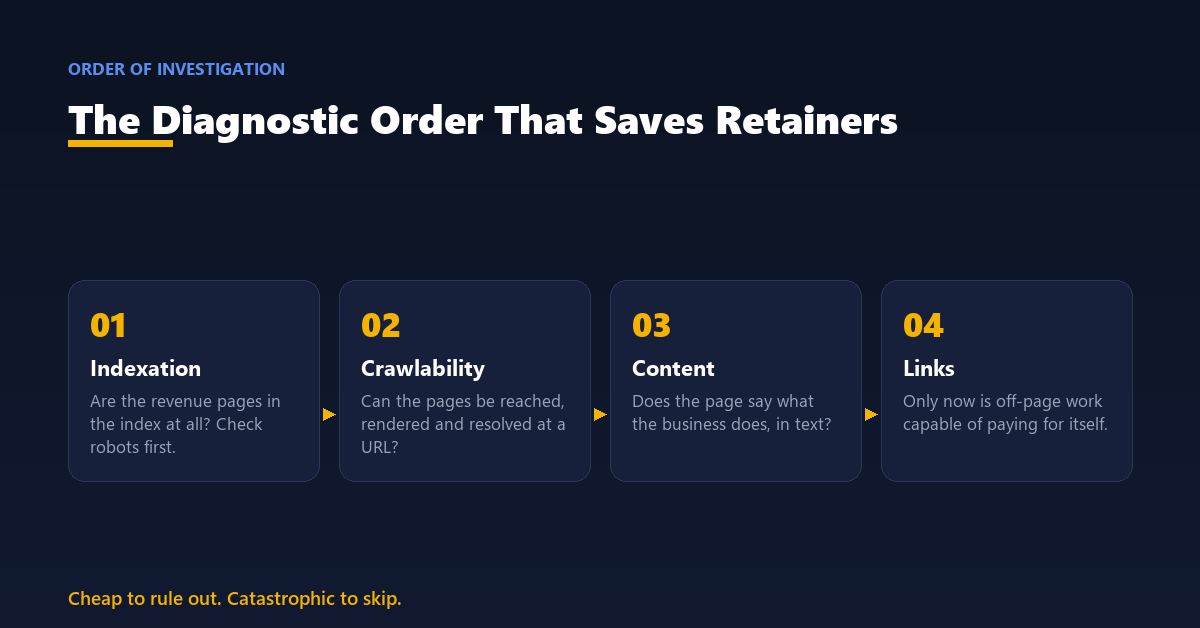
    The Diagnostic Order That Saves Retainers

    A diagnostic sequence beginning with indexation, then crawlability, then content and only finally links.
    Nothing further down the list can be diagnosed while the first item is unresolved.

    Mellinger’s complaint is not about bad strategy. It is about work being sold at a level of sophistication the site cannot yet benefit from. He describes small business owners coming to him after paying retainers of several hundred to several thousand a month, and finding basics missing:

    I’m not kidding when I say that they didn’t have meta descriptions, they didn’t have proper title tags. There was a case that the site wasn’t even being indexed. They had a robots TXT.— Matt Mellinger, SEO Gets / Local SEO Partners

    For an in-house lead or a board reviewing an agency, the governance point is that this is not detectable from a reporting deck. Every one of those engagements produced a monthly report. None of the reports said the site was not indexed, because reports are built from the metrics the agency chose, and an agency that has not checked indexation will not report on it.

    Mellinger On Paying For SEO On An Unindexed Site

    His summary of that situation is the sentence we would put at the top of any first advisory session:

    you’re paying an SEO company and your site isn’t even indexed.— Matt Mellinger, SEO Gets / Local SEO Partners

    Mellinger is candid that this is a heated subject for him — he describes the industry as having a churn-and-burn segment where agencies calculate that clients can be replaced within twelve months whether or not results arrive, and he says his own father was on the receiving end of it. When he asked that provider for six months of Search Console data, he was told they did not have it. His response at the time: “then how are you knowing what’s working?”

    That question is the one an advisor exists to ask on the client’s behalf, early, while it is still cheap to ask. It is worth noting that Mellinger is describing his own experience of a segment of the market, not presenting a survey; the strength of the language is his. The procurement lesson stands regardless of how widespread you believe the behaviour is.

    His advice to owners choosing a provider is refreshingly unsophisticated and we have adopted it into our own reference-checking. Ask for contact details of clients who got results and actually speak to them — in his words, “give me a phone number or an email or contact information of someone that you have helped that has gotten results that I can talk to.” And set an explicit expectation: which keywords, what should have happened in six to twelve months, and what you will do if it has not.

    Page-Level Reading Beats Site Totals

    The second thing worth taking from Mellinger is technical, and it changes how an advisor should read any Search Console report handed to them. He is building a Search Console tool, so he has been examining the data closely for a case study, and he describes a finding about where the complete picture lives.

    His account: when you export query-level data, the proportion of clicks the queries account for varies enormously — he cites a range from roughly five per cent on a very small site up to around seventy per cent — because of anonymised queries. But: “if you look at the page level, it shows you 100 % of the clicks almost every time.” His conclusion is direct — if you want more accuracy you need to go to the page level, “which most people don’t.”

    He also reports an anomaly he triple-checked, where exported page-level impressions exceeded the chart total for a twelve-month period, and is upfront that it did not make sense to him. We are repeating that with the same caveat he gave it: it is one observation from a study that was in progress at the time of recording, not a settled finding.

    The governing principle he draws from it is the useful part for a client conversation. The only numbers he treats as exact are leads and revenue — everything else is directional and should be read for patterns, trends and anomalies rather than absolute values. As he puts it, numbers tell a story, and a number without context means nothing. That is a standard an in-house lead can hold a reporting pack to.

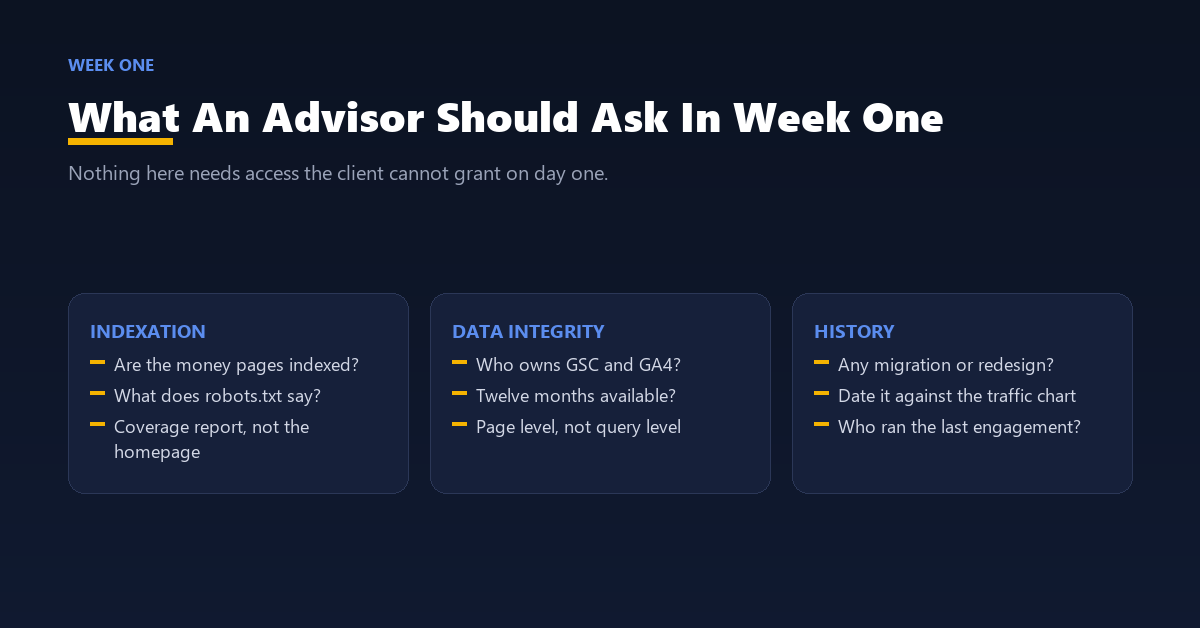
    What An Advisor Should Ask In Week One

    A week-one discovery question list covering indexation, analytics integrity, ownership and past migrations.
    Four questions that decide whether anything else in the engagement can be trusted.

    Our own week-one list, informed by the above rather than dictated by it. None of these require access to anything the client cannot supply on day one.

    • Are the pages that matter actually in the index? Not the homepage. The revenue pages. Check coverage and check the robots file before forming any other hypothesis.
    • Who owns the Search Console and analytics properties? If the answer is the outgoing agency, that is both a data-continuity problem and a negotiating one.
    • Can we see twelve months of data, at page level? If it does not exist, you have learned something more important than anything in it.
    • Has anything structural changed — a migration, a redesign, a CMS move? Date it, then line it up against the traffic chart before anyone theorises about algorithms.

    The purpose of putting indexation first is not that it is usually the answer. It is that it is cheap to rule out and catastrophic to miss, and an engagement that skips it can spend a quarter producing excellent work that no search engine has seen.

    Source: Matt Mellinger (SEO Gets / Local SEO Partners), interviewed on the Unscripted SEO Podcast. Quotes are verbatim from the episode transcript and are his views, not The SEO Advisory’s. Where we have added process, it is labelled as our own. If you want this run as a formal week-one review, that is the advisory; more notes are on the blog, and the AI-governance companion is Stewards of the AI.

  • An Advisor’s Rule For Judging A Link

    Advisory Note · Authority & Footprint

    An Advisor’s Rule For Judging A Link

    Relevance beats DA. Verification beats trust. Two practitioner standards worth building into your approval gate.

    At The SEO Advisory we read practitioner interviews from a governance seat: not “is this a clever tactic,” but “what standard should an in-house lead be able to hold an agency to?” Two recent conversations on the Unscripted SEO Podcast — with Bradley Benner of Semantic Links and Kristiyan Yankov of Above Apex — land on the same operating rule from opposite directions. Neither is selling you a metric. Both are describing a gate.

    The Metric In-House Teams Still Report

    Domain Authority and Domain Rating survive for an unglamorous reason: they are a single number, they are comparable month over month, and they fit on a slide. Nobody has to explain them. That is a reporting virtue, not an accuracy one — these are third-party estimates built by tool vendors, not signals Google publishes.

    Benner, who runs an off-page agency built specifically around this problem, is blunt about where that leaves you:

    It’s not some stupid third party metric like DA or DR or trust flow or anything else that matters about whether a link is valuable or not. What matters is whether it’s relevant.— Bradley Benner, Semantic Links

    He is not talking theoretically. He describes agencies still selling outdated work to local businesses and calls it what he thinks it is — unethical — on the grounds that if you sell a service you are obliged to keep up with what currently works. Whatever you make of the strength of that language, the underlying point is a procurement point: a metric that is easy to report is not the same as a metric that predicts value, and if your programme is judged on the easy one, that is what your agency will optimise for. This is the same argument we make in Footprint Beats Tricks from a different angle.

    Relevance As The Governing Standard

    Benner’s framing is that the SEO’s job has changed shape. As he puts it, the work is now “creating associations, strengthening those associations, and helping, forcing the models and the algorithms to recognize those associations” — between the brand, its products or services, and the places it serves. A link is valuable to the degree it strengthens one of those associations, and irrelevant links strengthen nothing.

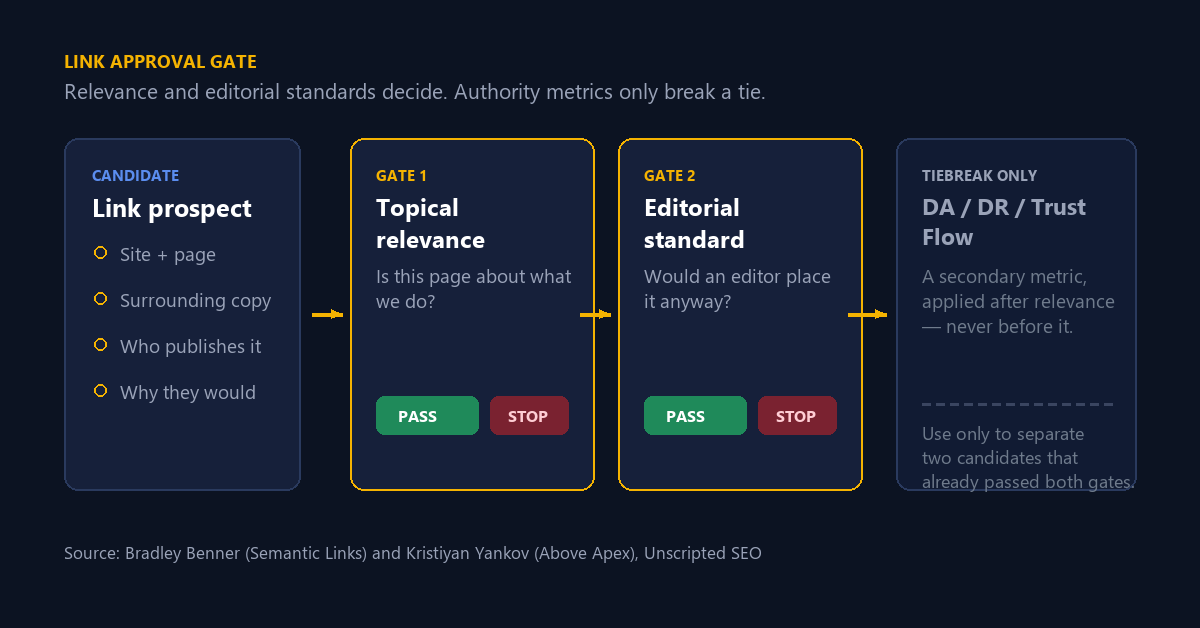
    A link approval gate scoring candidates on topical relevance and editorial standards before any authority metric is considered.
    Relevance and editorial standards decide. Authority metrics only break a tie.

    Usefully for anyone writing a policy, he describes relevance as layered rather than binary — “three layers or levels of relevance matching that can be achieved when you’re doing link building”:

    • The passage. Is the link placed inside content that is genuinely about the subject, near entities related to the business and the area it serves?
    • The publication. Are the overall topical themes of the host site relevant to what is being linked to?
    • The publication’s own profile. What is the relevance of the backlinks already pointing at that referring domain?

    One nuance gets lost when this gets compressed into “DR is dead,” and it matters for policy drafting. Benner does not ban authority metrics; he demotes them. His own words: if you want to use DA, DR or Trust Flow “as kind of a secondary metric after determining that a potential link source is relevant to what it’s going to be linking to, then fine.” His rule is sequence. “But you should look at relevance first.”

    That is a far more implementable standard than an outright ban, because it survives contact with a real shortlist. Two candidates both clear the relevance bar; you have budget for one; the tiebreak is allowed to be a number. What is not allowed is the number doing the deciding before relevance has been tested. If you are building the wider case for why this is where authority actually comes from, that is the argument collected in Authority & Footprint.

    Verify, Do Not Trust: A Screening Gate

    Yankov supplies the second half. Asked at the top of his interview why anyone should trust him, he declined the premise:

    You shouldn’t trust anyone. You should verify. You should verify, especially in our industry.— Kristiyan Yankov, Above Apex

    In practice that means looking at five to ten metrics as a starter rather than domain rating alone, and then applying human judgment to the thing itself — is this a genuine website that serves a purpose rather than a PBN, does it carry relevant content, is the link seamlessly integrated into the actual copy of the article. His test for whether that judgment is trustworthy is the most quotable line either guest offered:

    If I look at a link-building opportunity and it makes sense to me, it would be the same for Google, because Google is definitely not more stupid than me. It’s quite the opposite — it’s actually smarter.— Kristiyan Yankov, Above Apex

    There is a risk calibration buried in his answer that in-house leads should hear, because it changes the tone of the conversation with finance. Yankov’s reading of the leaked Google documentation, and of the analysts who worked through it, is that low-quality links are set aside rather than punished — Google “disregards them entirely” and does not count them. On that reading, the usual consequence of a badly-vetted link programme is not a catastrophe. It is a wasted budget: months of invoices buying links that were quietly ignored.

    We would treat that as his considered opinion rather than settled fact, and we would not use it to justify carelessness. But it does reframe the ask. You are not asking your board to fund a safety measure against a penalty. You are asking them to stop paying for links that do not count.

    Writing The Policy Your Agency Must Follow

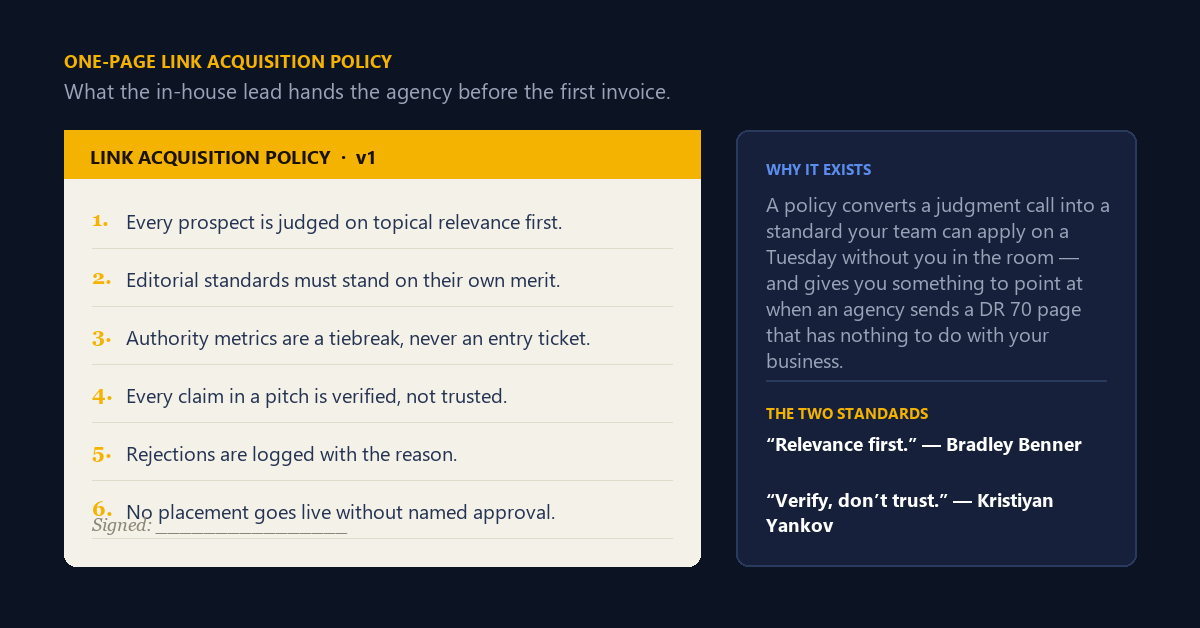
    Two practitioners, two sentences, one gate. Relevance first, then verify. The advisory job is turning that into something a marketing coordinator can apply on a Tuesday without you in the room.

    A one-page link acquisition policy document an in-house lead can hand to an external agency.
    A one-page standard is easier to enforce than a strong opinion.

    A workable one-pager reads roughly like this. Every prospect is assessed on topical relevance before any authority metric is opened. The placement must stand on editorial merit — a reader arriving on that page should find the link useful for reasons that have nothing to do with search. Authority metrics are permitted only as a tiebreak between candidates that have already passed. Every claim in an agency’s pitch — traffic, editorial standards, who actually publishes there — is verified rather than accepted. Rejections are logged with the reason, so the standard compounds into institutional knowledge instead of living in one person’s head. And no placement goes live without a named approver.

    The last two lines are the ones teams skip and then regret. A rejection log is what stops your third agency re-pitching the site your first agency was turned down from. A named approver is what makes the standard real rather than aspirational.

    None of this requires you to abandon the number your board likes. It requires you to move it to the end of the process, where it can no longer do any damage.

    Sources: Bradley Benner (Semantic Mastery / Semantic Links) and Kristiyan Yankov (Above Apex), interviewed on the Unscripted SEO Podcast. Quotes are verbatim. If you want this turned into a live approval gate for your team, that is exactly the work described in the SEO advisory.

  • Fractional Is a Relationship Word, Not a Search Word

    Advisory Note · Fractional SEO

    Fractional Is a Relationship Word, Not a Search Word

    Six operators who sell fractional roles — a CCO, a CFO, a director of operations, two consultants — plus one CMO who flatly refuses to. Here is what they reveal about when the model works, and when it is the wrong answer.

    “Fractional” went from nowhere to everywhere in about five years. As one host put it on the Unscripted podcast: nobody was fractional unless they were in their math class. Now there are fractional CMOs, CFOs, CTOs, COOs — and fractional SEO, which is what we do here.

    That speed should make a buyer suspicious. So rather than argue our own case, we went back through a run of interviews with people who actually sell the model — and one senior marketer who refuses to — and read them from the advisory seat. The most useful finding is a warning, and it comes from an SEO problem.

    The category has a demand problem

    George Little runs Brand Zap, positioned deliberately between a freelancer and a full agency. He uses the word “fractional” — but only in conversation, never as the offer. He learned that the expensive way.

    I had another version of this company that did not succeed a couple of years ago that was basically trying to push fractional creative director. No market for it, no search around it. Speaking of SEO, that’s really a good place to start. Is anyone even Googling this? And they weren’t.— George Little, Brand Zap

    This is the whole lesson in one anecdote, and it is a search lesson before it is a positioning lesson. He had named his company after the shape of the contract rather than the problem being solved. Buyers were searching for agencies, for freelancers, and for the consultant in between — not for a staffing arrangement.

    George now reserves the term for describing how the relationship feels once it has started: “I use the term only when like discussing the relationship, that sort of feel of the relationship for folks.” That is the correct use. Fractional is a good word for explaining an engagement and a bad word for winning one.

    What it actually means, stated plainly

    Joshua Altman runs Beltway Media as a fractional Chief Communications Officer, and gives the cleanest definition in the set:

    Fractional means we’re contractual, we’re part time workers, we’re fully integrated into the client’s company and team. So instead of having a forty hour a week chief communications officer, you have someone twenty five percent of that, one quarter, fractional.Joshua Altman, Beltway Media

    Note the load-bearing phrase: fully integrated into the client’s company and team. That is what separates fractional from an agency retainer. An agency sits outside and reports in. A fractional executive sits inside and owns the function. If a proposal does not describe integration, it is a retainer wearing a better word.

    The real trigger: somebody got stuck owning a function

    The most useful thing Joshua said was not a definition — it was a description of who calls him:

    One of the people we take over from the most are owners and founders or an early hire because they kind of just got stuck owning a function because they built the website, so now this is all on them. You have a lot of CTOs who built the website whenever it was built and now suddenly they’re in charge of all things digital. And they don’t want to. That’s not their job.— Joshua Altman

    Any SEO advisor will recognise this immediately, because it is the single most common way SEO ends up owned inside a company. Nobody decides to own SEO. Somebody built the site, or ran one campaign that worked, or was in the room when the agency was fired — and it stuck to them. They are now responsible for a discipline they did not choose, cannot benchmark, and have no time to keep current in.

    That is the honest trigger for fractional SEO. Not “we need more traffic.” It is “this function has an accidental owner.”

    Why the outside seat gets listened to — and why that is a problem

    Ash Nallawalla is a fractional enterprise SEO consultant and author of Accidental SEO Manager — the closest analogue in this group to what we do. He tells a story about one of Australia’s top four banks: hired as an outside consultant, given a four-hour audit presentation with a manager he “couldn’t normally get for a one-hour meeting,” promised a conservative 10% traffic lift in twelve months, and delivered it in eight days after implementation. Traffic doubled in eight months. Three years later it had tripled.

    Then he says the part that should make every buyer of fractional services pause:

    I’ve never had it since, because once you’re inside a company you’re no longer treated as the expert. So my lesson is: don’t reserve that trust for outside consultants. Give your internal expert the same weight.Ash Nallawalla, author of Accidental SEO Manager

    Read that carefully, because it cuts against our own commercial interest. Ash is saying his outside results came partly from a trust premium granted to outsiders — 100% acceptance of recommendations, no prioritisation fights — not purely from superior skill. The mechanism that makes fractional work is partly organisational psychology.

    The advisory reading: if you hire fractional expertise and then treat it like internal staff to be overruled, you have bought the cost without the mechanism. And if you already have a capable internal person you routinely overrule, your first move is not to hire us. It is to stop doing that.

    The seniority argument

    Ash’s standing complaint is about where the function sits:

    My soapbox is that the SEO, or the SEO manager, needs to sit higher in the hierarchy. I’d call the role something like a chief webmaster, or, if you don’t like that term, a chief web success officer — because web success spells company success.— Ash Nallawalla

    His example is mundane and devastating: a security team bought a firewall to stop scrapers, whitelisted Google, and unknowingly throttled their own SEO’s crawling from five million URLs a day to five million over two or three weeks. Nobody was wrong. The SEO was simply too far down the org chart to be in the conversation.

    He also offers a real number on the trend. When he wrote the first edition of his book, roughly one person on LinkedIn held a chief-webmaster-style title. By the second edition this year, around 300 did.

    This is the structural case for the fractional model in SEO specifically. Most companies cannot justify a full-time senior SEO leader, but the decisions that wreck organic performance — domain strategy, subdomain-versus-folder, replatforming, a firewall purchase — are all made at a level the junior owner never attends. Fractional buys seniority at the tier where the damage happens.

    The operator in the middle

    Lloyd Thompson runs Virtual DOO, a fractional director of operations practice, and describes the role in one line:

    The operator is that person who sits between the founder and the team.Lloyd Thompson, Virtual DOO

    The same geometry applies to SEO. The valuable fractional SEO is not the one producing more deliverables; it is the one standing between the owner’s intent and whoever executes — the agency, the developers, the content team — translating in both directions. Lloyd’s other observation transfers cleanly too: teams keep believing the next tool will solve the problem, when the fix is to simplify. That is as true of an SEO stack as an ops stack.

    Meaghan Wall runs the same pattern in finance as a fractional CFO, and Grant Simmons arrived at the model the way many senior practitioners do — agency, then brand, then consultant. The shape recurs across every function. That is a signal, not a fashion.

    The honest counterargument

    Matt Tyner is CMO at Bone Dry Roofing, one of the largest residential family-owned roofing contractors in the US, with fifteen-plus years in home services. Asked directly whether he was a fractional CMO, he was blunt:

    My experience has been completely internal. So I have not been a freelancer. I have not been a fractional CMO. When I’ve worked somewhere, it’s been you get 100% of my time.Matt Tyner, CMO, Bone Dry Roofing

    He is right for his situation, and it is worth being precise about why. His core argument elsewhere in that conversation is that marketing makes the promise and operations keeps it — which requires walking hand in hand with operations daily. Where marketing success depends on continuous, deep coupling with how the work actually gets delivered, a quarter of someone’s attention genuinely will not do it.

    Matt also identifies the failure mode that gives every outsourced model a bad name: layers. A marketing person hires the agency, the agency has an ops team, the ops team briefs the SEO — and by then the specialist has no route to propose anything meaningful. Fractional is defensible only insofar as it removes those layers. If it adds one, it is worse than an agency.

    The advisory read

    Taken together, these conversations produce a fairly strict test. Fractional is the right structure when the function has an accidental owner, when the damaging decisions happen above that owner’s level, and when the work is advisory and directional rather than continuous and operational. It is the wrong structure when the function must be coupled to daily delivery, when you would not extend the same trust you would give an outside consultant, or when it inserts one more layer between intent and execution.

    And whatever you call it, do not build the offer around the word. Ask what George asked: is anyone even Googling this?

    If the description of an accidental owner sounded like your company, that is the conversation we have on fractional SEO management — and if you are not sure the model fits at all, SEO advisory is the cheaper place to start.

    Sources: interviews from the Unscripted podcast network — Joshua Altman (fractional CCO), Ash Nallawalla (fractional enterprise SEO), Lloyd Thompson (fractional DOO), Meaghan Wall (fractional CFO), Grant Simmons, and Matt Tyner (internal CMO). George Little of Brand Zap is quoted from an Unscripted SEO conversation not yet published. Quotes are verbatim; transcription spacing has been normalised.

  • The Honest Case for Paid: An Advisor’s Read on Matt Slaymaker’s Ads Playbook

    The Honest Case for Paid: An Advisor’s Read on Matt Slaymaker’s Ads Playbook

    Episode Recap · Authority & Footprint

    The Honest Case for Paid: An Advisor’s Read on Matt Slaymaker’s Ads Playbook

    A paid-media operator argues for restraint — and every point maps to the judgment work of strategic SEO.

    At The SEO Advisory we read the Unscripted SEO Podcast from a strategic seat: not “which channel,” but “what should this business actually do first?” Matthew Slaymaker of Slaymaker Marketing is a paid-media operator — and the most valuable thing he said is an argument for restraint. Here’s the advisory read on his ads playbook.

    Readiness is a strategy question, not a channel question

    The instinct when growth stalls is to add a channel: turn on ads. Matt’s counter — consider turning them off — is exactly the judgment call an advisor is paid to make. If organic visitors who already trust you convert below 2–3%, paid traffic (which converts 30–50% worse) only spends faster. The lever isn’t the ad account; it’s the offer, the positioning, and the path. Fix those and every channel improves at once.

    If you’re not getting an organic conversion rate of two to three percent already, your ads probably are never gonna work.— Matthew Slaymaker

    “You might not be ready for ads yet.” — Matthew Slaymaker
    “You might not be ready for ads yet.” — Matthew Slaymaker

    Creative and targeting are the real levers

    Advisors think in levers and their weights. Matt gives us clean numbers: on Meta, creative is roughly 70% of performance, so broad targeting plus radically different angles beats fussy audience layering. On Google, targeting is still about half the game — intent decides who even sees the copy. Knowing which lever carries the weight on which platform is the difference between spending and investing.

    “Creative is 60, 70% of it on Meta.” — Matthew Slaymaker
    “Creative is 60, 70% of it on Meta.” — Matthew Slaymaker

    Footprint and shown values beat claims

    The through-line that matches our own thesis — footprint beats tricks — is that authority has to be shown, not stated. Everyone claims to be sustainable, made-in-USA, cruelty-free, so the words stop meaning anything. Patagonia earned belief with real receipts; Yellow Leaf Hammocks put the weaver’s name on every hammock. In an AI-flattened SERP, demonstrated authority and genuine mentions are what a brand can defend.

    Point AI at judgment, not volume

    Finally, the agentic-age lesson we keep returning to: use AI for leverage, keep a human on judgment. Matt’s best AI use isn’t an autonomous ad bot — it’s a Claude workflow scoring team proactivity and account attention so a growing agency stays close to clients. That’s stewardship, not automation for its own sake.

    Full conversation: Matthew Slaymaker on Ads, Creative Strategy & Honest Marketing on the Unscripted SEO Podcast. Connect with Matt on LinkedIn.
    From The Episode

    This recap is drawn from Matthew Slaymaker’s conversation with Jeremy Rivera on the Unscripted SEO Podcast. Matt published his own companion take on the same exchange — read it on the Slaymaker Marketing blog.

    Authentic Brand Values: Can Marketing Ever Be Genuinely From the Heart?

    Jeremy Rivera

    There’s a push and pull of there being taglines and values that came up after my interview with the Permacast wall company. And I’ll be asking PureAire, the oxygen monitoring company I’m meeting with tomorrow: what are the values you want to bring to the market? … There’s also this kind of make-believe world of marketing where you’re saying what your company’s values are — but you’re also tap-dancing, which isn’t genuine. Can you have genuine, from-the-heart marketing? That’s kind of my question.

    Matthew Slaymaker

    You can, absolutely — but you have to show it. You can’t just say it. … Everybody’s saying ‘we’re sustainable, we’re made in USA, we’re cruelty free’ — it doesn’t make you stand out anymore. One brand that did a good job of this: Yellow Leaf Hammocks. Every hammock that’s woven has the name of the person who wove it written on it. That’s the kind of stuff that actually brings your values to life. If you just say ‘we’re charitable,’ people don’t really trust or believe you nowadays. But if you can actually show it and bring it to life for them, that’s a very different thing.

    UNSCRIPTED SEO
    You Might Not Be Ready for Ads
    Ten truths from Matt Slaymaker

    Free download

    The honest-ads field guide

    The companion eBook to the episode — ten lessons on creative, targeting, and marketing that means it. No form, no gate.

  • Rob Bonham on SEO in the Agentic Age (Episode Recap)

    Rob Bonham on SEO in the Agentic Age (Episode Recap)

    Episode Recap · SEO in the AI Era

    Rob Bonham on SEO in the Agentic Age

    My conversation on the Unscripted SEO Podcast, recapped: why SEOs are now stewards of the AI, the 100-page mistake I keep seeing, and what actually wins the SERPs.

    I recently joined Jeremy Rivera on the Unscripted SEO Podcast to talk about what two decades in SEO — local, e-commerce, SaaS, and home services — have taught me about working in the agentic age. AI now handles the low-level busywork in minutes. The catch: that moves the value of a good SEO up the stack, to judgment and knowing what not to do. Here are the ideas that mattered most.

    We are stewards of the AI

    My central framing on the show: as SEOs, we’re now stewards of the AI. The tools are genuinely powerful, but they mostly recombine what already exists on the web. Point them at scale without oversight and you’ll confidently ship pages that pull in bots, five-second bounces, and thin answers — and Google will notice the missing user signals. Per Google’s own guidance on AI content, automation used mainly to game rankings breaks its spam policies, while original, experience-led content gets rewarded.

    “As SEOs, we are stewards of the AI.” — Rob Bonham
    “As SEOs, we are stewards of the AI.” — Rob Bonham

    The 100-page concrete-wall trap

    Jeremy brought the perfect real-world example: precast concrete walls florida — a company that used AI to spin up roughly a hundred near-duplicate pages — one for every city they service — each pulling random stock photos of concrete walls. The instinct was right: try to do a little more, cover more ground. But volume without information gain — no real user data, no first-hand expertise, nothing a machine couldn’t already generate — is just more of a not-great idea.

    It’s what happens when a business goes into a “fugue state” with Claude or ChatGPT and sends over 40-page documents, convinced they’ve replaced expertise with volume. From an actual expert’s seat, the notion is fine; the execution isn’t. You can’t ship it raw — but with a human setting strategy and reviewing every output, the power is absolutely there.

    Footprint wins the SERPs

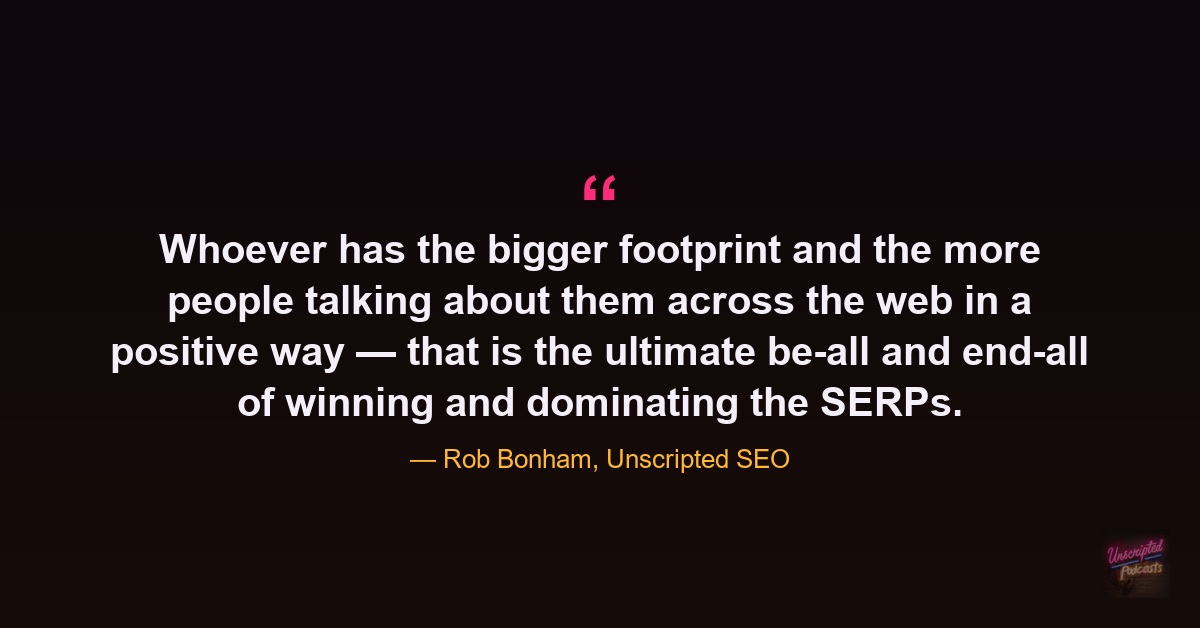
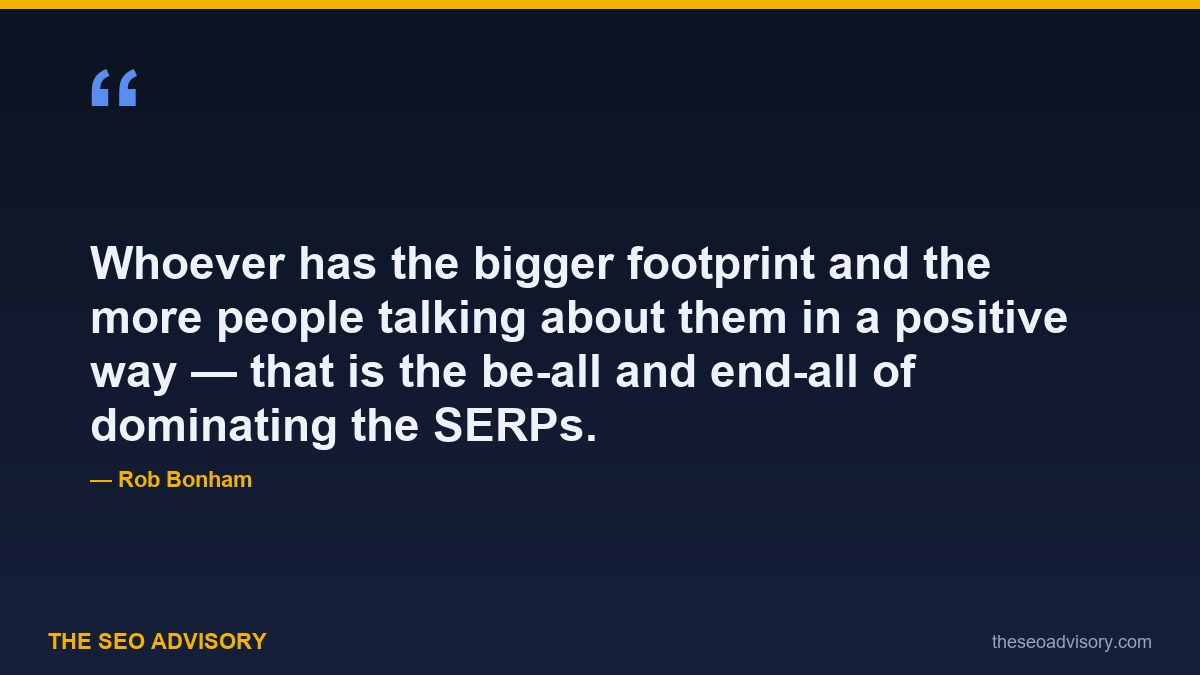
    If there’s one be-all-end-all, it’s this: whoever has the bigger footprint — more people talking about them across the web in a positive way — wins. That’s brand, mentions, and genuine authority, not link tricks. If you want the systematic version, SEO Arcade’s link building & authority resource guide is a solid starting point.

    “Whoever has the bigger footprint… wins the SERPs.” — Rob Bonham
    “Whoever has the bigger footprint… wins the SERPs.” — Rob Bonham

    Don’t sell yourself short

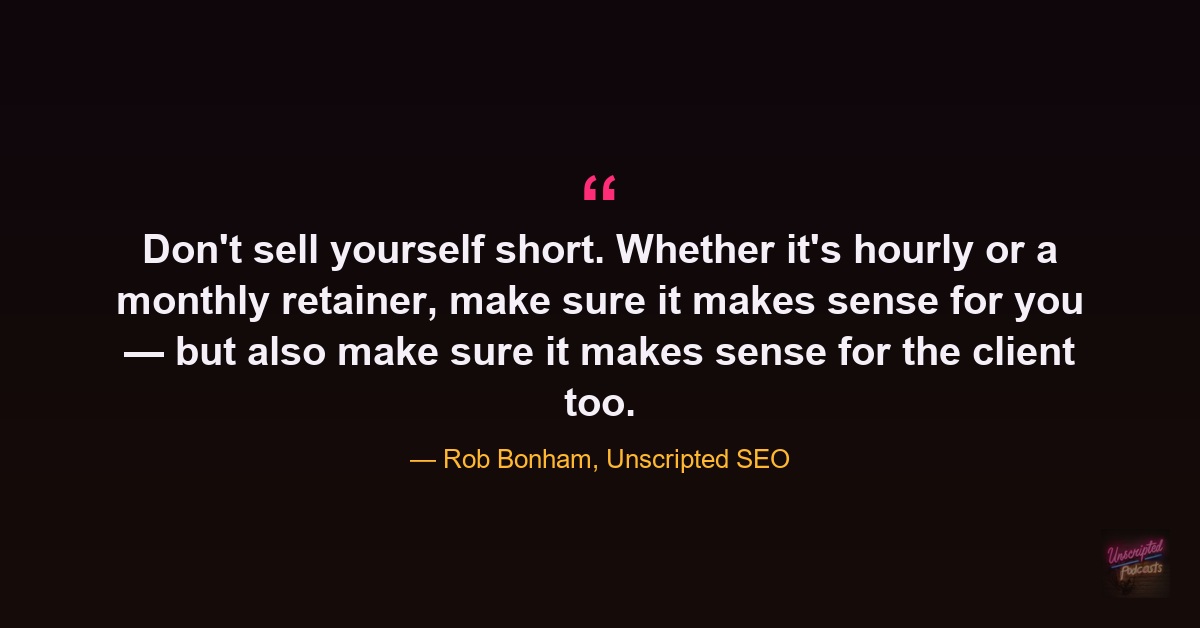
    We also got into the business of consulting. My advice to SEOs: don’t sell yourself short. Hourly or monthly retainer, price it so it makes sense for you and the client — a rate that lets you do the deep, judgment-heavy work is the rate that actually protects their results.

    “Don't sell yourself short.” — Rob Bonham
    “Don’t sell yourself short.” — Rob Bonham

    That’s the through-line of the whole conversation: use AI for leverage, keep a human in the loop for judgment. If you’d like that discipline built into your team, that’s what fractional SEO management is for — or start with a focused advisory engagement.

    Full conversation: Rob Bonham on SEO in the Agentic Age on the Unscripted SEO Podcast. Connect with Rob on LinkedIn, or explore more in our hub on SEO in the AI Era.
    THE SEO ADVISORY
    Get to Know Rob Bonham
    Fractional SEO Manager & SEO Advisor

    Free download

    Get to know me — in 5 minutes

    How Rob thinks about SEO in the AI era and how he works. No form, no gate.

  • Integrated Marketing: Why SEO Can’t Win Alone

    Integrated Marketing: Why SEO Can’t Win Alone

    Authority & Footprint

    Integrated Marketing: Why SEO Can’t Win Alone

    SEO in a silo underperforms. Here’s how integrated, multi-channel marketing makes every channel hold the others up.

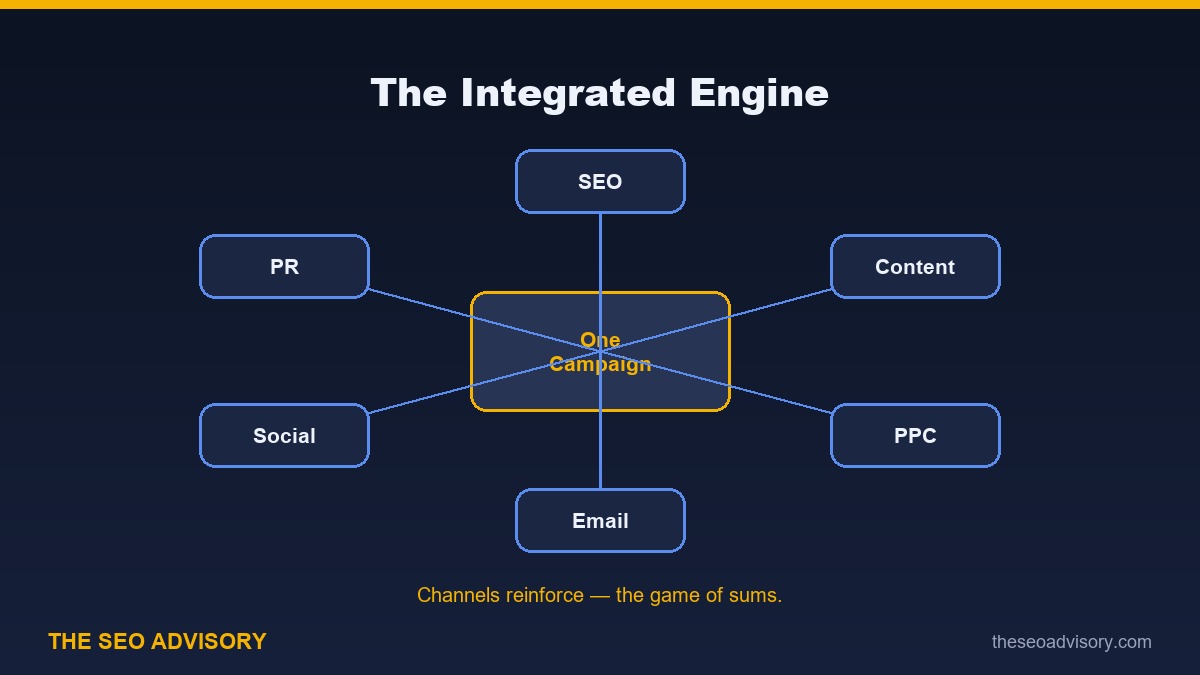
    The integrated engine: channels reinforce one campaign.
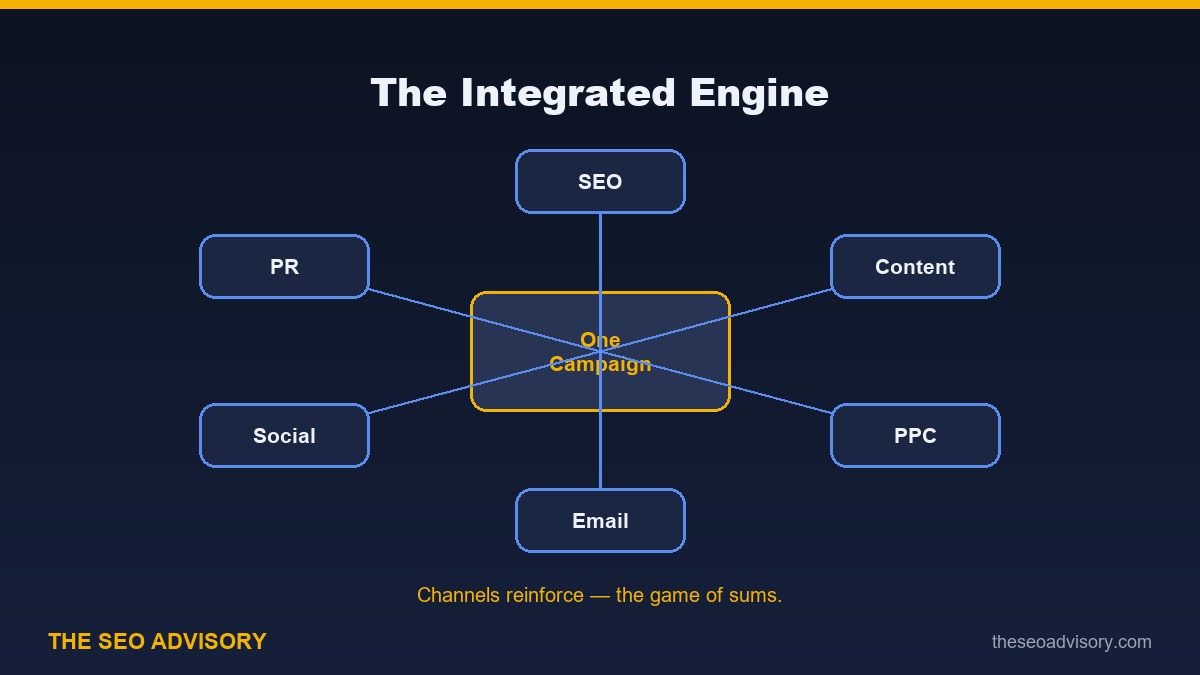
    The integrated engine: channels reinforce one campaign.

    SEO run as an island almost always underperforms. The teams that win treat it as one instrument in an integrated campaign — what Rob calls the game of sums.

    Multi-channel is the multiplier

    The numbers back it up: per Omnisend’s research, campaigns using three or more channels saw a 90% higher customer retention rate than single-channel campaigns. Channels don’t compete for budget — they compound.

    Rob Bonham on working channels together
    Rob Bonham on working channels together

    Distribution is the moat

    {}Nick Eubanks framed the why: when execution becomes infinite (and AI is making it so), distribution is the only remaining moat. Anyone can make the asset; not everyone can get it in front of the right audience across search, social, email, and PR. SEO Arcade’s content strategy resource guide helps you plan that distribution.

    Nick Eubanks on distribution as the moat
    Nick Eubanks on distribution as the moat

    The car-dealership play

    Rob’s go-to example from years running dealer campaigns: build a sales-event landing page (Black Friday, Memorial Day), then hit it from every angle — email to interested buyers, paid search and paid social, and organic social reinforcing the same message. One campaign, every channel, holding each other up.

    Make every channel hold the others up
    Make every channel hold the others up

    Orchestrating that is core to fractional SEO management — and the throughline of the Authority & Footprint hub.

    Originally explored with Nick Eubanks on the Unscripted SEO Podcast. More in our hub on Authority & Footprint.
    THE SEO ADVISORY
    Get to Know Rob Bonham
    Fractional SEO Manager & SEO Advisor

    Free download

    Get to know me — in 5 minutes

    How Rob thinks about SEO in the AI era and how he works. No form, no gate.

  • Footprint Beats Tricks: Link Building Reborn for the AI Era

    Footprint Beats Tricks: Link Building Reborn for the AI Era

    Authority & Footprint

    Footprint Beats Tricks: Link Building Reborn for the AI Era

    Forget DA and DR. Real link value comes from relevance, authority, and association — and a bigger footprint is what wins.

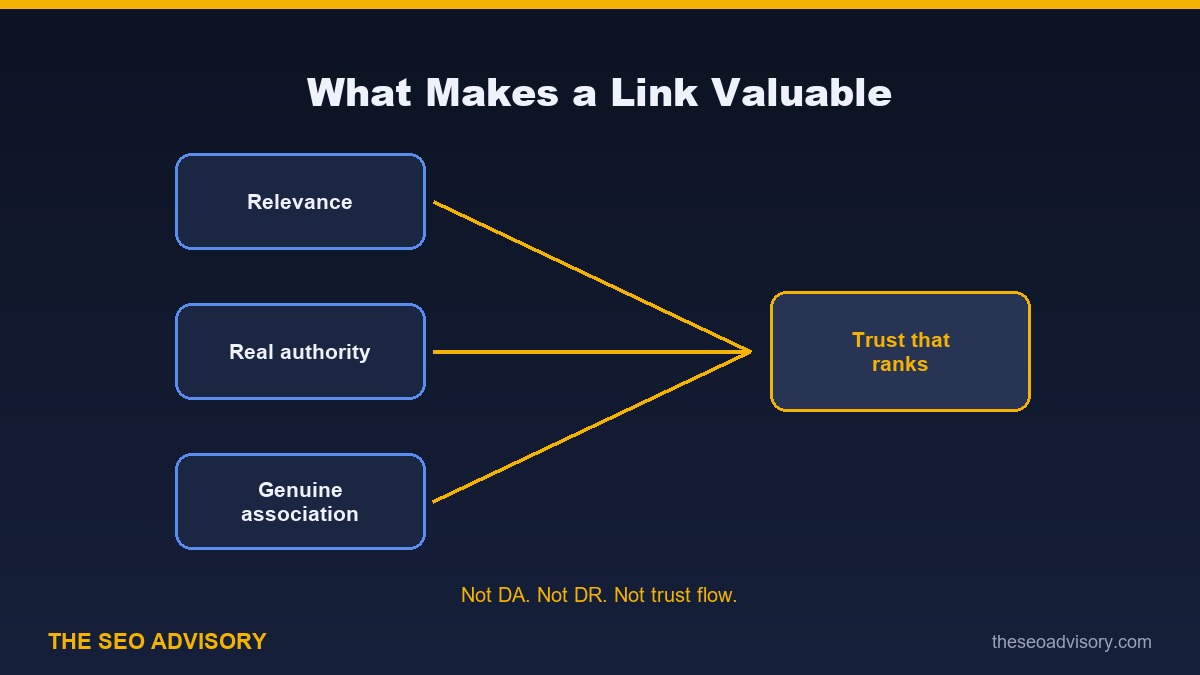
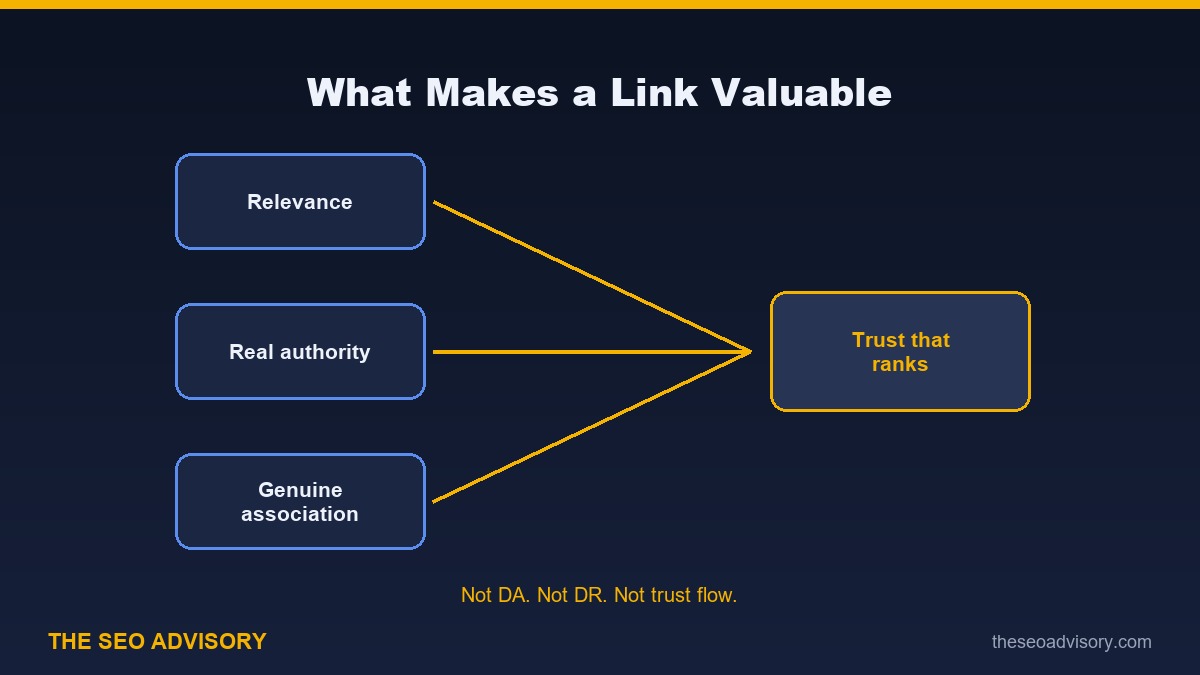
    What makes a link valuable: relevance, authority, association.
    What makes a link valuable: relevance, authority, association.

    Link building isn’t dead — it’s been reframed. The brands that win aren’t gaming a metric; they have a bigger footprint and more people talking about them across the web.

    Links still matter (the real ones)

    The data is clear that links remain a core trust signal: Backlinko’s analysis of 11.8 million results found the #1 result has, on average, 3.8× more backlinks than positions 2–10 — with the diversity of referring domains mattering most. It’s not volume; it’s breadth and quality.

    Rob Bonham on footprint
    Rob Bonham on footprint

    Stop pushing metrics

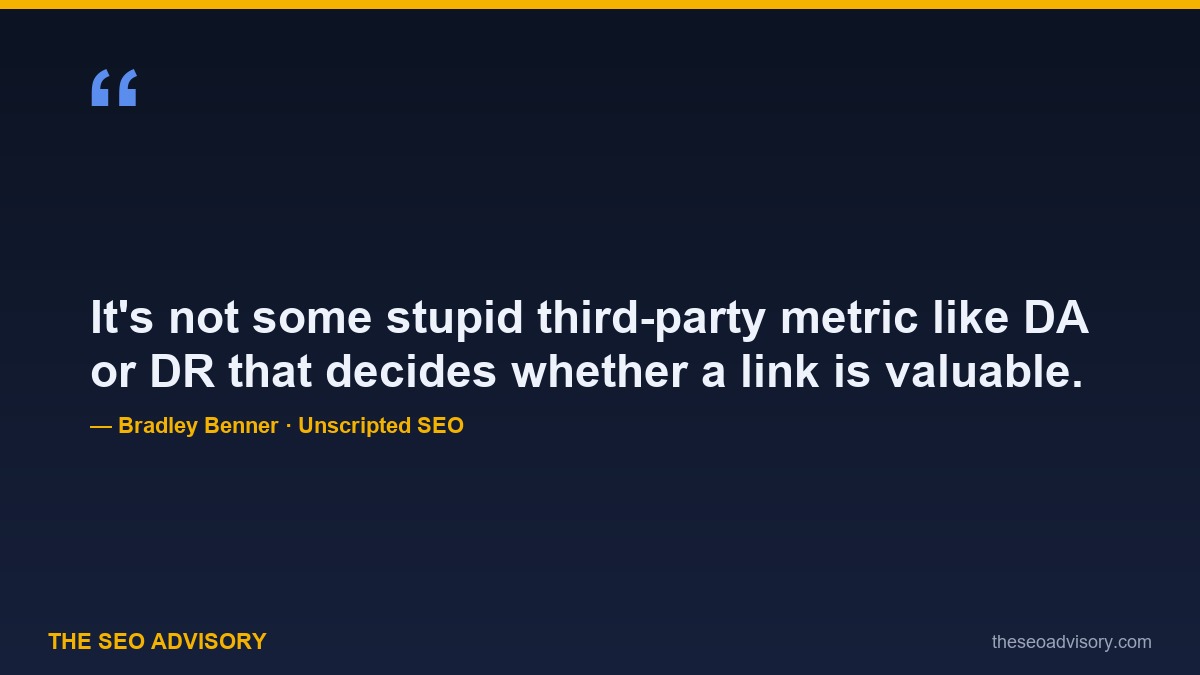
    {}Bradley Benner said it bluntly on the podcast: it’s not some third-party metric like DA or DR that decides whether a link is valuable — it’s relevance and genuine association. Our job is to build and strengthen those associations, not chase a number. SEO Arcade’s link building & authority guide is the deep dive.

    Bradley Benner on link metrics
    Bradley Benner on link metrics

    The easiest links you’re not asking for

    Rob’s favorite example is “shooting fish in a barrel”: at an e-commerce parts provider, the brands they carried all had “where to buy” pages — so they simply earned links from their own suppliers and partners. No outreach grind, no payment, just relationships that already existed. Most businesses leave that footprint on the table.

    Footprint beats tricks
    Footprint beats tricks

    Building an authority program is a core part of fractional SEO management. See the bigger picture in the Authority & Footprint hub.

    Originally explored with Bradley Benner on the Unscripted SEO Podcast. More in our hub on Authority & Footprint.
    THE SEO ADVISORY
    Get to Know Rob Bonham
    Fractional SEO Manager & SEO Advisor

    Free download

    Get to know me — in 5 minutes

    How Rob thinks about SEO in the AI era and how he works. No form, no gate.