Author: jeremy@seoarcade.com

  • An Advisor’s Rule For Judging A Link

    Advisory Note · Authority & Footprint

    An Advisor’s Rule For Judging A Link

    Relevance beats DA. Verification beats trust. Two practitioner standards worth building into your approval gate.

    At The SEO Advisory we read practitioner interviews from a governance seat: not “is this a clever tactic,” but “what standard should an in-house lead be able to hold an agency to?” Two recent conversations on the Unscripted SEO Podcast — with Bradley Benner of Semantic Links and Kristiyan Yankov of Above Apex — land on the same operating rule from opposite directions. Neither is selling you a metric. Both are describing a gate.

    The Metric In-House Teams Still Report

    Domain Authority and Domain Rating survive for an unglamorous reason: they are a single number, they are comparable month over month, and they fit on a slide. Nobody has to explain them. That is a reporting virtue, not an accuracy one — these are third-party estimates built by tool vendors, not signals Google publishes.

    Benner, who runs an off-page agency built specifically around this problem, is blunt about where that leaves you:

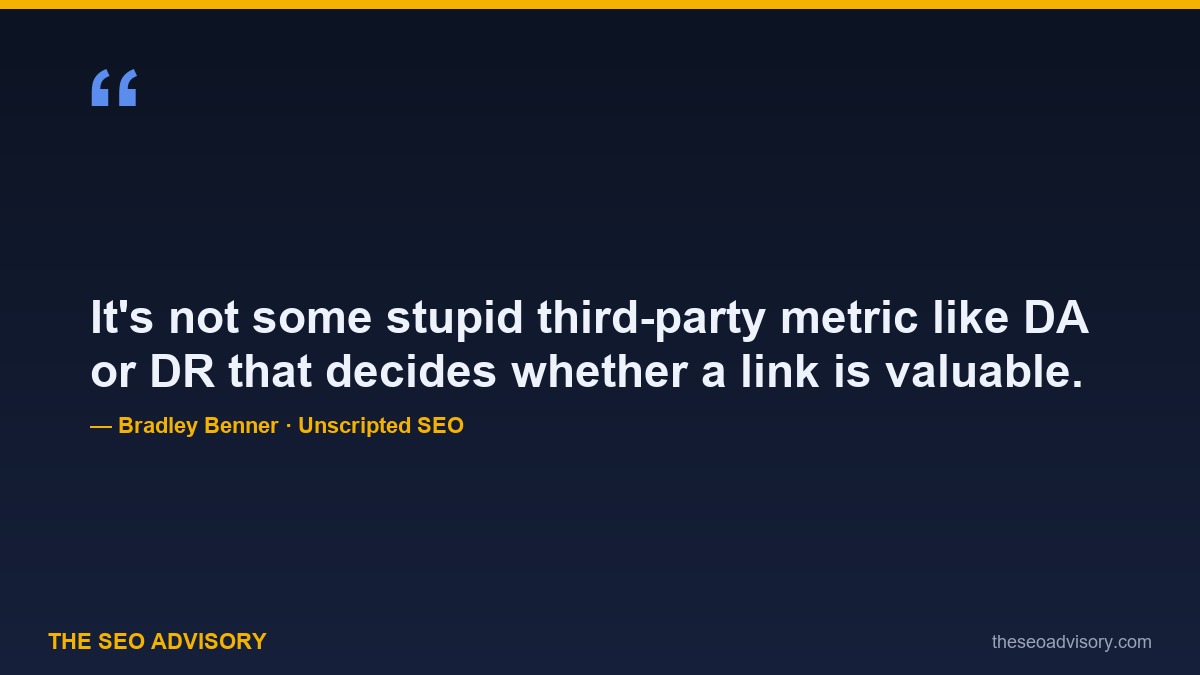
    It’s not some stupid third party metric like DA or DR or trust flow or anything else that matters about whether a link is valuable or not. What matters is whether it’s relevant.— Bradley Benner, Semantic Links

    He is not talking theoretically. He describes agencies still selling outdated work to local businesses and calls it what he thinks it is — unethical — on the grounds that if you sell a service you are obliged to keep up with what currently works. Whatever you make of the strength of that language, the underlying point is a procurement point: a metric that is easy to report is not the same as a metric that predicts value, and if your programme is judged on the easy one, that is what your agency will optimise for. This is the same argument we make in Footprint Beats Tricks from a different angle.

    Relevance As The Governing Standard

    Benner’s framing is that the SEO’s job has changed shape. As he puts it, the work is now “creating associations, strengthening those associations, and helping, forcing the models and the algorithms to recognize those associations” — between the brand, its products or services, and the places it serves. A link is valuable to the degree it strengthens one of those associations, and irrelevant links strengthen nothing.
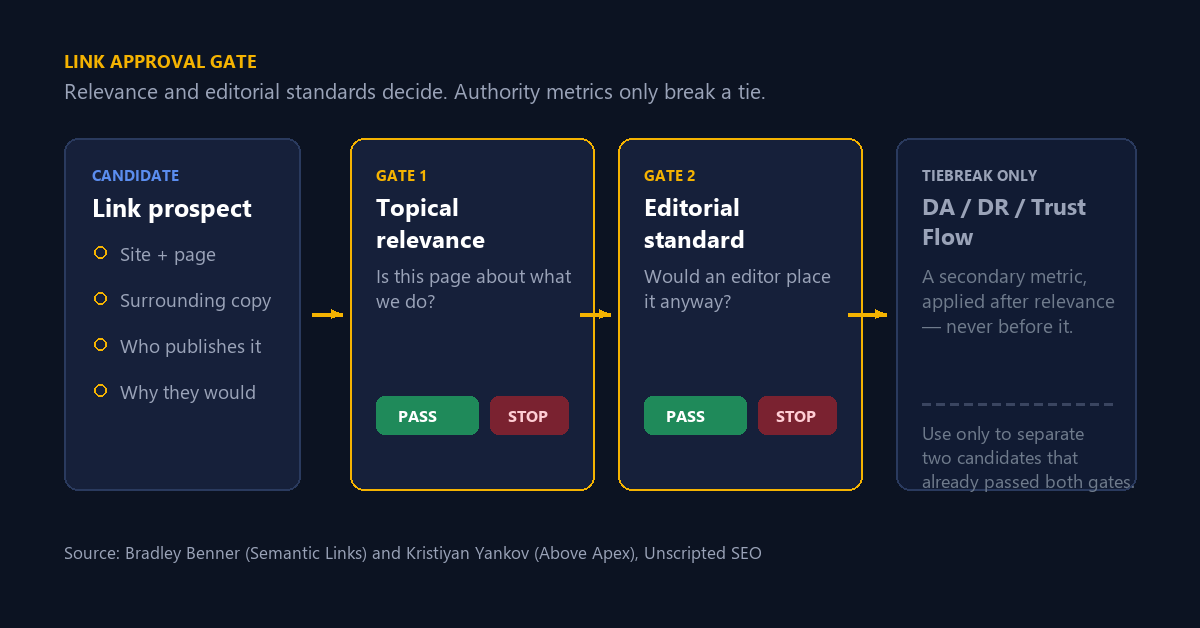
    A link approval gate scoring candidates on topical relevance and editorial standards before any authority metric is considered.
    Relevance and editorial standards decide. Authority metrics only break a tie.

    Usefully for anyone writing a policy, he describes relevance as layered rather than binary — “three layers or levels of relevance matching that can be achieved when you’re doing link building”:

    • The passage. Is the link placed inside content that is genuinely about the subject, near entities related to the business and the area it serves?
    • The publication. Are the overall topical themes of the host site relevant to what is being linked to?
    • The publication’s own profile. What is the relevance of the backlinks already pointing at that referring domain?

    One nuance gets lost when this gets compressed into “DR is dead,” and it matters for policy drafting. Benner does not ban authority metrics; he demotes them. His own words: if you want to use DA, DR or Trust Flow “as kind of a secondary metric after determining that a potential link source is relevant to what it’s going to be linking to, then fine.” His rule is sequence. “But you should look at relevance first.”

    That is a far more implementable standard than an outright ban, because it survives contact with a real shortlist. Two candidates both clear the relevance bar; you have budget for one; the tiebreak is allowed to be a number. What is not allowed is the number doing the deciding before relevance has been tested. If you are building the wider case for why this is where authority actually comes from, that is the argument collected in Authority & Footprint.

    Verify, Do Not Trust: A Screening Gate

    Yankov supplies the second half. Asked at the top of his interview why anyone should trust him, he declined the premise:

    You shouldn’t trust anyone. You should verify. You should verify, especially in our industry.— Kristiyan Yankov, Above Apex

    In practice that means looking at five to ten metrics as a starter rather than domain rating alone, and then applying human judgment to the thing itself — is this a genuine website that serves a purpose rather than a PBN, does it carry relevant content, is the link seamlessly integrated into the actual copy of the article. His test for whether that judgment is trustworthy is the most quotable line either guest offered:

    If I look at a link-building opportunity and it makes sense to me, it would be the same for Google, because Google is definitely not more stupid than me. It’s quite the opposite — it’s actually smarter.— Kristiyan Yankov, Above Apex

    There is a risk calibration buried in his answer that in-house leads should hear, because it changes the tone of the conversation with finance. Yankov’s reading of the leaked Google documentation, and of the analysts who worked through it, is that low-quality links are set aside rather than punished — Google “disregards them entirely” and does not count them. On that reading, the usual consequence of a badly-vetted link programme is not a catastrophe. It is a wasted budget: months of invoices buying links that were quietly ignored.

    We would treat that as his considered opinion rather than settled fact, and we would not use it to justify carelessness. But it does reframe the ask. You are not asking your board to fund a safety measure against a penalty. You are asking them to stop paying for links that do not count.

    Writing The Policy Your Agency Must Follow

    Two practitioners, two sentences, one gate. Relevance first, then verify. The advisory job is turning that into something a marketing coordinator can apply on a Tuesday without you in the room.
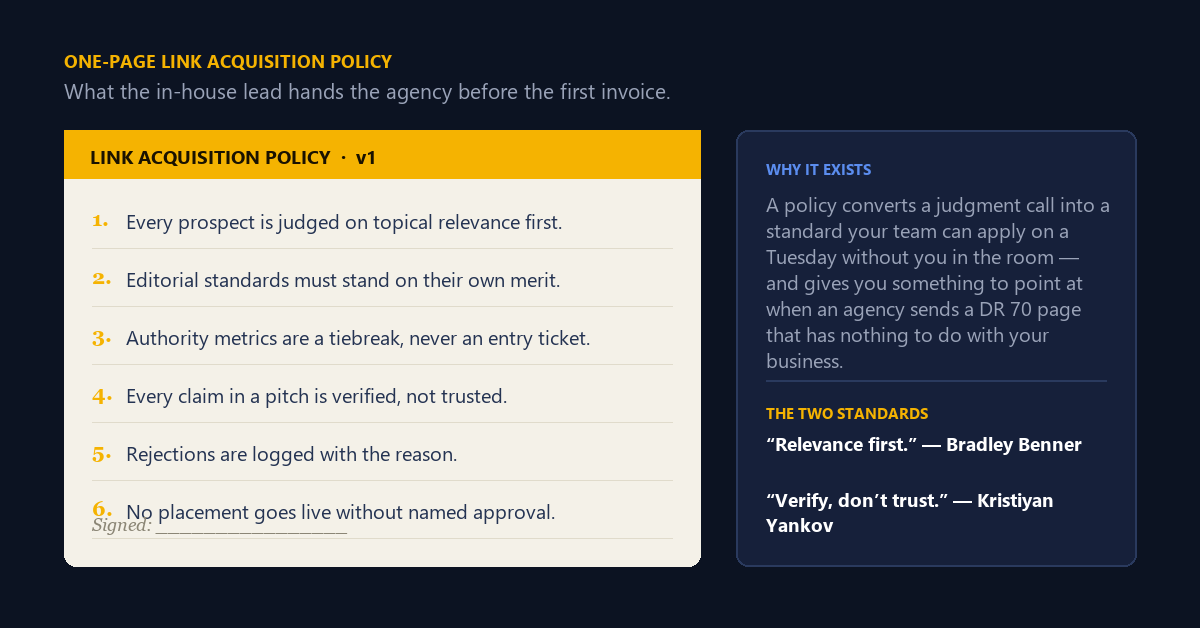
    A one-page link acquisition policy document an in-house lead can hand to an external agency.
    A one-page standard is easier to enforce than a strong opinion.

    A workable one-pager reads roughly like this. Every prospect is assessed on topical relevance before any authority metric is opened. The placement must stand on editorial merit — a reader arriving on that page should find the link useful for reasons that have nothing to do with search. Authority metrics are permitted only as a tiebreak between candidates that have already passed. Every claim in an agency’s pitch — traffic, editorial standards, who actually publishes there — is verified rather than accepted. Rejections are logged with the reason, so the standard compounds into institutional knowledge instead of living in one person’s head. And no placement goes live without a named approver.

    The last two lines are the ones teams skip and then regret. A rejection log is what stops your third agency re-pitching the site your first agency was turned down from. A named approver is what makes the standard real rather than aspirational.

    None of this requires you to abandon the number your board likes. It requires you to move it to the end of the process, where it can no longer do any damage.
    Sources: Bradley Benner (Semantic Mastery / Semantic Links) and Kristiyan Yankov (Above Apex), interviewed on the Unscripted SEO Podcast. Quotes are verbatim. If you want this turned into a live approval gate for your team, that is exactly the work described in the SEO advisory.

  • Fractional Is a Relationship Word, Not a Search Word

    Advisory Note · Fractional SEO

    Fractional Is a Relationship Word, Not a Search Word

    Six operators who sell fractional roles — a CCO, a CFO, a director of operations, two consultants — plus one CMO who flatly refuses to. Here is what they reveal about when the model works, and when it is the wrong answer.

    “Fractional” went from nowhere to everywhere in about five years. As one host put it on the Unscripted podcast: nobody was fractional unless they were in their math class. Now there are fractional CMOs, CFOs, CTOs, COOs — and fractional SEO, which is what we do here.

    That speed should make a buyer suspicious. So rather than argue our own case, we went back through a run of interviews with people who actually sell the model — and one senior marketer who refuses to — and read them from the advisory seat. The most useful finding is a warning, and it comes from an SEO problem.

    The category has a demand problem

    George Little runs Brand Zap, positioned deliberately between a freelancer and a full agency. He uses the word “fractional” — but only in conversation, never as the offer. He learned that the expensive way.

    I had another version of this company that did not succeed a couple of years ago that was basically trying to push fractional creative director. No market for it, no search around it. Speaking of SEO, that’s really a good place to start. Is anyone even Googling this? And they weren’t.— George Little, Brand Zap

    This is the whole lesson in one anecdote, and it is a search lesson before it is a positioning lesson. He had named his company after the shape of the contract rather than the problem being solved. Buyers were searching for agencies, for freelancers, and for the consultant in between — not for a staffing arrangement.

    George now reserves the term for describing how the relationship feels once it has started: “I use the term only when like discussing the relationship, that sort of feel of the relationship for folks.” That is the correct use. Fractional is a good word for explaining an engagement and a bad word for winning one.

    What it actually means, stated plainly

    Joshua Altman runs Beltway Media as a fractional Chief Communications Officer, and gives the cleanest definition in the set:

    Fractional means we’re contractual, we’re part time workers, we’re fully integrated into the client’s company and team. So instead of having a forty hour a week chief communications officer, you have someone twenty five percent of that, one quarter, fractional.— Joshua Altman, Beltway Media

    Note the load-bearing phrase: fully integrated into the client’s company and team. That is what separates fractional from an agency retainer. An agency sits outside and reports in. A fractional executive sits inside and owns the function. If a proposal does not describe integration, it is a retainer wearing a better word.

    The real trigger: somebody got stuck owning a function

    The most useful thing Joshua said was not a definition — it was a description of who calls him:

    One of the people we take over from the most are owners and founders or an early hire because they kind of just got stuck owning a function because they built the website, so now this is all on them. You have a lot of CTOs who built the website whenever it was built and now suddenly they’re in charge of all things digital. And they don’t want to. That’s not their job.— Joshua Altman

    Any SEO advisor will recognise this immediately, because it is the single most common way SEO ends up owned inside a company. Nobody decides to own SEO. Somebody built the site, or ran one campaign that worked, or was in the room when the agency was fired — and it stuck to them. They are now responsible for a discipline they did not choose, cannot benchmark, and have no time to keep current in.

    That is the honest trigger for fractional SEO. Not “we need more traffic.” It is “this function has an accidental owner.”

    Why the outside seat gets listened to — and why that is a problem

    Ash Nallawalla is a fractional enterprise SEO consultant and author of Accidental SEO Manager — the closest analogue in this group to what we do. He tells a story about one of Australia’s top four banks: hired as an outside consultant, given a four-hour audit presentation with a manager he “couldn’t normally get for a one-hour meeting,” promised a conservative 10% traffic lift in twelve months, and delivered it in eight days after implementation. Traffic doubled in eight months. Three years later it had tripled.

    Then he says the part that should make every buyer of fractional services pause:

    I’ve never had it since, because once you’re inside a company you’re no longer treated as the expert. So my lesson is: don’t reserve that trust for outside consultants. Give your internal expert the same weight.— Ash Nallawalla, author of Accidental SEO Manager

    Read that carefully, because it cuts against our own commercial interest. Ash is saying his outside results came partly from a trust premium granted to outsiders — 100% acceptance of recommendations, no prioritisation fights — not purely from superior skill. The mechanism that makes fractional work is partly organisational psychology.

    The advisory reading: if you hire fractional expertise and then treat it like internal staff to be overruled, you have bought the cost without the mechanism. And if you already have a capable internal person you routinely overrule, your first move is not to hire us. It is to stop doing that.

    The seniority argument

    Ash’s standing complaint is about where the function sits:

    My soapbox is that the SEO, or the SEO manager, needs to sit higher in the hierarchy. I’d call the role something like a chief webmaster, or, if you don’t like that term, a chief web success officer — because web success spells company success.— Ash Nallawalla

    His example is mundane and devastating: a security team bought a firewall to stop scrapers, whitelisted Google, and unknowingly throttled their own SEO’s crawling from five million URLs a day to five million over two or three weeks. Nobody was wrong. The SEO was simply too far down the org chart to be in the conversation.

    He also offers a real number on the trend. When he wrote the first edition of his book, roughly one person on LinkedIn held a chief-webmaster-style title. By the second edition this year, around 300 did.

    This is the structural case for the fractional model in SEO specifically. Most companies cannot justify a full-time senior SEO leader, but the decisions that wreck organic performance — domain strategy, subdomain-versus-folder, replatforming, a firewall purchase — are all made at a level the junior owner never attends. Fractional buys seniority at the tier where the damage happens.

    The operator in the middle

    Lloyd Thompson runs Virtual DOO, a fractional director of operations practice, and describes the role in one line:

    The operator is that person who sits between the founder and the team.— Lloyd Thompson, Virtual DOO

    The same geometry applies to SEO. The valuable fractional SEO is not the one producing more deliverables; it is the one standing between the owner’s intent and whoever executes — the agency, the developers, the content team — translating in both directions. Lloyd’s other observation transfers cleanly too: teams keep believing the next tool will solve the problem, when the fix is to simplify. That is as true of an SEO stack as an ops stack.

    Meaghan Wall runs the same pattern in finance as a fractional CFO, and Grant Simmons arrived at the model the way many senior practitioners do — agency, then brand, then consultant. The shape recurs across every function. That is a signal, not a fashion.

    The honest counterargument

    Matt Tyner is CMO at Bone Dry Roofing, one of the largest residential family-owned roofing contractors in the US, with fifteen-plus years in home services. Asked directly whether he was a fractional CMO, he was blunt:

    My experience has been completely internal. So I have not been a freelancer. I have not been a fractional CMO. When I’ve worked somewhere, it’s been you get 100% of my time.— Matt Tyner, CMO, Bone Dry Roofing

    He is right for his situation, and it is worth being precise about why. His core argument elsewhere in that conversation is that marketing makes the promise and operations keeps it — which requires walking hand in hand with operations daily. Where marketing success depends on continuous, deep coupling with how the work actually gets delivered, a quarter of someone’s attention genuinely will not do it.

    Matt also identifies the failure mode that gives every outsourced model a bad name: layers. A marketing person hires the agency, the agency has an ops team, the ops team briefs the SEO — and by then the specialist has no route to propose anything meaningful. Fractional is defensible only insofar as it removes those layers. If it adds one, it is worse than an agency.

    The advisory read

    Taken together, these conversations produce a fairly strict test. Fractional is the right structure when the function has an accidental owner, when the damaging decisions happen above that owner’s level, and when the work is advisory and directional rather than continuous and operational. It is the wrong structure when the function must be coupled to daily delivery, when you would not extend the same trust you would give an outside consultant, or when it inserts one more layer between intent and execution.

    And whatever you call it, do not build the offer around the word. Ask what George asked: is anyone even Googling this?

    If the description of an accidental owner sounded like your company, that is the conversation we have on fractional SEO management — and if you are not sure the model fits at all, SEO advisory is the cheaper place to start.

    Sources: interviews from the Unscripted podcast network — Joshua Altman (fractional CCO), Ash Nallawalla (fractional enterprise SEO), Lloyd Thompson (fractional DOO), Meaghan Wall (fractional CFO), Grant Simmons, and Matt Tyner (internal CMO). George Little of Brand Zap is quoted from an Unscripted SEO conversation not yet published. Quotes are verbatim; transcription spacing has been normalised.

  • The Honest Case for Paid: An Advisor’s Read on Matt Slaymaker’s Ads Playbook

    The Honest Case for Paid: An Advisor’s Read on Matt Slaymaker’s Ads Playbook

    Episode Recap · Authority & Footprint

    The Honest Case for Paid: An Advisor’s Read on Matt Slaymaker’s Ads Playbook

    A paid-media operator argues for restraint — and every point maps to the judgment work of strategic SEO.

    At The SEO Advisory we read the Unscripted SEO Podcast from a strategic seat: not “which channel,” but “what should this business actually do first?” Matthew Slaymaker of Slaymaker Marketing is a paid-media operator — and the most valuable thing he said is an argument for restraint. Here’s the advisory read on his ads playbook.

    Readiness is a strategy question, not a channel question

    The instinct when growth stalls is to add a channel: turn on ads. Matt’s counter — consider turning them off — is exactly the judgment call an advisor is paid to make. If organic visitors who already trust you convert below 2–3%, paid traffic (which converts 30–50% worse) only spends faster. The lever isn’t the ad account; it’s the offer, the positioning, and the path. Fix those and every channel improves at once.

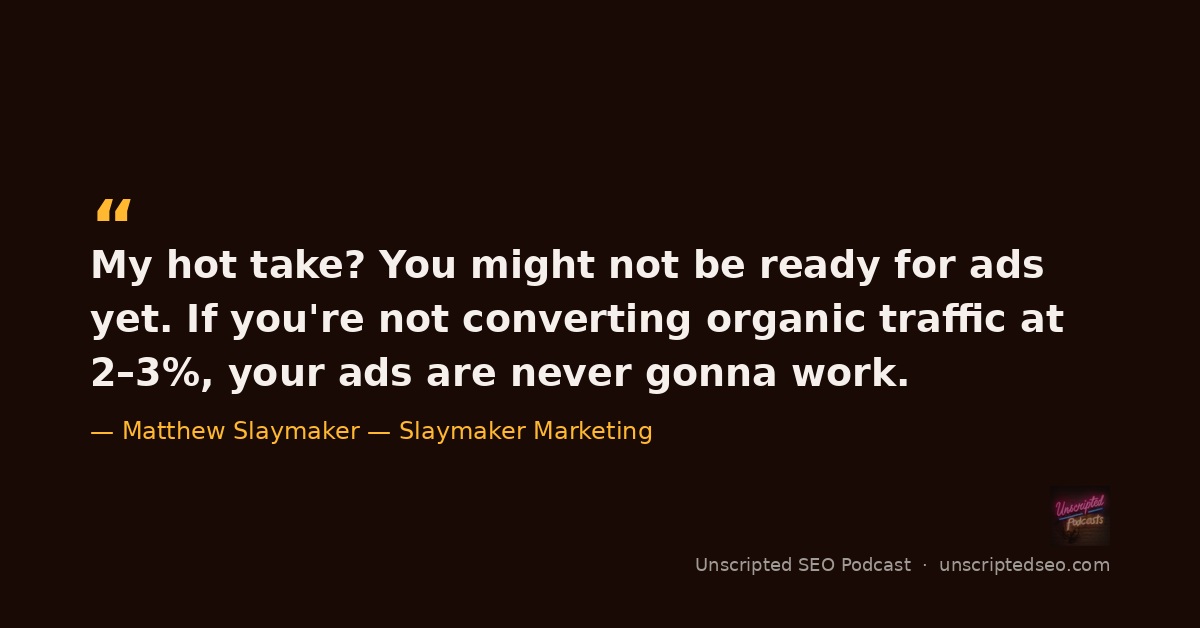
    If you’re not getting an organic conversion rate of two to three percent already, your ads probably are never gonna work.— Matthew Slaymaker

    “You might not be ready for ads yet.” — Matthew Slaymaker
    “You might not be ready for ads yet.” — Matthew Slaymaker

    Creative and targeting are the real levers

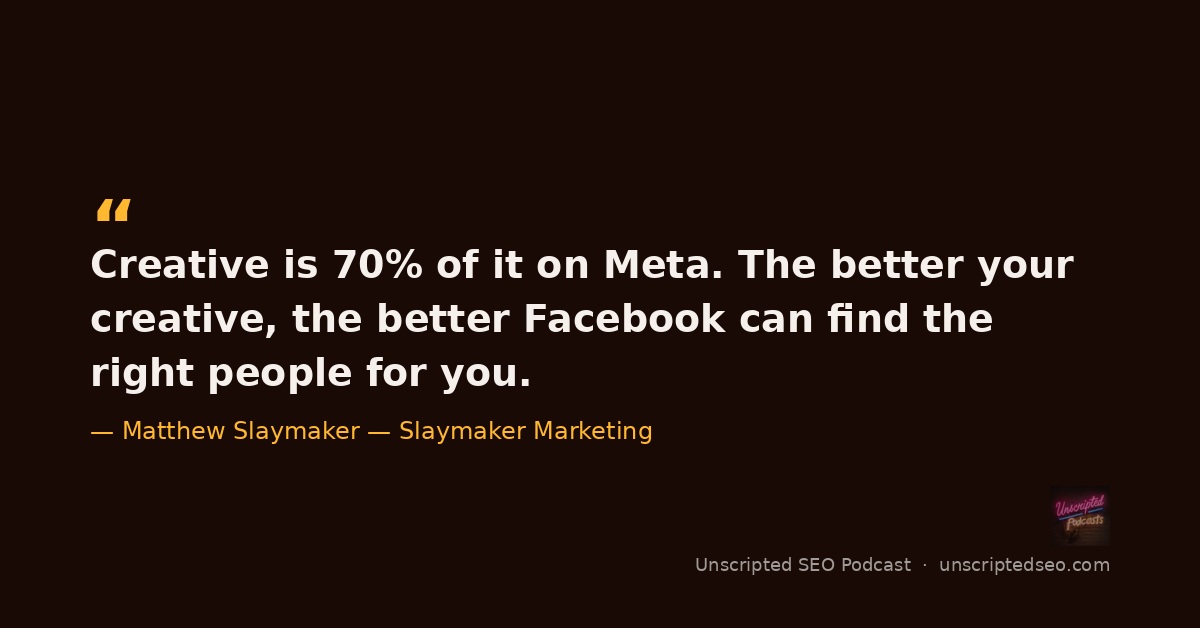
    Advisors think in levers and their weights. Matt gives us clean numbers: on Meta, creative is roughly 70% of performance, so broad targeting plus radically different angles beats fussy audience layering. On Google, targeting is still about half the game — intent decides who even sees the copy. Knowing which lever carries the weight on which platform is the difference between spending and investing.

    “Creative is 60, 70% of it on Meta.” — Matthew Slaymaker
    “Creative is 60, 70% of it on Meta.” — Matthew Slaymaker

    Footprint and shown values beat claims

    The through-line that matches our own thesis — footprint beats tricks — is that authority has to be shown, not stated. Everyone claims to be sustainable, made-in-USA, cruelty-free, so the words stop meaning anything. Patagonia earned belief with real receipts; Yellow Leaf Hammocks put the weaver’s name on every hammock. In an AI-flattened SERP, demonstrated authority and genuine mentions are what a brand can defend.

    Point AI at judgment, not volume

    Finally, the agentic-age lesson we keep returning to: use AI for leverage, keep a human on judgment. Matt’s best AI use isn’t an autonomous ad bot — it’s a Claude workflow scoring team proactivity and account attention so a growing agency stays close to clients. That’s stewardship, not automation for its own sake.

    Full conversation: Matthew Slaymaker on Ads, Creative Strategy & Honest Marketing on the Unscripted SEO Podcast. Connect with Matt on LinkedIn.
    From The Episode

    This recap is drawn from Matthew Slaymaker’s conversation with Jeremy Rivera on the Unscripted SEO Podcast. Matt published his own companion take on the same exchange — read it on the Slaymaker Marketing blog.

    Authentic Brand Values: Can Marketing Ever Be Genuinely From the Heart?

    Jeremy Rivera

    There’s a push and pull of there being taglines and values that came up after my interview with the Permacast wall company. And I’ll be asking PureAire, the oxygen monitoring company I’m meeting with tomorrow: what are the values you want to bring to the market? … There’s also this kind of make-believe world of marketing where you’re saying what your company’s values are — but you’re also tap-dancing, which isn’t genuine. Can you have genuine, from-the-heart marketing? That’s kind of my question.

    Matthew Slaymaker

    You can, absolutely — but you have to show it. You can’t just say it. … Everybody’s saying ‘we’re sustainable, we’re made in USA, we’re cruelty free’ — it doesn’t make you stand out anymore. One brand that did a good job of this: Yellow Leaf Hammocks. Every hammock that’s woven has the name of the person who wove it written on it. That’s the kind of stuff that actually brings your values to life. If you just say ‘we’re charitable,’ people don’t really trust or believe you nowadays. But if you can actually show it and bring it to life for them, that’s a very different thing.

    UNSCRIPTED SEO
    You Might Not Be Ready for Ads
    Ten truths from Matt Slaymaker

    Free download

    The honest-ads field guide

    The companion eBook to the episode — ten lessons on creative, targeting, and marketing that means it. No form, no gate.

  • Rob Bonham on SEO in the Agentic Age (Episode Recap)

    Rob Bonham on SEO in the Agentic Age (Episode Recap)

    Episode Recap · SEO in the AI Era

    Rob Bonham on SEO in the Agentic Age

    My conversation on the Unscripted SEO Podcast, recapped: why SEOs are now stewards of the AI, the 100-page mistake I keep seeing, and what actually wins the SERPs.

    I recently joined Jeremy Rivera on the Unscripted SEO Podcast to talk about what two decades in SEO — local, e-commerce, SaaS, and home services — have taught me about working in the agentic age. AI now handles the low-level busywork in minutes. The catch: that moves the value of a good SEO up the stack, to judgment and knowing what not to do. Here are the ideas that mattered most.

    We are stewards of the AI

    My central framing on the show: as SEOs, we’re now stewards of the AI. The tools are genuinely powerful, but they mostly recombine what already exists on the web. Point them at scale without oversight and you’ll confidently ship pages that pull in bots, five-second bounces, and thin answers — and Google will notice the missing user signals. Per Google’s own guidance on AI content, automation used mainly to game rankings breaks its spam policies, while original, experience-led content gets rewarded.

    “As SEOs, we are stewards of the AI.” — Rob Bonham
    “As SEOs, we are stewards of the AI.” — Rob Bonham

    The 100-page concrete-wall trap

    Jeremy brought the perfect real-world example: precast concrete walls florida — a company that used AI to spin up roughly a hundred near-duplicate pages — one for every city they service — each pulling random stock photos of concrete walls. The instinct was right: try to do a little more, cover more ground. But volume without information gain — no real user data, no first-hand expertise, nothing a machine couldn’t already generate — is just more of a not-great idea.

    It’s what happens when a business goes into a “fugue state” with Claude or ChatGPT and sends over 40-page documents, convinced they’ve replaced expertise with volume. From an actual expert’s seat, the notion is fine; the execution isn’t. You can’t ship it raw — but with a human setting strategy and reviewing every output, the power is absolutely there.

    Footprint wins the SERPs

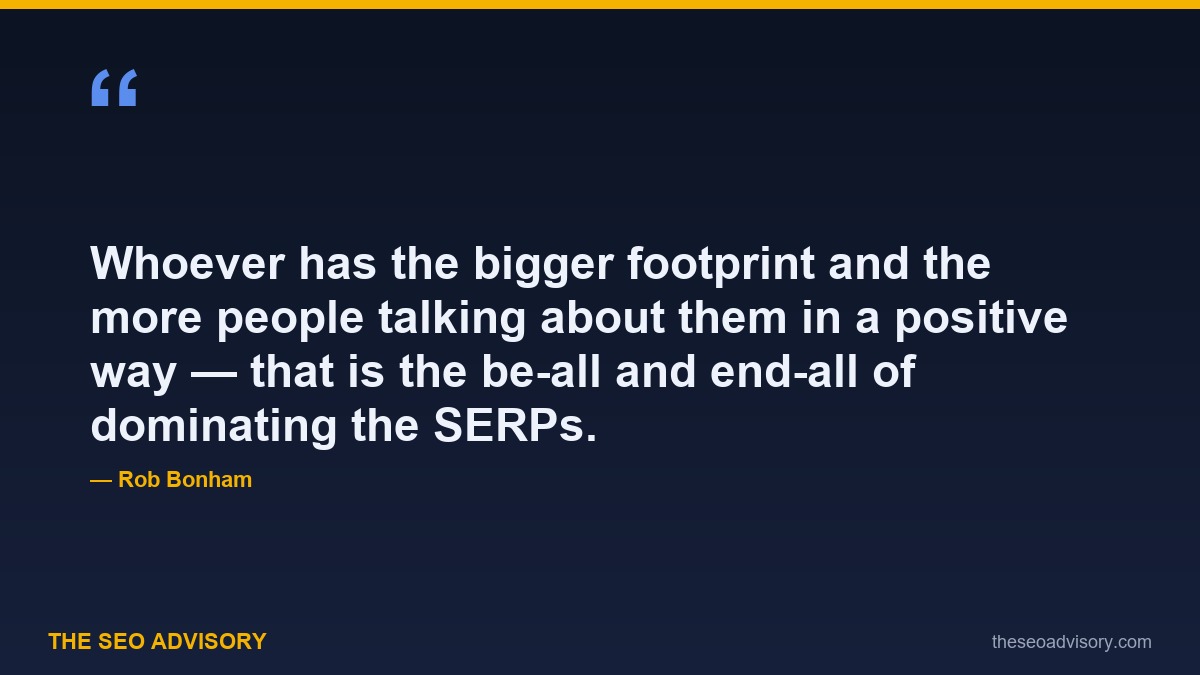
    If there’s one be-all-end-all, it’s this: whoever has the bigger footprint — more people talking about them across the web in a positive way — wins. That’s brand, mentions, and genuine authority, not link tricks. If you want the systematic version, SEO Arcade’s link building & authority resource guide is a solid starting point.

    “Whoever has the bigger footprint… wins the SERPs.” — Rob Bonham
    “Whoever has the bigger footprint… wins the SERPs.” — Rob Bonham

    Don’t sell yourself short

    We also got into the business of consulting. My advice to SEOs: don’t sell yourself short. Hourly or monthly retainer, price it so it makes sense for you and the client — a rate that lets you do the deep, judgment-heavy work is the rate that actually protects their results.

    “Don't sell yourself short.” — Rob Bonham
    “Don’t sell yourself short.” — Rob Bonham

    That’s the through-line of the whole conversation: use AI for leverage, keep a human in the loop for judgment. If you’d like that discipline built into your team, that’s what fractional SEO management is for — or start with a focused advisory engagement.

    Full conversation: Rob Bonham on SEO in the Agentic Age on the Unscripted SEO Podcast. Connect with Rob on LinkedIn, or explore more in our hub on SEO in the AI Era.
    THE SEO ADVISORY
    Get to Know Rob Bonham
    Fractional SEO Manager & SEO Advisor

    Free download

    Get to know me — in 5 minutes

    How Rob thinks about SEO in the AI era and how he works. No form, no gate.

  • Integrated Marketing: Why SEO Can’t Win Alone

    Integrated Marketing: Why SEO Can’t Win Alone

    Authority & Footprint

    Integrated Marketing: Why SEO Can’t Win Alone

    SEO in a silo underperforms. Here’s how integrated, multi-channel marketing makes every channel hold the others up.

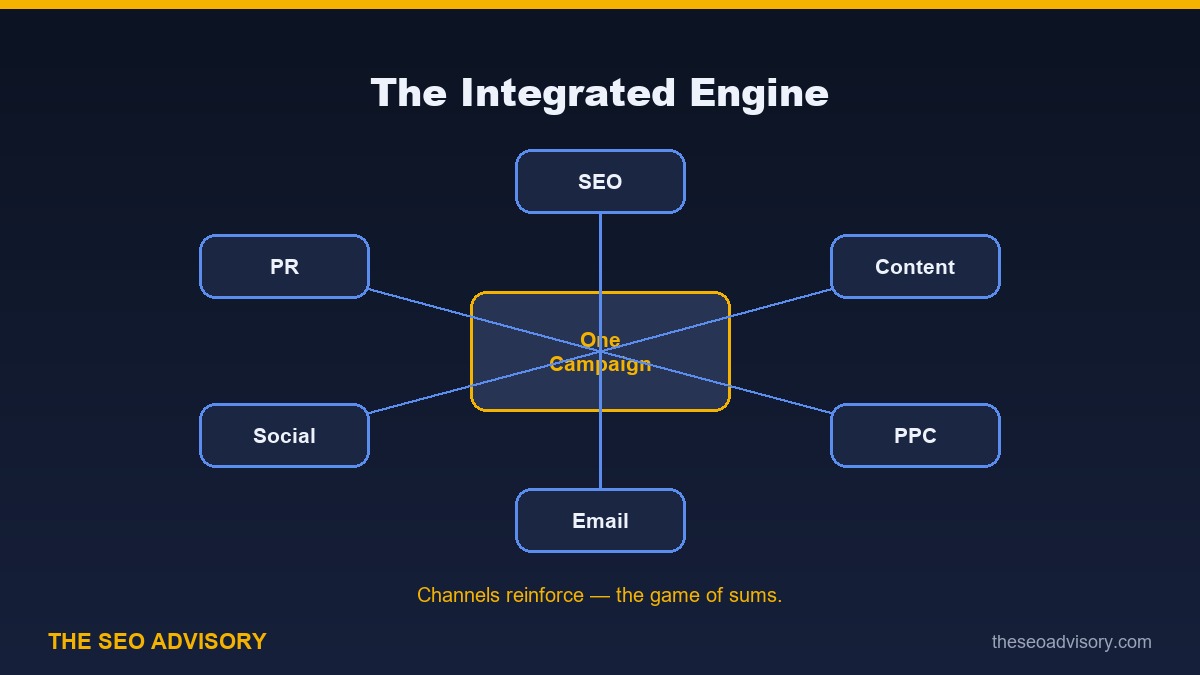
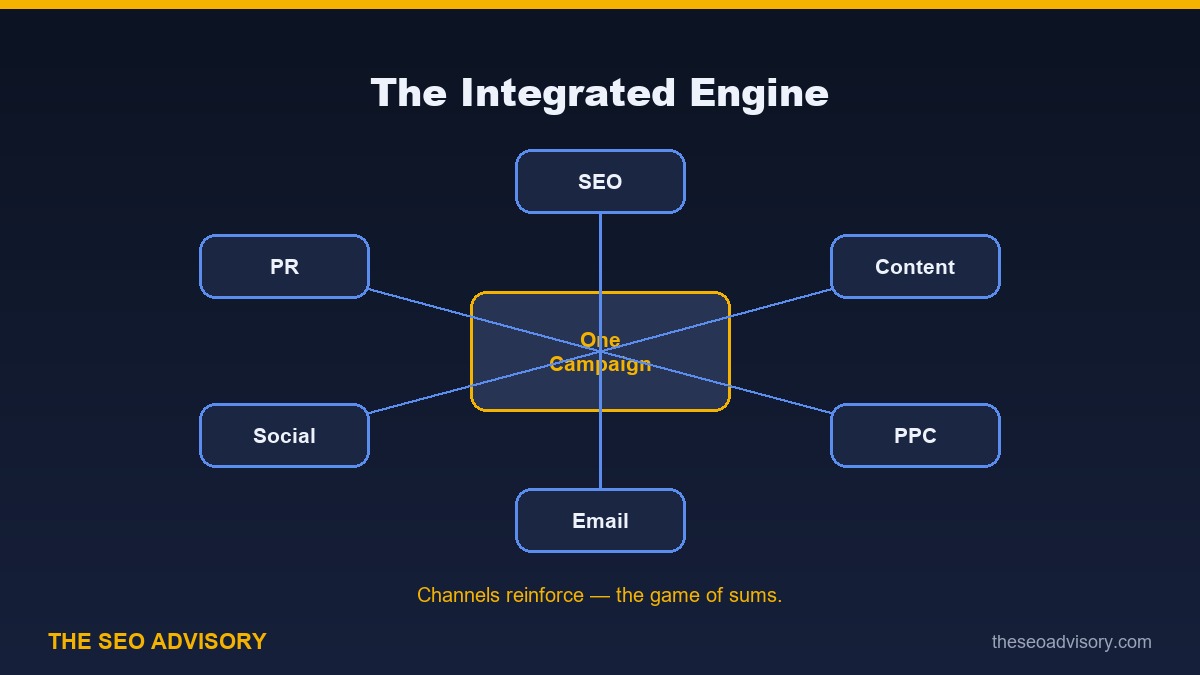
    The integrated engine: channels reinforce one campaign.
    The integrated engine: channels reinforce one campaign.

    SEO run as an island almost always underperforms. The teams that win treat it as one instrument in an integrated campaign — what Rob calls the game of sums.

    Multi-channel is the multiplier

    The numbers back it up: per Omnisend’s research, campaigns using three or more channels saw a 90% higher customer retention rate than single-channel campaigns. Channels don’t compete for budget — they compound.

    Rob Bonham on working channels together
    Rob Bonham on working channels together

    Distribution is the moat

    {}Nick Eubanks framed the why: when execution becomes infinite (and AI is making it so), distribution is the only remaining moat. Anyone can make the asset; not everyone can get it in front of the right audience across search, social, email, and PR. SEO Arcade’s content strategy resource guide helps you plan that distribution.

    Nick Eubanks on distribution as the moat
    Nick Eubanks on distribution as the moat

    The car-dealership play

    Rob’s go-to example from years running dealer campaigns: build a sales-event landing page (Black Friday, Memorial Day), then hit it from every angle — email to interested buyers, paid search and paid social, and organic social reinforcing the same message. One campaign, every channel, holding each other up.

    Make every channel hold the others up
    Make every channel hold the others up

    Orchestrating that is core to fractional SEO management — and the throughline of the Authority & Footprint hub.

    Originally explored with Nick Eubanks on the Unscripted SEO Podcast. More in our hub on Authority & Footprint.
    THE SEO ADVISORY
    Get to Know Rob Bonham
    Fractional SEO Manager & SEO Advisor

    Free download

    Get to know me — in 5 minutes

    How Rob thinks about SEO in the AI era and how he works. No form, no gate.

  • Footprint Beats Tricks: Link Building Reborn for the AI Era

    Footprint Beats Tricks: Link Building Reborn for the AI Era

    Authority & Footprint

    Footprint Beats Tricks: Link Building Reborn for the AI Era

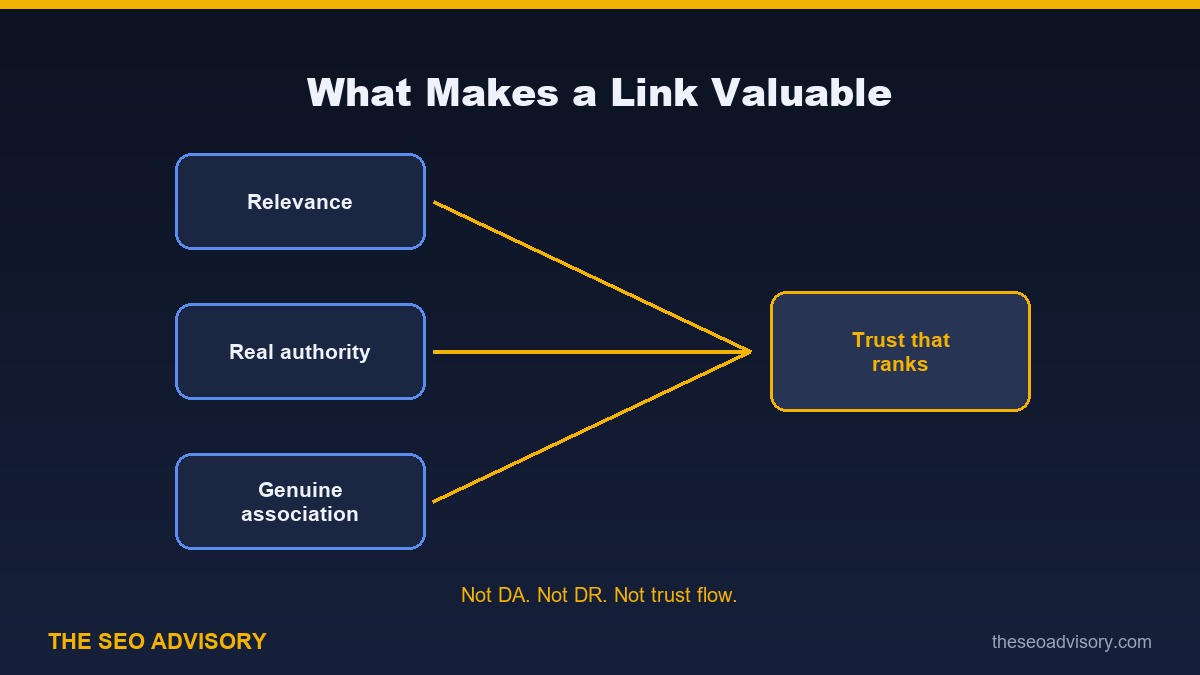
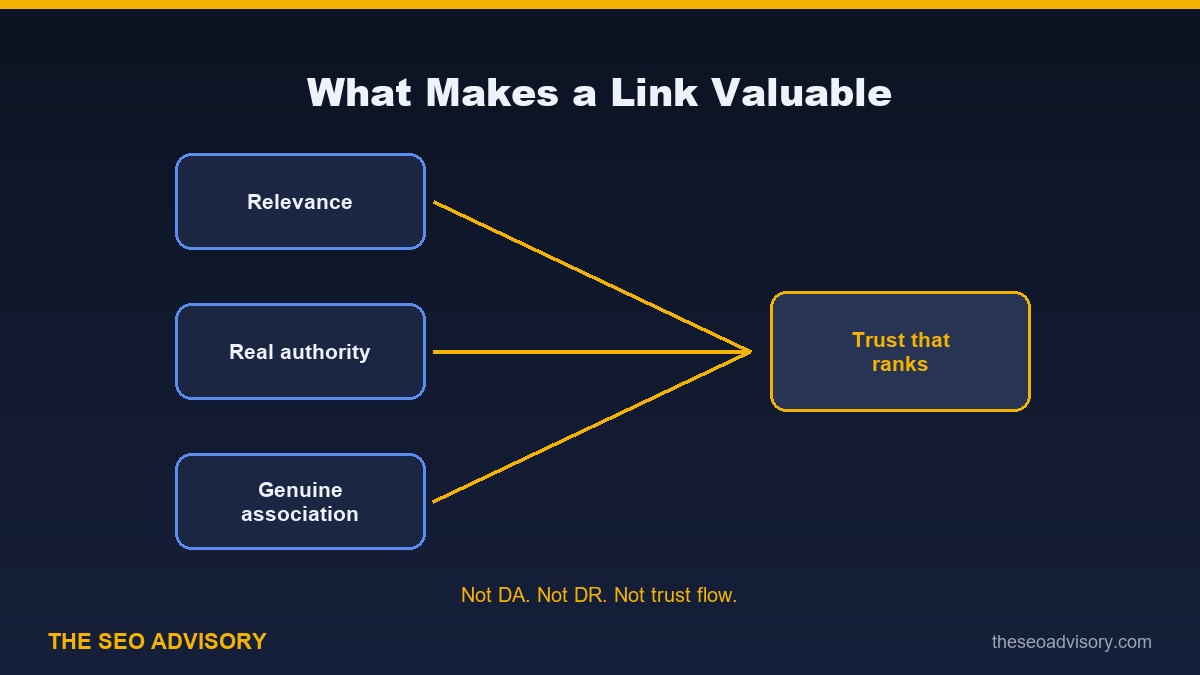
    Forget DA and DR. Real link value comes from relevance, authority, and association — and a bigger footprint is what wins.

    What makes a link valuable: relevance, authority, association.
    What makes a link valuable: relevance, authority, association.

    Link building isn’t dead — it’s been reframed. The brands that win aren’t gaming a metric; they have a bigger footprint and more people talking about them across the web.

    Links still matter (the real ones)

    The data is clear that links remain a core trust signal: Backlinko’s analysis of 11.8 million results found the #1 result has, on average, 3.8× more backlinks than positions 2–10 — with the diversity of referring domains mattering most. It’s not volume; it’s breadth and quality.

    Rob Bonham on footprint
    Rob Bonham on footprint

    Stop pushing metrics

    {}Bradley Benner said it bluntly on the podcast: it’s not some third-party metric like DA or DR that decides whether a link is valuable — it’s relevance and genuine association. Our job is to build and strengthen those associations, not chase a number. SEO Arcade’s link building & authority guide is the deep dive.

    Bradley Benner on link metrics
    Bradley Benner on link metrics

    The easiest links you’re not asking for

    Rob’s favorite example is “shooting fish in a barrel”: at an e-commerce parts provider, the brands they carried all had “where to buy” pages — so they simply earned links from their own suppliers and partners. No outreach grind, no payment, just relationships that already existed. Most businesses leave that footprint on the table.

    Footprint beats tricks
    Footprint beats tricks

    Building an authority program is a core part of fractional SEO management. See the bigger picture in the Authority & Footprint hub.

    Originally explored with Bradley Benner on the Unscripted SEO Podcast. More in our hub on Authority & Footprint.
    THE SEO ADVISORY
    Get to Know Rob Bonham
    Fractional SEO Manager & SEO Advisor

    Free download

    Get to know me — in 5 minutes

    How Rob thinks about SEO in the AI era and how he works. No form, no gate.

  • Why Publishing 100 AI Pages Will Tank Your Rankings

    Why Publishing 100 AI Pages Will Tank Your Rankings

    SEO in the AI Era

    Why Publishing 100 AI Pages Will Tank Your Rankings

    Spinning up content at volume feels productive. Here’s why thin, scaled pages quietly wreck the signals that actually rank you.

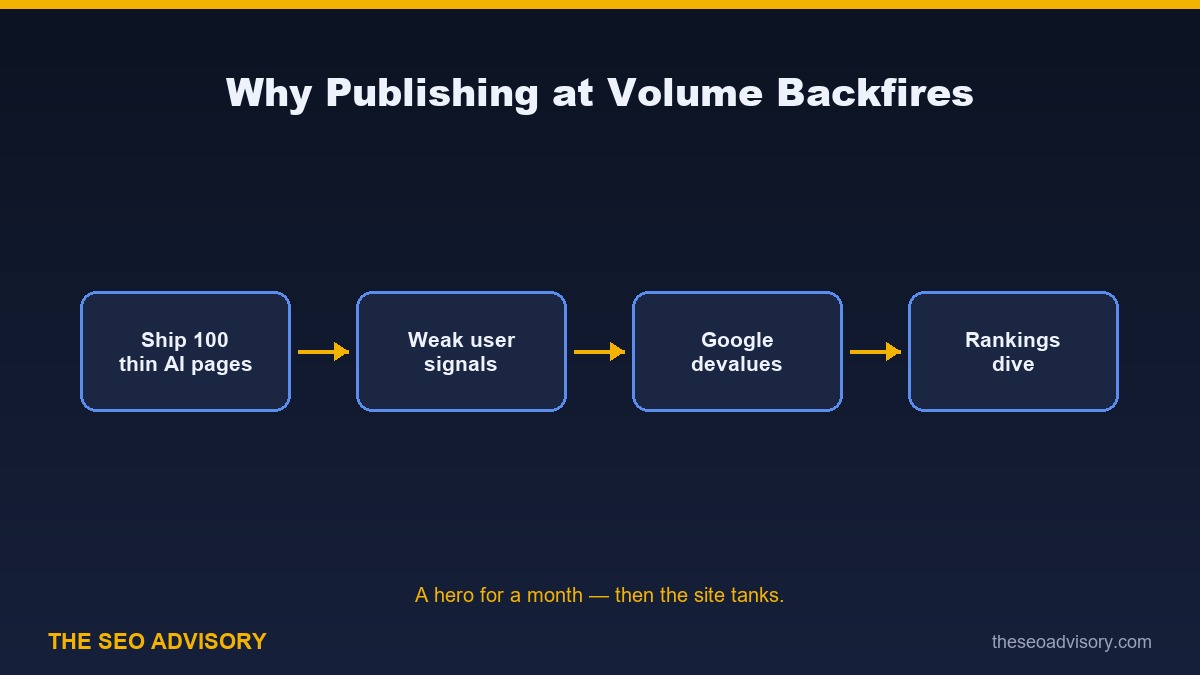
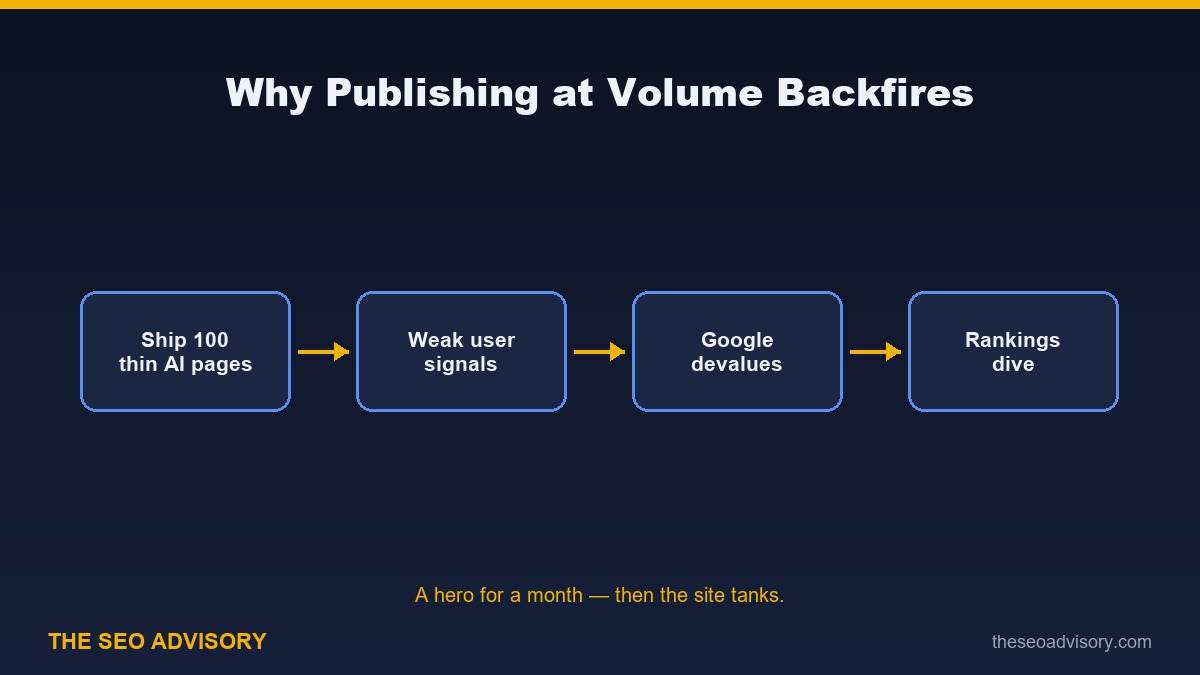
    The volume trap: thin pages weaken signals until rankings dive.
    The volume trap: thin pages weaken signals until rankings dive.

    It’s the most tempting button in modern SEO: generate a hundred pages in an afternoon. The output looks like progress. The results, a few months later, rarely are.

    Volume is not a strategy

    When you flood a site with thin, near-duplicate pages, the user signals aren’t there — high bounces, no engagement, no conversions — and Google devalues the content accordingly. It can even cross a line: Google’s scaled content abuse policy specifically targets generating many pages (including with AI) primarily to manipulate rankings rather than help people.

    Rob Bonham on publishing at volume
    Rob Bonham on publishing at volume

    Updates only hurt the incomplete

    {}Ernesto Ortiz framed it perfectly on the podcast: algorithm updates just turn the dials on which factors matter, and if you drop, it’s usually because you were incomplete — you optimized for the things that don’t. Volume papers over incompleteness; it never fixes it. Build fewer, genuinely complete pages instead. SEO Arcade’s content strategy resource guide is a solid blueprint.

    Ernesto Ortiz on incomplete content
    Ernesto Ortiz on incomplete content

    The agency cautionary tale

    Rob has watched this play out from inside agencies: a client drops the retainer, has the in-house team publish 50–100 AI pages a month, and looks like a hero — for a few months. Then the site tanks, and they start looking at everyone sideways. The fix isn’t more pages; it’s the judgment to ship the right ones.

    Thin pages tank ranking signals
    Thin pages tank ranking signals

    If you want a senior eye on what to publish (and what to kill), that’s the heart of fractional SEO management, and the opposite philosophy to the one explored in our AI-era hub.

    Originally explored with Ernesto Ortiz on the Unscripted SEO Podcast. More in our hub on SEO in the AI Era.
    THE SEO ADVISORY
    Get to Know Rob Bonham
    Fractional SEO Manager & SEO Advisor

    Free download

    Get to know me — in 5 minutes

    How Rob thinks about SEO in the AI era and how he works. No form, no gate.

  • Stewards of the AI: Using AI in SEO Without Wrecking Your Site

    Stewards of the AI: Using AI in SEO Without Wrecking Your Site

    SEO in the AI Era

    Stewards of the AI: Using AI in SEO Without Wrecking Your Site

    AI can do an SEO’s busywork in minutes. Using it well still takes judgment — here’s how to get the leverage without the rankings risk.

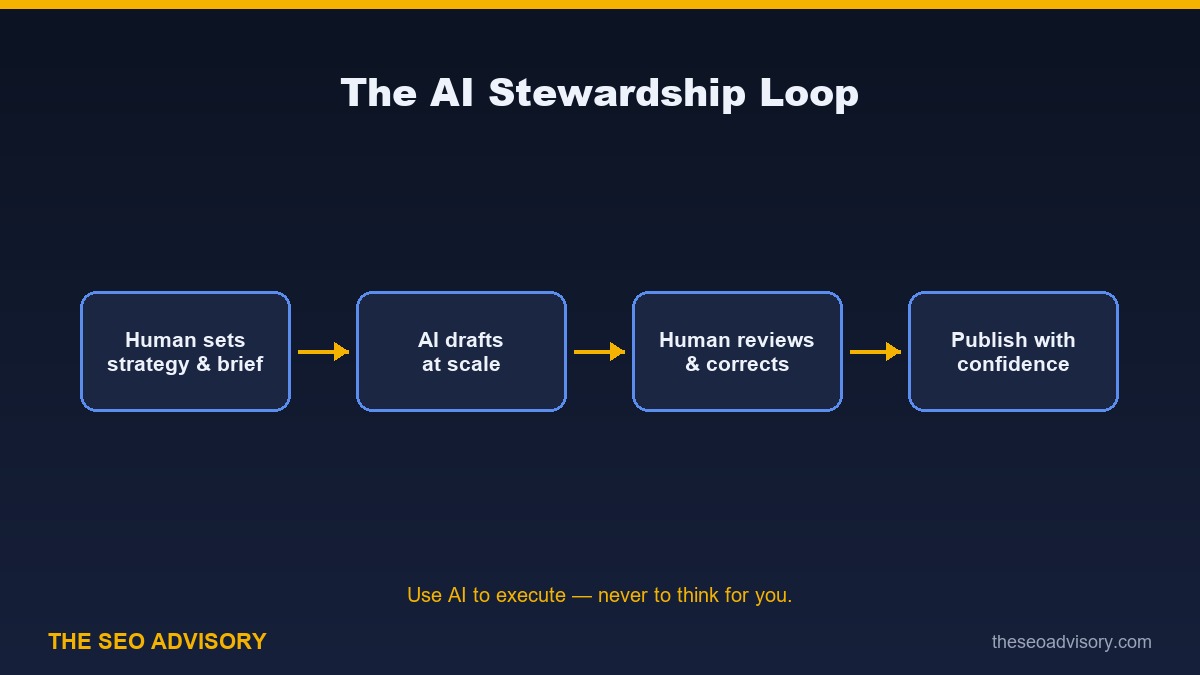
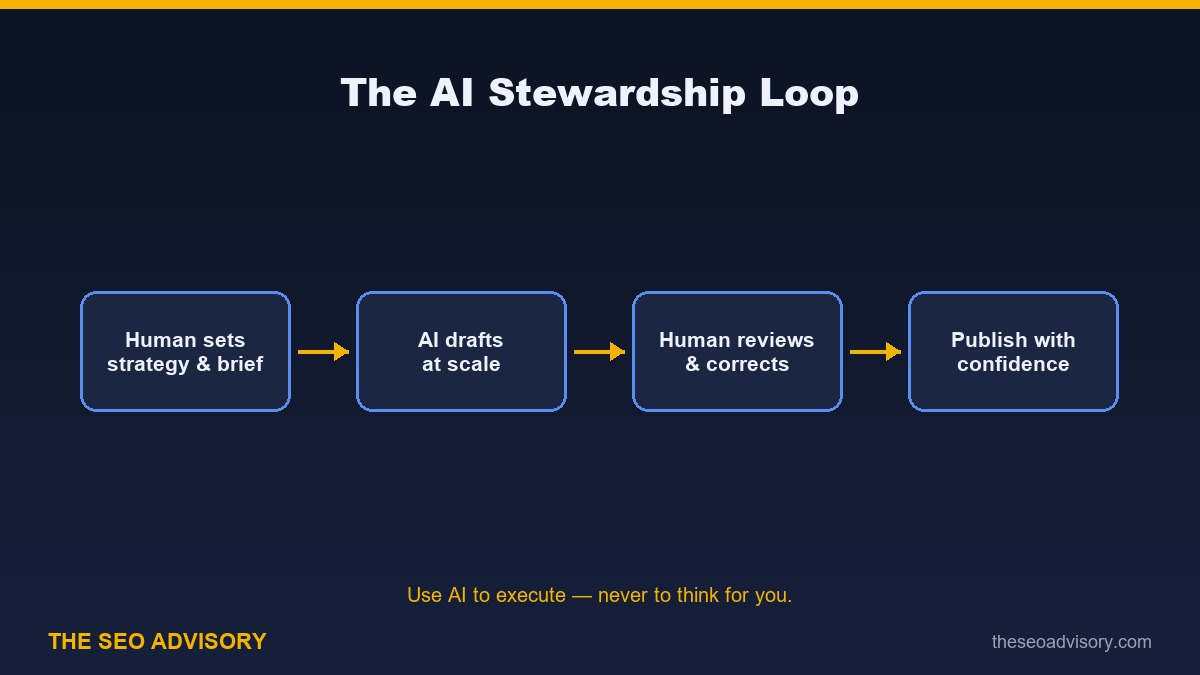
    The AI stewardship loop: humans set strategy, AI executes, humans review.
    The AI stewardship loop: humans set strategy, AI executes, humans review.

    The low-level work that used to fill an SEO’s month — title tags, meta descriptions, on-page fixes — is now a few minutes of prompting. That’s a genuine unlock. It’s also a trap. The value of a good SEO has moved up the stack, from doing the work to exercising the judgment about which work is worth doing.

    You’re the driver, not the passenger

    Rob Bonham’s framing is simple: we are stewards of the AI. AI mostly recombines what already exists, so without human oversight it confidently produces pages that pull in bots, five-second bounces, and thin “answers” that erode trust. Google has been explicit about this — per Google’s guidance on AI content, using automation primarily to manipulate rankings violates its spam policies, while original, people-first content that demonstrates real experience and expertise is rewarded.

    Rob Bonham on AI stewardship
    Rob Bonham on AI stewardship

    AI search is not SEO 2.0

    On the Unscripted SEO Podcast, {}Brittany Trafis put a finer point on it: treating AI search like a fresh coat of paint on keyword-and-rank SEO is how you stay invisible. The fundamentals carry over, but the execution — structured, sourced, genuinely helpful content — has to be deliberate. For the deeper playbook, see SEO Arcade’s entity, brand authority & AI-visibility guide.

    Brittany Trafis on AI search
    Brittany Trafis on AI search

    A quick gut check from the field

    Rob’s favorite example: you could spin up a hundred city-specific pages for a concrete-pouring business. Should you? Probably not. Each one would be a near-duplicate with no real user data, no first-hand expertise, nothing a machine couldn’t already generate. The right move is to use AI to execute a human-set strategy — then review every output before it ships.

    Judgment is still the job
    Judgment is still the job

    That’s the whole discipline: brief with strategy, let AI draft at scale, and keep a human in the loop to correct it. Want help building that workflow into your team? That’s exactly what fractional SEO management is for — or start with a focused advisory engagement.

    Originally explored with Brittany Trafis on the Unscripted SEO Podcast. More in our hub on SEO in the AI Era.
    THE SEO ADVISORY
    Get to Know Rob Bonham
    Fractional SEO Manager & SEO Advisor

    Free download

    Get to know me — in 5 minutes

    How Rob thinks about SEO in the AI era and how he works. No form, no gate.