
Advisory Note · Team Structure
Half Your SEO Team Is Doing PR
An advisory read on Zak Ali: if the job is digital PR, that is an org chart decision, not an opinion piece.
Most commentary about SEO becoming public relations stops at the observation. For an in-house lead, the observation is not the interesting part — the interesting part is that if it is true, it is a staffing question, a reporting-line question and a budget question, and those have to be answered by someone with the authority to answer them.
Zak Ali, who leads SEO at Finder in the US, is one of the few practitioners who has actually made the organisational change rather than writing about it.
The Two Types Of SEO Left
His formulation, on the Unscripted SEO Podcast:
He adds that you have to steer into it and see where the writing is on the wall — and then describes what steering into it cost him. In May of the previous year he decided, in his words, to kill the SEO team and have a generalist marketing team instead. He is candid that it was rough at the beginning: telling people who had spent years building a specialism that they were growth marketers now.
For a governance reader, that is the material fact. This is not a prediction. It is a practitioner describing a restructure he executed, including the part where it was uncomfortable. Whether you agree with the conclusion, the honest version of the argument includes a real organisational cost.
The framing that gets him there is worth keeping attached, because it is the business case. His view is that the role of every SEO is audience cultivation — getting people in, converting them, and retaining them — and that “retention should be a core KPI of every SEO.” The PR conclusion follows from the audience premise rather than standing on its own.
What This Means For Your Org Chart
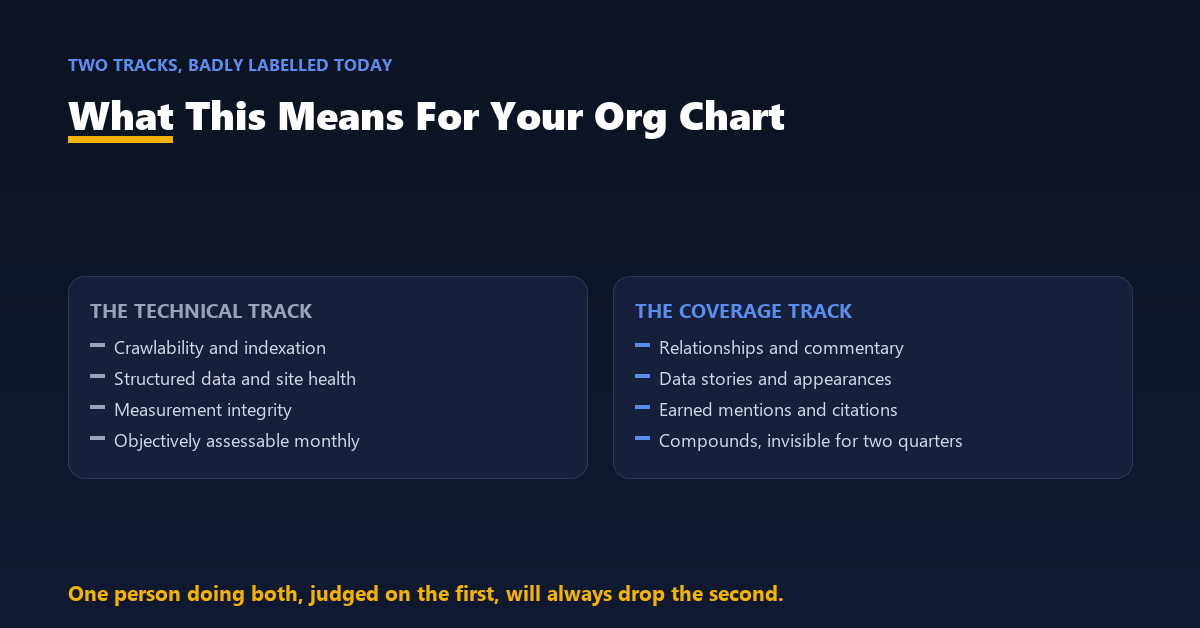
Our own reading, not Ali’s prescription. His answer was to dissolve the specialism entirely; that is one valid response and it is not the only one. The more common situation is an SEO function that already contains both kinds of work, badly labelled, reviewed against a single set of metrics that suits only one of them.
- The technical track. Crawlability, indexation, structured data, site health, measurement integrity. Objectively assessable, mostly on-site, and it does not stop mattering because the other track exists.
- The coverage track. Relationships, commentary, data stories, appearances, earned mentions. Slow to start, compounding, and impossible to evaluate on a monthly ranking report.
The failure most in-house teams are living with is one person expected to do both, assessed on the metrics of the first. That person will always deprioritise the coverage work, because it does not show up in the report they are judged on — which is a management design fault, not a performance problem.
Hiring For Coverage Instead Of Rankings
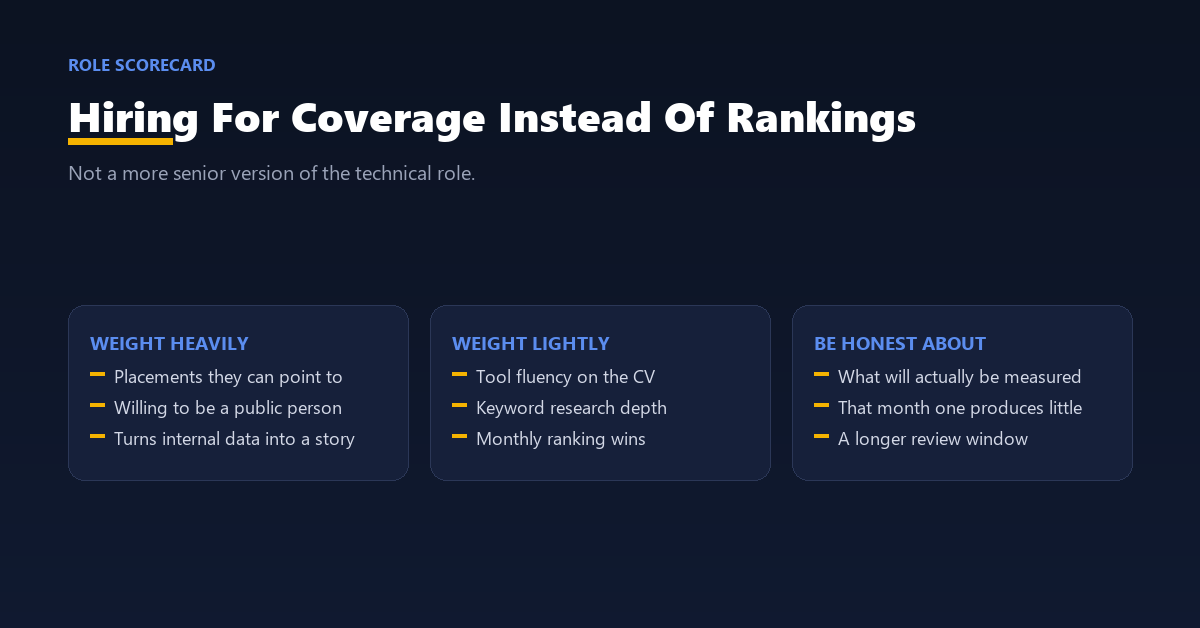
If you accept the split, the second role is not a more senior version of the first and should not be recruited as one. Our scorecard for it:
- Evidence of earned coverage. Specific placements they can point to and explain how they got. Weight this above every tool on the CV.
- Willingness to be a public person. The work involves appearing, being quoted and being disagreed with. Not everyone wants that and it is not a defect.
- Comfort with data as a story. Can they take an internal number and make it something a journalist would run?
- Relationship stamina. This role produces very little in month one and a great deal in month nine. Hire someone who has demonstrably worked at that tempo.
- Enough technical literacy to be credible. Not to do the technical work — to talk to the person who does without either of them switching off.
And be honest in the job description about what will be measured, because hiring someone for coverage and then reviewing them on rankings produces a resignation in nine months.
Reporting Lines That Stop The Turf War
The predictable conflict is with communications or PR, who reasonably consider media relationships their function and will not enjoy a second team briefing the same journalists.
Our recommended structure, from having watched this go wrong: one owner of external relationships, wherever it sits, and the other function contributes to it rather than running a parallel programme. If comms owns relationships, the SEO coverage lead supplies the data stories, the technical angles and the search-informed topics, and comms places them. If SEO owns it, comms gets right of review. What does not work is both teams pitching independently, because the journalist notices before the CMO does.
The metric question resolves the same way. A coverage function reviewed on rankings will produce rankings work. Review it on placements, mentions, citations and branded search — and accept a longer assessment window than a technical roadmap needs, because the first two quarters genuinely look like nothing is happening.