
Advisory Note — SEO in the AI Era
Brand vs non-brand reporting, without the overclaim
Search Console now labels every click as branded or non-branded. Report the two lines separately, keep the hidden queries out of your claims, and treat brand demand as something the whole company moves.
For years the brand line in an SEO report has been a guess. Someone wrote a regex for the company name, ran it over the queries Search Console was willing to show, and called the result “branded traffic”. Everything else became non-brand by default. Leadership saw one number for each, and nobody in the room knew how much of it was inference.
That changed this month. On 16 November 2026 Google added a branded classification to the Search Console Search Analytics API, a year after the same split appeared as a filter in the Performance report. Every click on an eligible property now carries Google’s own label: branded or non-branded.
For anyone who reports SEO upward — an in-house lead, an agency team, a fractional SEO manager — this is the most useful reporting change in a long time. It is also easy to oversell. Here is how Rob Bonham would set up the brand vs non-brand section of a monthly report, and the claims we would keep out of it.
What the brand vs non-brand label covers, and what it doesn’t
Google describes the classifier as an internal, AI-assisted system. It counts your brand name in any language, its misspellings, and products or services unique to your site. You do not write the rules, and you cannot edit them.
The practical limits matter more than the model:
- History starts on 21 February 2026. Any year-on-year brand comparison has to wait until next spring, or rely on your old regex for the earlier period, labelled as a different method.
- Not every property is eligible. Ineligible properties return no rows and no error. An empty brand line can mean “not classified”, not “zero brand demand”.
- It labels clicks. It does not reveal queries. The anonymised queries Search Console has always withheld stay withheld. You now know which bucket they fall into, not what they were.
That last point is where most of the reporting mistakes will come from, so we will come back to it.
Why one blended number has been misleading leadership
Brand and non-brand clicks behave like two different channels. Brand clicks come from people who already know you, sit near position one and convert well. Non-brand clicks come from people who have never heard of you, which is the audience SEO is usually hired to win. Add them together and the trend in one can hide the trend in the other.
SEO Arcade, which ran the Search Console study behind this piece, shows it on its own site. In March 2026 seoarcade.com took 79 Google clicks: 46 branded and 33 non-branded. In October it took 96: 21 branded and 75 non-branded. A blended chart shows modest growth. The split shows non-brand clicks more than doubling while brand clicks fell by more than half.
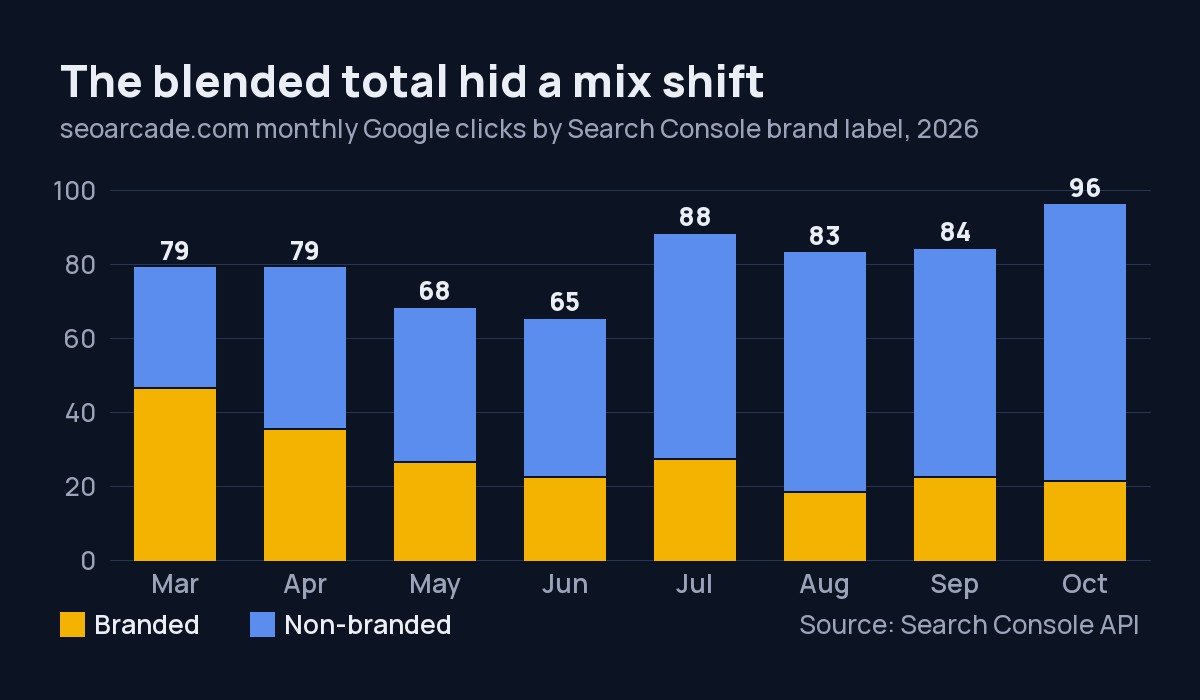
Those are two different conversations with an executive. One is about whether the brand is losing awareness. The other is about whether the SEO programme is reaching new demand. A single line answers neither.
The averages are worse. Over the full period, seoarcade.com’s branded clicks sat at an average position of 1.4 with a 24% click-through rate. Non-branded clicks averaged position 23 at 0.12%. The blended CTR describes neither group, and it moves whenever the mix moves, even if nothing about your rankings changed.
What to put in the monthly report
The brand vs non-brand section does not need to be long. It needs two separate lines, a stated source and the same method every month:
- Two click lines, never one. Branded and non-branded clicks as separate series, with the total shown below them rather than instead of them.
- Impressions, CTR and position per bucket. If you report average position at all, report it twice. A blended position is a mix statistic, not a ranking.
- Non-brand clicks by landing page. The brand label combines with page, device, country and date, so you can show which pages are winning new demand without needing the hidden queries.
- Source and method in one line. “Search Console API, Google’s brand classification, 1 to 31 October.” If you switched from a regex this month, say so, and do not chart the two methods as one line.
- An annotation layer. Launches, campaigns, PR hits, podcast appearances, events. You will need it for the brand line, for reasons Rob explains below.
Non-brand clicks are the line the SEO team owns. Brand clicks are a line it influences and shares. Label them that way in the report and you avoid the argument later.
What not to claim from the brand split
The new label tempts teams to say more than the data supports. Three claims to keep out of the deck.
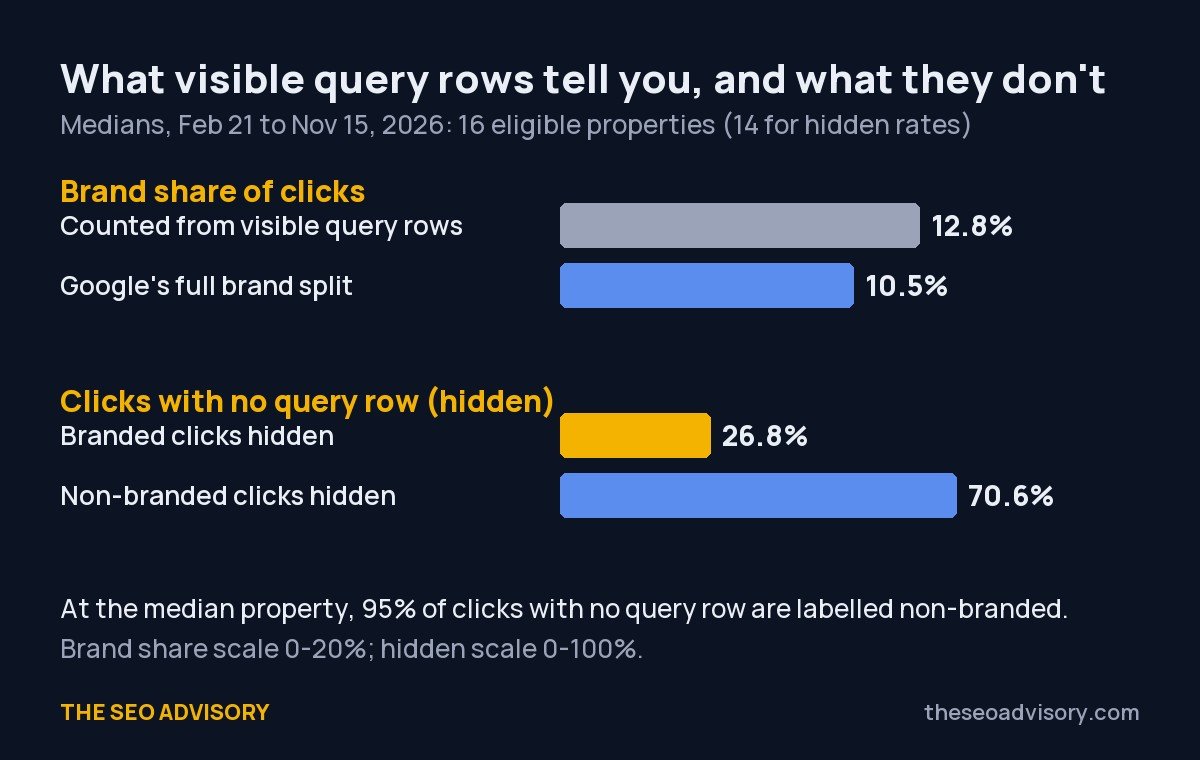
“We now know what the hidden queries are.” You do not. Search Console still withholds a large share of queries, and the brand label only tells you which side of the line those clicks fall on. In SEO Arcade’s study of 16 eligible properties, the median one had 71% of its non-branded clicks with no query row, against 27% of its branded clicks. At the median property, 95% of the hidden clicks carried Google’s non-branded label. The full method is in the SEO Arcade study of the branded queries API, and the background on missing queries is in its research on dark clicks in Google Search Console.
“Our brand share is what the query report says.” If you calculate brand share from visible query rows, you are measuring the bucket Google hides least. The median visible-row brand share in the study was 12.8%; Google’s full split put it at 10.5%. On seoarcade.com the gap was 59% against 30%. A regex report would have told leadership the site was twice as dependent on brand as it was.
“Brand went up, so SEO worked.” Maybe. Brand searches respond to everything the company does. Which brings us to Rob.
How brand demand from other work shows up in search
When Jeremy Rivera asked Rob how an SEO makes the case for being paid once attribution is gone, part of his answer was about exactly this spillover:
“you might be getting better visibility for your branded searches. So maybe your homepage traffic is gonna go up, you’re getting shown more frequently. Google trusts your brand more because they know that you’re […] providing a quality website experience.”Rob Bonham, on Unscripted SEO
The point runs both ways. Good SEO work can lift branded visibility, and so can a trade show, a podcast tour, a paid campaign or a press mention. All of them land in the same branded bucket, usually on the homepage. Rob’s reminder about where that traffic arrives is worth keeping in front of an executive team:
“your homepage ranks for […] potentially thousands, tens of thousands of keywords.”Rob Bonham, on Unscripted SEO
So treat the branded line as a shared demand signal. When it rises, check the annotation layer first: what else did the company do that month? If a campaign lines up with the lift, say so, and give the campaign the credit. If nothing else explains it and the SEO work does, make the case as a correlation and label it as one. We set out how to make that case without overclaiming in how to prove value when attribution is gone.
This framing protects the SEO team as much as it constrains it. Brand demand can fall for reasons nobody in SEO controls — a quiet quarter for PR, a cut paid budget, a competitor’s launch. If the report has always said the brand line is shared, a drop in it is a company conversation, not a verdict on the SEO programme. Rob’s wider argument, that SEO does not sit in a silo, is the reason to build the report this way.
A brand vs non-brand report leadership can trust
If you are rebuilding the section this month, this is the version we would hand an executive team:
- Headline metric: non-branded clicks, month on month, with the pages that drove the change.
- Context metric: branded clicks, beside the company activity annotated for the same period.
- Per-bucket CTR and position, and no blended averages.
- A method note naming the source, the date range and whether the property is eligible for the classification.
- One sentence on what the data cannot show: the hidden queries are still hidden, and most of them are non-brand.
The split will not make the SEO number bigger. In most cases it makes the non-brand number smaller and more honest, which is the version a CFO will still believe next quarter.
Work with Rob
Want a second read on your SEO reporting?
Rob advises in-house and agency SEO teams on strategy, including what to put in front of leadership.