
Advisory Note · Diagnostics & Governance
Before The Strategy, Check The Index
An advisory read on Matt Mellinger: confirm the pages are indexed before anyone diagnoses anything more sophisticated.
An advisory engagement is mostly a sequencing problem. The client already has opinions about what is wrong, the incumbent agency has a different set, and the advisor’s job is to impose an order of investigation that stops everyone paying for sophisticated work on top of a broken foundation. Matt Mellinger, co-founder of SEO Gets and of the agency Local SEO Partners, gave a blunt account on the Unscripted SEO Podcast of what that order should start with.
The Diagnostic Order That Saves Retainers
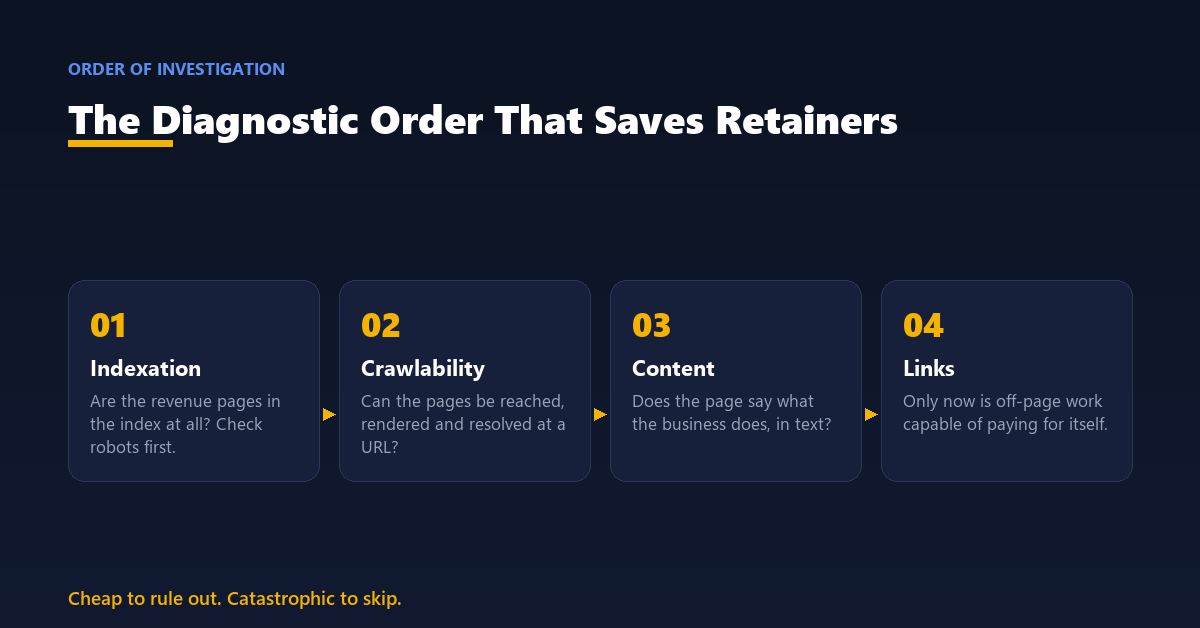
Mellinger’s complaint is not about bad strategy. It is about work being sold at a level of sophistication the site cannot yet benefit from. He describes small business owners coming to him after paying retainers of several hundred to several thousand a month, and finding basics missing:
For an in-house lead or a board reviewing an agency, the governance point is that this is not detectable from a reporting deck. Every one of those engagements produced a monthly report. None of the reports said the site was not indexed, because reports are built from the metrics the agency chose, and an agency that has not checked indexation will not report on it.
Mellinger On Paying For SEO On An Unindexed Site
His summary of that situation is the sentence we would put at the top of any first advisory session:
Mellinger is candid that this is a heated subject for him — he describes the industry as having a churn-and-burn segment where agencies calculate that clients can be replaced within twelve months whether or not results arrive, and he says his own father was on the receiving end of it. When he asked that provider for six months of Search Console data, he was told they did not have it. His response at the time: “then how are you knowing what’s working?”
That question is the one an advisor exists to ask on the client’s behalf, early, while it is still cheap to ask. It is worth noting that Mellinger is describing his own experience of a segment of the market, not presenting a survey; the strength of the language is his. The procurement lesson stands regardless of how widespread you believe the behaviour is.
His advice to owners choosing a provider is refreshingly unsophisticated and we have adopted it into our own reference-checking. Ask for contact details of clients who got results and actually speak to them — in his words, “give me a phone number or an email or contact information of someone that you have helped that has gotten results that I can talk to.” And set an explicit expectation: which keywords, what should have happened in six to twelve months, and what you will do if it has not.
Page-Level Reading Beats Site Totals
The second thing worth taking from Mellinger is technical, and it changes how an advisor should read any Search Console report handed to them. He is building a Search Console tool, so he has been examining the data closely for a case study, and he describes a finding about where the complete picture lives.
His account: when you export query-level data, the proportion of clicks the queries account for varies enormously — he cites a range from roughly five per cent on a very small site up to around seventy per cent — because of anonymised queries. But: “if you look at the page level, it shows you 100 % of the clicks almost every time.” His conclusion is direct — if you want more accuracy you need to go to the page level, “which most people don’t.”
He also reports an anomaly he triple-checked, where exported page-level impressions exceeded the chart total for a twelve-month period, and is upfront that it did not make sense to him. We are repeating that with the same caveat he gave it: it is one observation from a study that was in progress at the time of recording, not a settled finding.
The governing principle he draws from it is the useful part for a client conversation. The only numbers he treats as exact are leads and revenue — everything else is directional and should be read for patterns, trends and anomalies rather than absolute values. As he puts it, numbers tell a story, and a number without context means nothing. That is a standard an in-house lead can hold a reporting pack to.
What An Advisor Should Ask In Week One
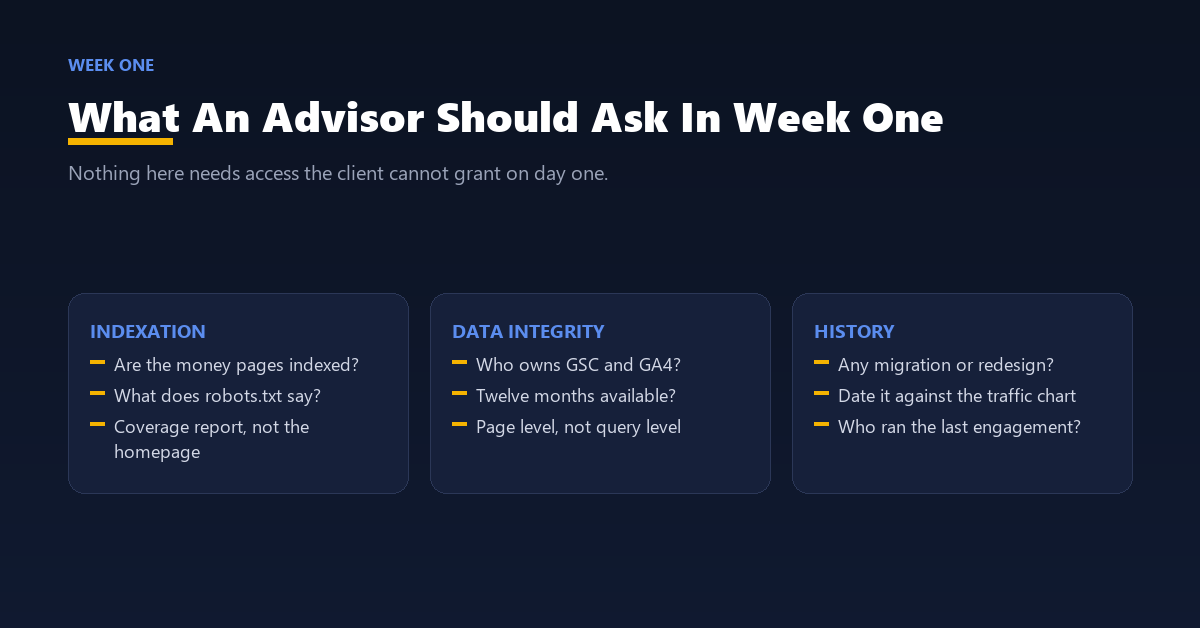
Our own week-one list, informed by the above rather than dictated by it. None of these require access to anything the client cannot supply on day one.
- Are the pages that matter actually in the index? Not the homepage. The revenue pages. Check coverage and check the robots file before forming any other hypothesis.
- Who owns the Search Console and analytics properties? If the answer is the outgoing agency, that is both a data-continuity problem and a negotiating one.
- Can we see twelve months of data, at page level? If it does not exist, you have learned something more important than anything in it.
- Has anything structural changed — a migration, a redesign, a CMS move? Date it, then line it up against the traffic chart before anyone theorises about algorithms.
The purpose of putting indexation first is not that it is usually the answer. It is that it is cheap to rule out and catastrophic to miss, and an engagement that skips it can spend a quarter producing excellent work that no search engine has seen.