
Advisory Note · Authority & Footprint
An Advisor’s Rule For Judging A Link
Relevance beats DA. Verification beats trust. Two practitioner standards worth building into your approval gate.
At The SEO Advisory we read practitioner interviews from a governance seat: not “is this a clever tactic,” but “what standard should an in-house lead be able to hold an agency to?” Two recent conversations on the Unscripted SEO Podcast — with Bradley Benner of Semantic Links and Kristiyan Yankov of Above Apex — land on the same operating rule from opposite directions. Neither is selling you a metric. Both are describing a gate.
The Metric In-House Teams Still Report
Domain Authority and Domain Rating survive for an unglamorous reason: they are a single number, they are comparable month over month, and they fit on a slide. Nobody has to explain them. That is a reporting virtue, not an accuracy one — these are third-party estimates built by tool vendors, not signals Google publishes.
Benner, who runs an off-page agency built specifically around this problem, is blunt about where that leaves you:
He is not talking theoretically. He describes agencies still selling outdated work to local businesses and calls it what he thinks it is — unethical — on the grounds that if you sell a service you are obliged to keep up with what currently works. Whatever you make of the strength of that language, the underlying point is a procurement point: a metric that is easy to report is not the same as a metric that predicts value, and if your programme is judged on the easy one, that is what your agency will optimise for. This is the same argument we make in Footprint Beats Tricks from a different angle.
Relevance As The Governing Standard
Benner’s framing is that the SEO’s job has changed shape. As he puts it, the work is now “creating associations, strengthening those associations, and helping, forcing the models and the algorithms to recognize those associations” — between the brand, its products or services, and the places it serves. A link is valuable to the degree it strengthens one of those associations, and irrelevant links strengthen nothing.
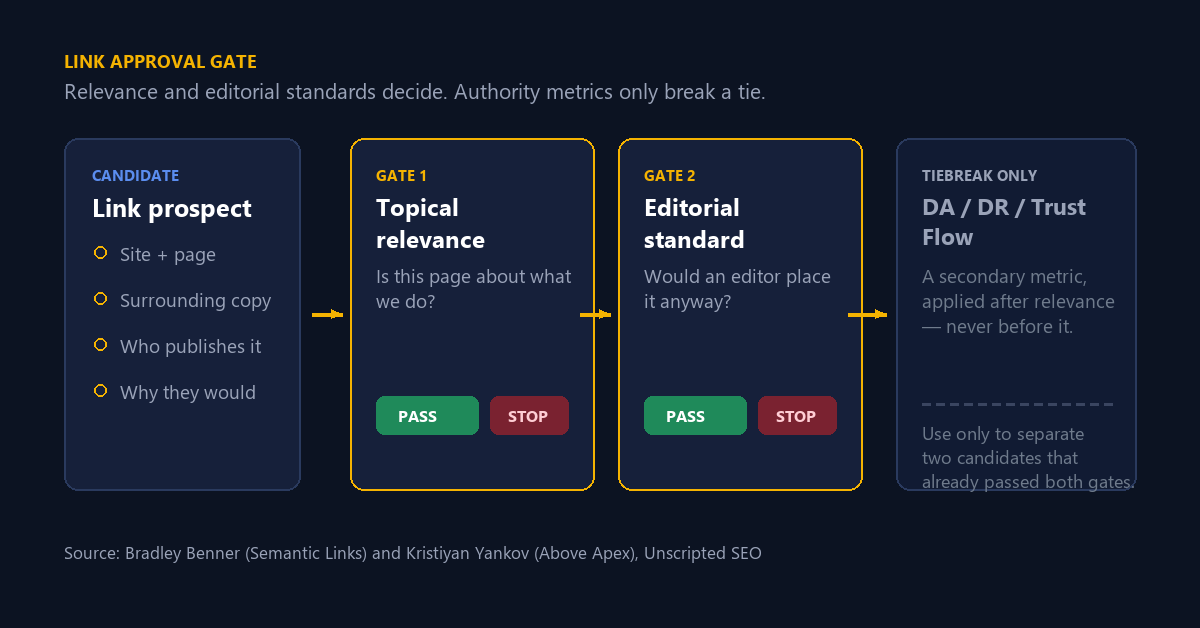
Usefully for anyone writing a policy, he describes relevance as layered rather than binary — “three layers or levels of relevance matching that can be achieved when you’re doing link building”:
- The passage. Is the link placed inside content that is genuinely about the subject, near entities related to the business and the area it serves?
- The publication. Are the overall topical themes of the host site relevant to what is being linked to?
- The publication’s own profile. What is the relevance of the backlinks already pointing at that referring domain?
One nuance gets lost when this gets compressed into “DR is dead,” and it matters for policy drafting. Benner does not ban authority metrics; he demotes them. His own words: if you want to use DA, DR or Trust Flow “as kind of a secondary metric after determining that a potential link source is relevant to what it’s going to be linking to, then fine.” His rule is sequence. “But you should look at relevance first.”
That is a far more implementable standard than an outright ban, because it survives contact with a real shortlist. Two candidates both clear the relevance bar; you have budget for one; the tiebreak is allowed to be a number. What is not allowed is the number doing the deciding before relevance has been tested. If you are building the wider case for why this is where authority actually comes from, that is the argument collected in Authority & Footprint.
Verify, Do Not Trust: A Screening Gate
Yankov supplies the second half. Asked at the top of his interview why anyone should trust him, he declined the premise:
In practice that means looking at five to ten metrics as a starter rather than domain rating alone, and then applying human judgment to the thing itself — is this a genuine website that serves a purpose rather than a PBN, does it carry relevant content, is the link seamlessly integrated into the actual copy of the article. His test for whether that judgment is trustworthy is the most quotable line either guest offered:
There is a risk calibration buried in his answer that in-house leads should hear, because it changes the tone of the conversation with finance. Yankov’s reading of the leaked Google documentation, and of the analysts who worked through it, is that low-quality links are set aside rather than punished — Google “disregards them entirely” and does not count them. On that reading, the usual consequence of a badly-vetted link programme is not a catastrophe. It is a wasted budget: months of invoices buying links that were quietly ignored.
We would treat that as his considered opinion rather than settled fact, and we would not use it to justify carelessness. But it does reframe the ask. You are not asking your board to fund a safety measure against a penalty. You are asking them to stop paying for links that do not count.
Writing The Policy Your Agency Must Follow
Two practitioners, two sentences, one gate. Relevance first, then verify. The advisory job is turning that into something a marketing coordinator can apply on a Tuesday without you in the room.
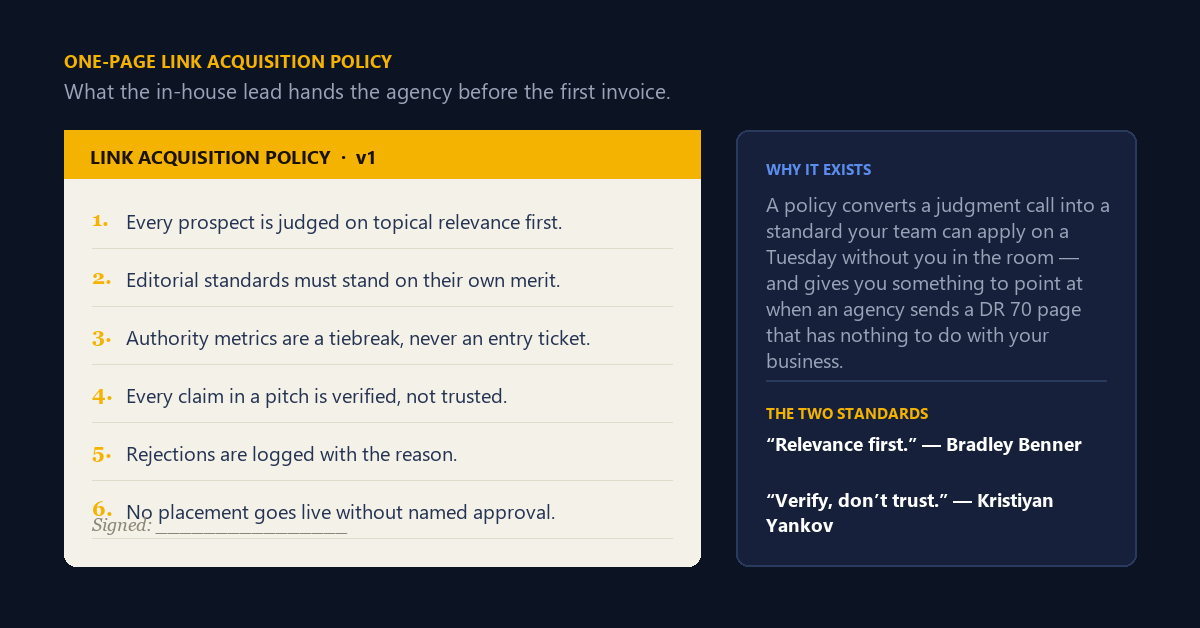
A workable one-pager reads roughly like this. Every prospect is assessed on topical relevance before any authority metric is opened. The placement must stand on editorial merit — a reader arriving on that page should find the link useful for reasons that have nothing to do with search. Authority metrics are permitted only as a tiebreak between candidates that have already passed. Every claim in an agency’s pitch — traffic, editorial standards, who actually publishes there — is verified rather than accepted. Rejections are logged with the reason, so the standard compounds into institutional knowledge instead of living in one person’s head. And no placement goes live without a named approver.
The last two lines are the ones teams skip and then regret. A rejection log is what stops your third agency re-pitching the site your first agency was turned down from. A named approver is what makes the standard real rather than aspirational.
None of this requires you to abandon the number your board likes. It requires you to move it to the end of the process, where it can no longer do any damage.