
Advisory Note — Authority & Footprint
How long does SEO take to work?
It depends on what you changed. Fixes to pages that already rank can show up within weeks. New pages chasing established terms usually take far longer, and most never get there. Here is how to tell which clock you are on.
SEO runs on two clocks, and the honest answer depends on which one you are paying for. Changes to pages Google already ranks can register as soon as those pages are recrawled, which Google says can take anywhere from a few days to a few weeks. New pages aimed at competitive queries run much slower. When Ahrefs tracked a million newly published URLs for a year, only 1.74% of them reached the top 10.
An advisor who gives you one number for both has not looked at your site yet. You should be asking for two.
New pages run on a slow clock
The slow clock is slow because the pages you are competing with have been there for years. Patrick Stox’s 2025 study for Ahrefs, built on 1.3 million random US keywords, found that 72.9% of the pages in Google’s top 10 are more than three years old, up from 59% when the same study ran in 2017. The average page in position one is five years old. Pages under a year old make up 13.7% of top-10 results, down from 22%.
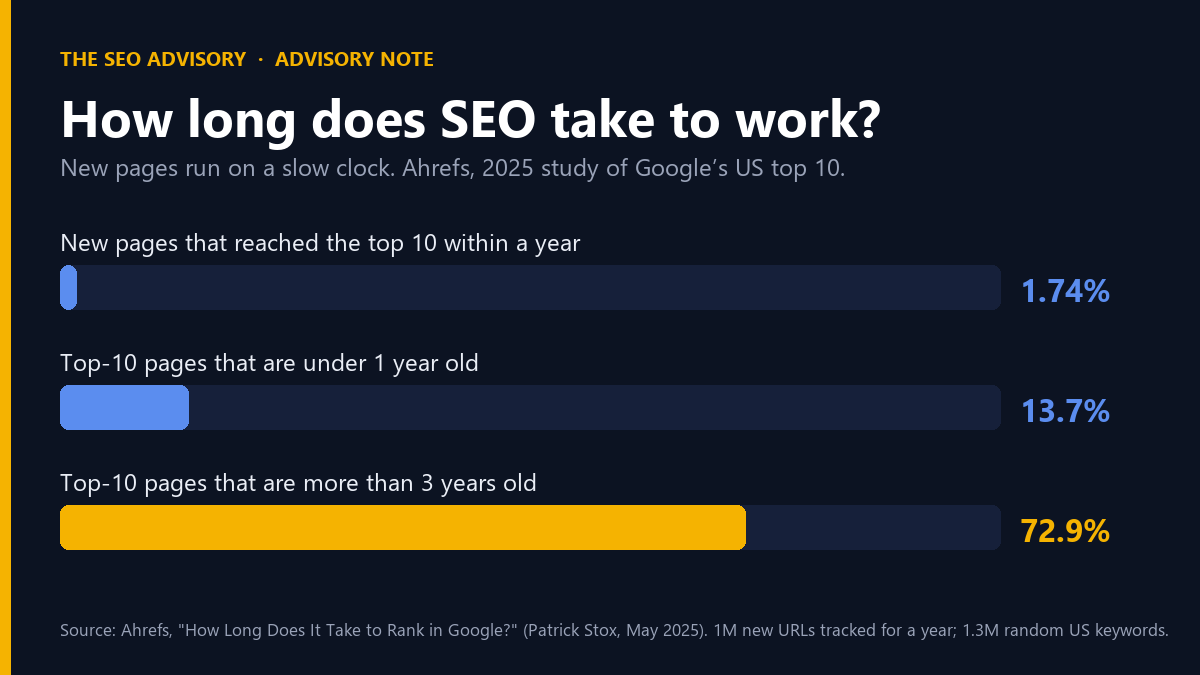
There is a second number in the same study that matters more for planning. Of the new pages that did make the top 10, 40.82% got there within a month. Our read, and it is a judgement rather than a finding: when a new page is going to win, it tends to show signs early. A page that has sat on page five for six months is not usually one more month of patience away from page one. It needs a better page, more authority behind it, or a different target.
Work on pages that already rank runs fast
The fast clock covers anything that changes a page Google already knows and already shows. Rewriting a title that gets impressions but no clicks. Fixing an indexing problem on a template. Adding internal links to a page sitting at position eleven. None of that waits for a domain to age. It waits for a recrawl, and then for enough searches to tell you whether it moved.
Before any of this, check that the pages are in the index at all. A page Google has not indexed has no timeline, which is why we put the index check before the strategy.
Most engagements should start on the fast clock for a simple reason: it produces evidence within a quarter, and evidence is what lets you decide whether to fund the slow work.
Fast results from volume are borrowed
The shortcut being sold hardest right now is volume. Publish fifty or a hundred AI-assisted pages a month and the graph goes up. Rob Bonham, who runs this practice, described how that ends for the agency that sells it on the Unscripted SEO podcast:
“You’re gonna work yourself into a hole. And you might be you know looking like a like a hero, you know, for maybe a month, a few months, who knows, maybe six months out. But you know, as soon as as soon as that site starts to tank, and it it and it surely will after you know a period, then then they’re gonna start looking at their their agency sideways”Rob Bonham, The SEO Advisory
Google’s spam policies name the pattern directly as scaled content abuse. The timeline matters here because it hides the problem. A programme that looks fast in month three and collapses in month eight looked like the best decision you made for five months. We cover the mechanics in why publishing 100 AI pages will tank your rankings.
What a credible timeline looks like in a proposal
Google’s own guidance on hiring an SEO gives you the question to ask: “What kind of results do you expect to see, and in what timeframe?” The same page says plainly that no one can guarantee a #1 ranking on Google. So the answer you want is not a date for a ranking. It is a plan that says what will be measurable, and when.
Rob’s advice to consultants writing those plans works just as well for a buyer reading one:
“you’re giving your your roadmap of six months or twelve months, whatever it is, you’re including deliverables that you can reasonably fulfill on.”Rob Bonham
In practice, a proposal worth signing separates three things:
- What should move inside 90 days. Indexed pages, impressions and clicks on pages that already rank, and the specific fixes expected to change them.
- What runs on the slow clock. New pages and new topics, with an honest note that most new pages in competitive spaces do not reach page one inside a year.
- When you stop. A checkpoint, with the metric that would tell both sides the work is not paying for itself. If nobody will name that condition, use the four questions we would ask any advisor.
Measurement has its own problem now, because a growing share of discovery never produces a trackable click. Read how to prove value when attribution is gone before you agree on what counts as “working”.
What these numbers cannot tell you
The Ahrefs figures describe random keywords, most of them low-volume, across the whole web. Your market may move faster or slower. And page age correlates with ranking without causing it: older pages have had longer to collect links, mentions and engagement. Pages do not ripen like fruit. The things that make a page rank take time to accumulate, and nobody can sell you the accumulation in advance.
So ask for the two clocks separately. If the proposal in front of you has one date on it, send it back.
Free download
Get to know me — in 5 minutes
How Rob thinks about SEO in the AI era and how he works. No form, no gate.